The historic building where girls learned to sew, boys learned to fix furniture, and immigrants learned English, and which for the past thirty years protected your community’s irreplaceable historic documents and photographs is now an empty shell.
Over the course of several months, volunteers carefully transported 350 years of Huntington history from the Trade School building on Main Street at the east end of Huntington village in preparation for a major project to restore the building to its original glory and to expand the building to provide more space to protect the existing collection of historic materials and to welcome new additions to that collection. This is the most important project undertaken by the Huntington Historical Society in over a generation. The Historical Society needs your help to make it a success.
To understand the project, let’s go back to the beginning—the very beginning. In 1903, Huntington celebrated the 250th anniversary of its founding. Thousands attended the three-day celebration over the Fourth of July weekend. The highlight of the celebration was a speech given by President Theodore Roosevelt to a large crowd gathered in an empty field near the intersection of what is now New York Avenue and Gerard Street.

President Theodore Roosevelt at Huntington’s 250th Anniversary celebration.
A committee of local women gathered historic artifacts from attics, basements and barns around town for a display on colonial life in Huntington. That collection was kept together by the committee, which eventually became the Huntington Historical Society.
Fast forward some eighty years. The Historical Society by the 1980s operated two house museums—the circa 1750 Conklin House on High Street and New York Avenue, which was given to the Society in 1911, and the 1795 Kissam House on Park Avenue, which it had purchased in 1967. The small collection of colonial artifacts gathered in 1903 grew tremendously over the decades to include letters, diaries, business records, local newspapers, maps, deeds, family histories, and photographs—thousands and thousands of photographs of the way we were.
More space was needed to properly preserve this growing collection. In 1979, Town government had consolidated its offices in the old high school building across from Heckscher Park, making several buildings at the east end of the village available. The Tudor Revival trapezoidal shaped Trade School building caught the eye of the Historical Society.
The Trade School building was constructed over the course of the summer of 1905 to house the Huntington Sewing and Trade School. The school had started in the basement of St. John’s Church on Park Avenue in 1881. At first the school taught sewing to the girls of the church. Some of the items the girls created were sent to missions in the West and later during World War I to France.
By the mid-1890s, the curriculum was expanded to teach boys as well. The boys learned to mend and sew buttons and also to weave hammocks and fishnets. At around the same time, it was decided that the school should be moved out of the church basement to a location closer to the business district so as not to restrict attendance “to church or color.”
At the turn of the twentieth century, Miss Paulding’s Sewing School was providing instruction to up to 150 students a week in rented quarters in the village. In 1904, the school was formally chartered as the Huntington Sewing and Trade School. In 1905, the school began to look for a permanent location. Local philanthropist Cornelia Prime—who would later donate the clock tower in Huntington’s first Town Hall and the land for Huntington Hospital, among many other gifts to the community—agreed to erect a suitable building for the school. Dr. Oliver L. Jones donated land on the north side of Main Street across from the Old Burying Ground.
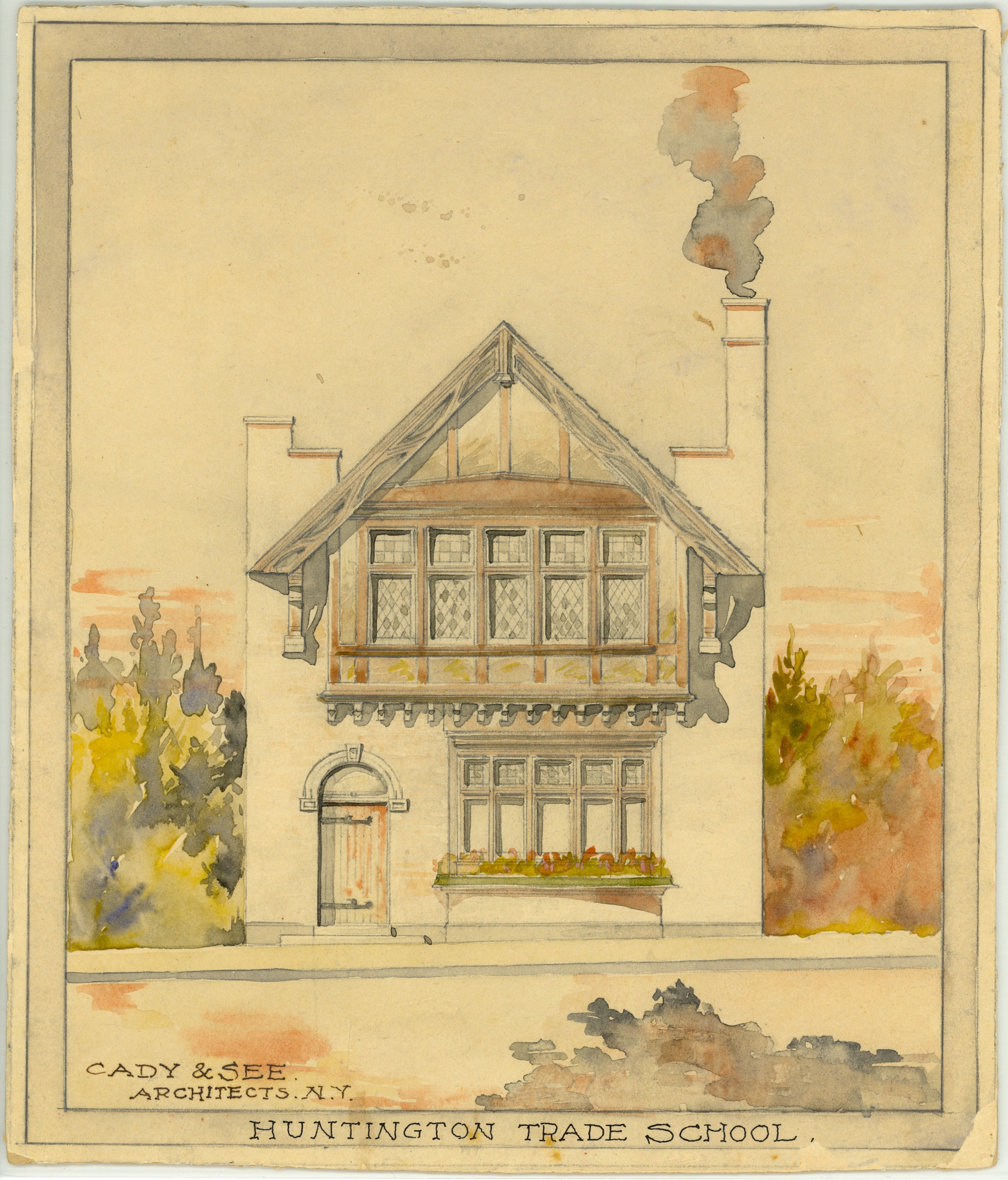
The architect’s rendering of the Trade School building, 1905
Cady, Berg & See, the firm that designed the Museum of Natural History in New York, the Metropolitan Opera House as well as several academic buildings at New England colleges, was selected as the architect for the building. Twelve years earlier, the firm had also designed the Soldiers & Sailors Memorial Building, Huntington’s first library building. The new school building copied the library’s Tudor Revival style. The building also conformed to the site’s trapezoidal shape enabling a traveler from the east to see three sides of the building at the same time.
The cornerstone was laid on August 10, 1905. The first classes in the new building were held just four months later on December 2, 1905.

Emma Paulding, the school’s director, lays the cornerstone for the new building , August 10, 1905
The building saw a variety of uses over the years. During World War I, the local chapter of the Red Cross used the building for its home front activities. The curriculum expanded to teach vocational skills to immigrants. Courses were also offered to help immigrants learn English and civics to meet the requirements for naturalization.
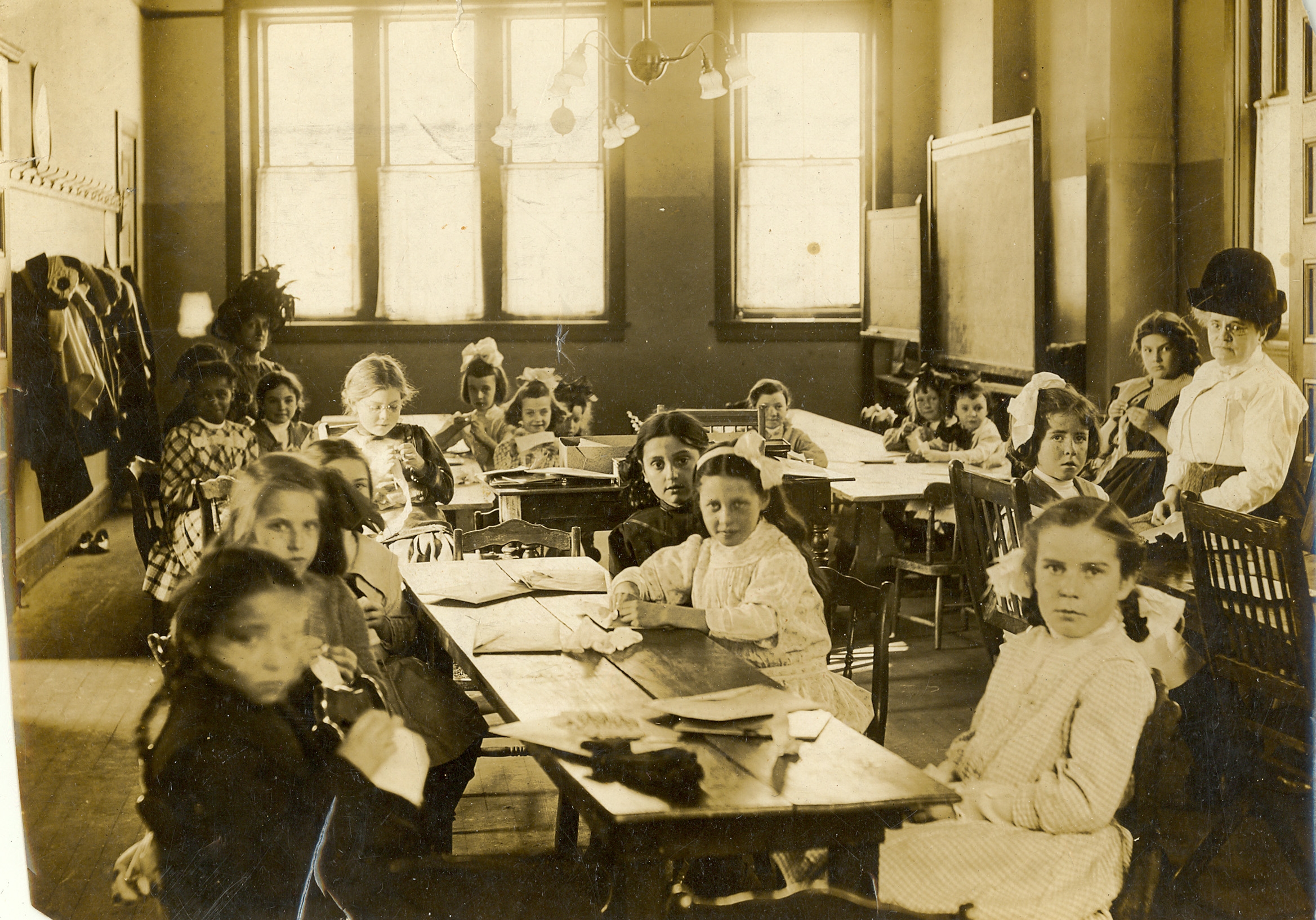
The main floor of the Trade School building.
Miss Lefferts taught dance classes, a Talmud Torah School rented space, the Red Cross taught “young mothers the feeding and care of children,” the Huntington Choral Society practiced here, to name a few of the building’s many uses.
In 1937, the Huntington School District took ownership of the building and used it for shop classes. Students from the High School (which is now Town Hall) walked over to the Trade School. Wood shop was taught on the first floor, electric and metal work on the second floor.
In 1965, the Town purchased the building to help alleviate crowding at the Old Town Hall building. Town government used the building for the Comptroller’s office and later the Town Supervisor and Town Attorney had offices there.
In the 1970s, the Town realized that operating out of multiple buildings in widely scattered locations was not efficient. As Town government grew, the school district found it no longer needed the large school building across from Heckscher Park. The High School had been moved to a new building on Oakwood Road in 1958 and the building was being used as a Junior High School.
Meanwhile, the Huntington Historical Society’s collections grew tremendously over the course of the twentieth century. The fireproof vault built at the Conklin House in the 1920s was no longer big enough to hold the priceless collection. With the aid of private donations and a National Endowment for Humanities grant, the Society paid the Town $50,000 for the Trade School building. Another $75,000 was spent to renovate the building: new heating systems, new roof, plaster repair, painting, new handicap accessible restroom, etc.
At first the archives collection and research room comfortably occupied the lower level. Within ten years, exhibit space on the main level gave way to the growing archives collection. Within another ten years, it was obvious that a more long-term solution was needed. Plans were made to build an addition in the vacant lot the Historical Society owned on the west side of the building.

Architect’s rendering of the entrance plaza and the new addition, which is set back to preserve the architecture of the 1905 building.
The project finally commenced in the summer of 2014. The project will restore the 1905 building. The windows will be restored. The old electric wiring, which still relied on early fuses, will be replaced. The HVAC systems will be replaced. Plaster walls will be repaired and painted. New carpets will be installed.

Restoring the magnificient diamond pane windows of the Trade School.
But most important, the capacity of the building to accommodate the Historical Society’s ever growing collection of historic material will be greatly increased. High density shelving on the lower levels of the old building and the new addition alone will triple the storage capacity of the building. Other space in the new addition will provide even more storage.
The project is important to the future preservation of Huntington’s history—not only the materials already being preserved, but also future donations. Without the additional space this project will provide, the history of the more recent past could well be lost to future generations.
NOTE: The Huntington Historical Society is still seeking donations to ensure the completion of this project. At the time of this posting, the Historical Society has raised through private donations almost $800,000. A grant from the New York State Office of Parks, Recreation and Historic Preservation adds another $400,000 to the budget. The total project budget is $1.5 million, meaning an additional $300,000 needs to be raised.
If you love Huntington’s history, which you must if you read this blog, it is imperative that you support this project. It is no surprise that as Huntington Town Historian, I support the project. Many people assume my family has lived here for generations. Some even think I’m a WASP. In fact, I’m an Irish Catholic who moved to Huntington as a kid. My wife moved here after we were married. But it doesn’t take long to appreciate how special Huntington is and how important its history is to its unique sense of place.
That is why the largest charitable donation we have ever made is for this project. We urge you to show your support with a donation of any size. Large donations are important, but smaller ones also make a difference by showing foundations and other funding agencies that the project has broad public support. If everyone who follows this blog gave $100, the project would be $10,000 closer to its goal. Donations can be made in installments. For example, a pledge of $1,000, which would be noted on the donor plaque, could be paid by making monthly donations of $35. Donors have until June 30, 2017 to complete their pledge.
Please make a donation today at www.savehuntingtonhistory.org or by mailing a check to The Huntington Historical Society, 2 High Street, Huntington, NY 11743. If you have any questions about the project, call Linda Walch, executive director of the Historical Society at (631) 427-7045, ext. 405. Future generations of Huntingtonians will thank you.
 Huntington History