Feeds:
Posts
Comments

Archive for April, 2020

In 1965, the Town of Huntington placed a historical marker on the southwest corner of Main Street and Spring Road to commemorate Huntington’s Earliest Church:

Besides emphasizing a rather insignificant fact—the sales price—the marker compounded the error by using “LBS” to designate English currency instead of using the symbol £.

In September 2017, Harvey Spencer, an English ex-pat living in Northport, mentioned the error to me. Then a few months later another resident sent me an email complaining that “5 LBS is a measurement of weight, not money. 5 POUNDS should have been used, or perhaps the symbol. Most amusing, but reflects poorly on the town’s intellect.” Ouch.

As far as I know no one else had raised the issue in the 53 years the sign had been there—certainly not in the 18 years since I became Town Historian.

Of course, the English unit of currency originally did correspond to a unit of weight.  In the Middle Ages, silver coins were the common currency of several European countries. If one weighed 240 of those silver coins, he would find they weighed a pound.  Under the old system, a British Pound was made up of 20 shillings and each shilling was made up of 12 pence; or 240 pence to a Pound. After decimalization in 1971, a British Pound has only 100 pence, not 240. And a pound of silver is worth much more than a Pound (about 181 times more).

But that doesn’t excuse using Lbs in place of £. The lack of the proper symbol so offended Mr. Spencer that he and his wife Lesley agreed to pay for the not insubstantial cost of a new marker.

Surely, there must be something more to say about Huntington’s earliest church than the price it was sold for. Actually, there is not much more recorded about the original church. Nonetheless, the wording could be more complete:

The new mark recently installed on the southwest corner of Main Street & Spring Road.

One question still remained: exactly where was the first church building*?  As Al Sforza pointed out in his book Portrait of A Small Town II, Huntington, New York “In The Beginning,” there is some question in the historical record as to the location of Huntington’s first church building. Dr. Sforza cites three records to support a location on the north side of Main Street.

First, a footnote on page 306 of Volume II of the Town Records published in 1888, says the church was “on ‘meeting house brook’ (now Prime Avenue).” Since Prime Avenue is north of Main Street, this reference indicates the church was on the north side of Main Street. However, it is possible that the footnote refers to the road as it runs south of Main Street even though on the 1873 map of Huntington that road is labeled as Spring Street.

Another source, the 1882 History of Suffolk County, was written by Charles R. Street, who also provided the footnote above. That text asserts that the church stood “about where the thimble factory of Ezra C. Prime now stands.” The fact that the historical marker for Prime’s thimble factory is on the north side of the street seems to support the conclusion that the church was also on the north side of the street. However, by 1882, Ezra Prime had converted his first thimble factory on the north side of Main Street into a residence and had opened a second factory on the south side of Main Street.

The third reference is from Romanah Sammis’ 1937 book Huntington Babylon Town History, which states that the church was “on the north side of Oyster Bay Path and beside the stream which then became Meeting House Brook.” Mrs. Sammis may have been relying on Mr. Street’s statements.

In any event, each of these sources was written more than two centuries after the church was built and 167 years after it had been dismantled. In other words, there is no definitive support for either location, so the new marker was installed in the same location as the 1965 marker.

The current confusion about the location of the 1665 church mirrors the controversy about where to build a new church in 1715. As early as 1711, the townspeople agreed that a new church was needed. Forty men pledged various amounts ranging from £30 to 3 shillings to build the new church “in the hollow in the same place where the ould meeting house now standeth or near there abouts.” The total amount pledged was £228. 13s+. At the time, there were at least 132 heads of household living in Huntington.

No further reference to building a new church are found in the Town Records until four years later when notice was given to the inhabitants of town that “the Majer part of sd in habitants Doth agree to gitt timber for a new meeting house; to be sett upon the East hill.” So much for building in the hollow.

The dispute pitted the West End men against the East End men. The West Enders favored building in the hollow where the old church was. The East Enders wanted to build at the top of the hill to the east. It is hard to imagine that each side objected to having to walk an extra 200 yards up hill either before or after Sunday services. There must have been more to the dispute than a longer walk, but whatever it may have been has been lost to history.

By 1715, 14 of the men who had pledged to donate to build the new church in the hollow had changed their minds. There were an additional seven identified as “west end men” whose names had not appeared on the 1711 list who also consented to build the new church on the East Hill. Twenty-four of those who had pledged in 1711 did not consent to building on the East Hill; they were joined by 16 men who were not on the 1711 list of potential donors. So the supporters of building in the hollow remained at 40 in number, less than a third of the men of the town.

In March 1715, the East Enders suggested arbitration. Each side would select a minister and those two ministers would select a third to settle the matter after each side presented its case. The offer was made “for peace and quietness Sake that Soo we may be united amoung us and that wee may live to gether like Christians as wee ought to do.” The West Enders accepted the suggestion and by mid-April each side selected ten men to make its case before Mr. Magnis, minister of Jemeco (perhaps Jamaica), Mr. Pomarary, minister of Newtown and Mr. Wolcy, minister of Oyster Bay.

The ministers were apparently successful in resolving the dispute. In June 1715, the West End men agreed to locate the new church on the East Hill. It seems that they had previously taken matters into their own hands and began to build a new meetinghouse near the old church. As part of the agreement, the East End men agreed to reimburse the West End men for the expense in money and labor for erecting the framing for a new building and to move it to the hill. Once the new church was completed, the West End men “are to have Equall priveledge in and with the sd. House as if the whole town had built the sd. House in Equall proportion according to Estates.” The agreement was made “for uniting and Continuing us all in peace Love and unity.”

Two years later, Mr. Wolcy of Oyster Bay was invited to come to Huntington to assist Mr. Jones as minister of the new church. As for the old church, it was auctioned off to Jonas Platt, Jr. for £5. 2s. Mr. Platt was given a year to pay. What he did with the old building is not known.

And what of that new church built on the East Hill in 1715?  It served the community until the American Revolution.  At first the occupying British troops used the building as stable.  Then it was dismantled to build a fort on top of the Old Burying Ground.  Soon after the war, a third Old First Church was built.  It continues to be a place of worship today.

___________________________________________________

*  That original church or meetinghouse was built to comply with the newly enacted Duke’s Laws, promulgated by the Royal Governor soon after the English took control of the area from the Dutch. The Duke’s Laws provided that

Whereas the publique Worship of God is much discredited for want of painful & able Ministers to Instruct the people in the true Religion and for want of Convenient places Capable to receive any Number or Assembly of people in a decent manner for Celebrating Gods holy Ordinances These ensueing Lawes are to be observed in every parish (Viz.) 1. That in each Parish within this Government a church be built in the most Convenient part thereof, Capable to receive and accomodate two Hundred Persons.


+ To put that sum in perspective, in 1713, Jacob Conklin paid £96. 10s. 6d. for 2,792 acres of land in Half Hollow Hills. Charles Street notes in the Town Records (Vol. II, page 317 footnote), “How he acquired the large sums of money which he disbursed during this period in the purchase of lands was a mystery never fully solved.” According to legend, Conklin had been a member of the pirate Captain Kidd’s crew—either voluntarily or by force. At one point, Captain Kidd sailed into Cold Spring Harbor to replenish the ship’s water supply. Conklin, who had been born in Huntington, managed to escape with a tidy sum of money, which was either his wages or treasure he stole from the captain. Whether that’s true or not, it is a good story.

Read Full Post »

We are living in a historic time.  Never before have we experienced a pandemic like the current COVID-19 pandemic.  The closest event is the pandemic of 1918 (there are been three other pandemics in the last century, in 1957, 1968 and 2009).  With advances in medicine and public health policy, the connection between today and events a century ago may seem tenuous.  But sometimes the connections are personal and profound.  The first recorded death in Huntington from the 1918 influenza pandemic was Pasquale BiFulco, a 38 year old Italian immigrant who died at Huntington Hospital on October 13, 1918.  A century later, on April 1, 2020, Mr. BiFulco’s grandson, Dr. Al Sforza, the beloved historian of Huntington Station, died in the same hospital from COVID-19.

What was life like in Huntington during the 1918 pandemic?  What can we tell future generations about life during this crisis?

I will try to provide an answer to the first question.  I hope you will help to provide the answer to the second question.

The country was, of course, at war in 1918 and perhaps the worst of the pandemic was experienced in army camps.  The first cases in the United States were at an army base in Kansas in March of 1918.  At the end of September 1918, it was reported that there were 300 cases of influenza at Camp Mills in Nassau County, including one death.  A local doctor, Nathaniel Meyers, had left his thriving medical practice in Huntington to train as a surgeon in order to serve in Europe.  The 29 year old doctor died in New York City.  He is listed on the Town’s World War I monument at the Main Street entrance to the Old Burying Ground (at least three of the 39 Huntingtonians listed on the memorial died as a result of the pandemic).

As the trauma of the war subsided, the tragedy of the pandemic was accelerating.  In 1918, the Jos family lived on 8th St. in Huntington Station.  Nine year old Rose and her younger brother Joe contracted the flu.  Their mother Louisa used a conventional method of treating colds and applied mustard plasters to their chests.  The children recovered, but their mother became very ill.  Her husband and an older son raced to the nearest telephone which was located at Mullen’s Hotel near the train station.   Louisa died during the night on
November 8th before the doctor arrived the next morning.  She was 36 years old and left her husband with five children.  Rose Jos remembered watching her mother being taken away down the stairs; one of her brothers was crying.  She also remembered hearing all the church bells in the area ringing when her mother was laid out. It was Armistice Day.

The disease was known as the Spanish Flu not because it originated in Spain, but because Spanish newspapers were the first to report on the disease.  As a neutral country during World War I, Spanish journalists weren’t subject to censorship as journalists in the warring countries were.  Reporting on the pandemic was scarce in Germany, France and Britain.  (In Spain, the 1918 disease was referred to as the French Flu. We won’t get into a discussion of why the current disease is not the Chinese Flu.)

By late September, notices were published in the local papers to prevent “the alarming spread of the Spanish influenza all over the country.”  People were advised to “Keep out of crowds and away from theatres, movie houses and other places where people come together in large numbers.”  Use of handkerchiefs was encouraged.  Spitting was discouraged.  Those with colds were advised to gargle three times a day with a mix of “half a teaspoonful of table salt, half a teaspoonful of baking soda and six ounces of water.”

On October 4, The Long-Islander devoted one and a half columns to the Surgeon General’s report on the epidemic.  The report presented a review of previous epidemics back to 412 B.C. as well as the little that was known about the current manifestation of the disease.  The main step to be taken to avoid contracting the disease sounds familiar: avoid crowds.  However, unlike our current situation, the Surgeon General claimed that “the disease is too mild to make it advisable to stop all the activities of a city.”  He did recommend that “masks for sick-room attendants are advisable.”

Copies of this poster could be ordered from the Surgeon General’s office.

The Surgeon General concluded by noting, “The most dangerous form of human contact in the presence of epidemic influenza is, in all probability, that with coughers and sneezers.  Coughing and sneezing, except behind a handkerchief, is as great a sanitary offense as promiscuous spitting, and should be equally condemned.”  So much for asymptomatic spreaders of a virus.

The editor of The Long-Islander sought to allay people’s fears: “Don’t get frightened after reading that learned dissertation in our columns this week on Spanish influenza and take to your bed.  It is after all the old-fashioned grip and every time you cough or sneeze it does not signify you are going to have it.  Keep your courage up and avoid overcrowded cars and other meeting places.  Do not get too tired from overwork and eat moderately.  Live in the open air as far as possible.”

Two weeks later, the situation in Huntington took a turn for the worse.  By mid-October, it was reported that 151 children at the Union Free School in Huntington were home with influenza and four teachers were also sick.  One teacher, 22 year old Gertrude Ross, had died.  To put the impact of the disease in perspective, the graduating class of 1918 had 26 students, which means that the 151 sick students may have been about half the student population.  School officials asked Dr. Gibson, the Town’s Public Health Officer, whether they should close the schools.  Dr. Gibson said disease was “of a mild type” and advised that closing the schools was unnecessary, but that children showing symptoms of influenza should be sent home at once.  Within a week, the schools were ordered to be closed.

Pastors of the protestant churches in town canceled Sunday services.  The pastor of St. Hugh’s Catholic church held mass out on the lawn.

The shutdown didn’t last long.  Theatres and dance halls reopened on Saturday, November 2; churches on Sunday; and schools on Monday.  Time missed from school would be made up during the Christmas break and Lincoln’s birthday.

On November 8, the virus was reported to be “rapidly on the wane all over the country.”  The Huntington Board of Health was congratulated for taking the steps necessary to halt the spread of the disease.  A week later it was claimed that “the spread of influenza has been completely checked and there is no further danger.”

Another week passed and East Side School in Cold Spring Harbor had to be closed “owing to the sudden outbreak of the influenza in the village, several families being ill.”  By the end of the year, it was reported that “the influenza has broken out again in Commack and nearly every family has one or all members down with it.”  Before long, Teresa Rommandato of Commack had lost her husband, a son, and a daughter to the disease. Four other sons and two daughters survived and another son was born a few weeks later.

A notice from January 1919

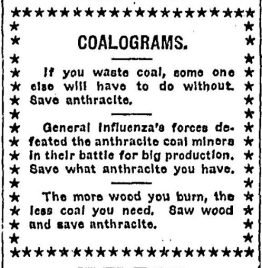
During the course of the epidemic, like now, the shortage of nurses was noted.  People were also discouraged from hoarding–in 1918 it was coal that was in short supply.  Many miners had been sidelined by the disease.  Homeowners with wooded lots were encouraged to burn wood instead of coal.

Four months after declaring victory over the disease in November, the threat continued.  “It is said to be on the decrease just now on Long Island.  Let us hope it will soon run its course.”  The advice for staying healthy: “It is best not to overwork or what is more important, not to overeat.  Get full hours of sleep, avoid excitement and preserve a cheerful, sunny frame of mind.”

Although the basic advice to avoid crowds and cover your mouth when coughing or sneezing remains true today as it was in 1918, our current experience of the disease is much different.  Other than for a few days in late October, public life did not pause in 1918.  People went about their daily routine until struck down by the virus.  And decisions about whether to close schools and other public gathering places was made on a local level, varying from town to town.  Now these decisions are made on a statewide basis and rather than recommendations, the edicts are mandatory.  Those failing to maintain social distancing (i.e. staying six feet from others) may be subject to a fine.

Because the archives are closed, I have not been able to see what documentation there is, if any, about people’s experiences during the 1918 pandemic.  What did they do, what did they think, how did it affect them?  These are the types of questions I hope you will help us to answer for future generations looking back on 2020 and the extraordinary measures we have taken.

The Association of Public Historians of New York State is seeking your help in recording how we came through this crisis:

We are living in a historic moment in time! The COVID-19 crisis is reshaping our daily lives and our communities. In the future, others will look back and learn from our experiences. This is why it is so important to begin recording the history of the COVID-19 pandemic and its effect on New York State’s people and communities. What is happening to us right now must not be forgotten! We need to document our experiences so that they can inform the response to future crises.

The Association is seeking answers to questions such as:

  • How are you feeling?
  • What are you hearing and seeing around you?
  • What are you doing, and what effect is this having on you, your family, your neighbors, and your community?
  • How is your life different now than it was before the pandemic?

To help you record your answers, the Association has prepared a Google Form, which can be found at https://forms.gle/ZUxePXJLcQC2fKCK8.  The form requires a Google account.  If you don’t have an account and don’t want to create one, you can leave a comment here or send an email to me at rhughes@huntingtonny.gov.

Thank you for your help.  Be well.  Stay Home.


Read Full Post »