A barbershop is often a place where stories, gossip, and tall tales are shared. Some are true, some are embellished, and some are just plain wrong. In the case of Cold Spring Harbor’s barbershop, the same could be said about the stories and tall tales told about the shop itself.

Here’s what is said. The small building was moved to Cold Spring Harbor from Huntington in 1890 by Oliver Jones, who took possession of it after the owner defaulted on a mortgage. The building once was the post office and telegraph office. For a period, it housed the local library collection. It was an ice cream parlor and candy shop. A wealthy woman purchased the building, secured a barber, and made provisions that it must always be a barbershop because she was motivated by a desire to keep her husband from traveling to Manhattan for his haircuts and perhaps other pursuits.
Some of that is true.
The story begins in Huntington. Hewlett Scudder, not yet 30 years old but from an old Huntington family, was making a name for himself in real estate and insurance. He was described as “tall, well proportioned and passes as a good looking fellow.”[1] In August 1891, he had brokered the purchase of the Stuart property at the east end of Huntington village. The property stretched from New York Avenue to east of the Trade School building at 209 Main Street and as far north as Union Place. He arranged the sale of the property to the Huntington Real Estate Association, a syndicate of wealthy investors that Scudder had helped organize and in which he was an investor.[2] A month later, his syndicate closed on the Temple property on Cold Spring Hill at the other end of the village.[3] Both properties would be divided into building lots and sold to the public or individual members of the syndicate.
The Stuart property investment was wildly successful, the investors made a 93% profit in one year.[4] Now the location of a row of brick commercial buildings, the first building erected on the property after the purchase was “a portable house” built by Scudder to serve as his real estate office.[5] Eighteen months later, Oliver Jones, one of the investors in the syndicate, found out just how portable the house was.
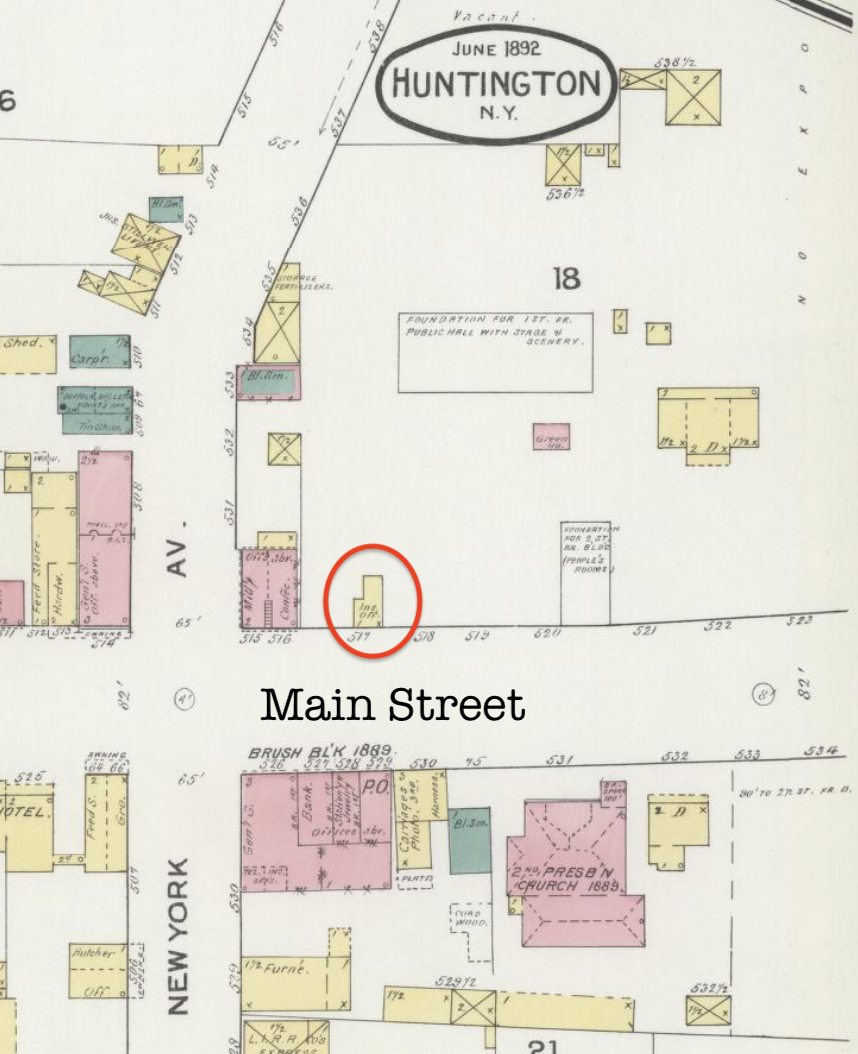
On August 2, 1892, a year after closing on the Stuart property, Scudder told his wife he was going to Middletown, NJ for business. He never returned. His wife feared foul play. Some suspected suicide because a relative had committed suicide a month earlier. Others alleged he fled debts he could not pay. Indeed, when Charles R. Street, a lawyer hired by Scudder’s wealthy uncle, examined Scudder’s books, he found debts of $6,500 (for comparison, the Stuart property had been purchased for $20,000). Scudder had borrowed heavily from the Bank of Huntington. His notes were endorsed by many of the well to do of Huntington. “The night before leaving town Scudder borrowed money wherever he could get it, and had several checks cashed, overdrawing his account considerably.”[6] Cash paid for lots in the Temple property received days before Scudder disappeared could not be found.[7]
How had such a successful young man amassed so much debt? Reportedly, Scudder was a regular participant in a nightly high-stakes poker game in the village. He also liked to bet on horse races. Apparently, he was not as successful with his bets as he was with his real estate career. The biggest loser in this mess—other than Scudder’s wife—was Dr. Oliver L. Jones, one of the investors in the real estate syndicate and owner of the property on which Scudder had built his “portable house.”[8]
While things were being sorted out, the small building was rented to Edward Johnson to use for a fish and vegetable market.[9] In the spring, Jones hired William Bingham to move the building to Cold Spring Harbor “to be used for a post office and telegraph office.”[10]
The building was moved to property on the south side of Main Street opposite Shore Road. The 40-acre property on which the building now stood had long been owned by the Conklin family. That property had been purchased from the estate of Elizabeth Conklin, widow of Richard M. Conklin, by Charles H. Jones in 1879.[11] Jones died three years later, and the property was inherited by his daughter, Mary E. Jones, wife of Oliver L. Jones.
The first use of the Scudder building after it was moved to Cold Spring Harbor was to serve as the local Western Union telegraph office. Eva Wright was the operator. With the onset of colder weather in October 1893, Miss Wright moved operations to her father’s house because Western Union did not supply coal to heat the Scudder building. She moved back to the Scudder building the following March.[12] The post office was moved into the building in March 1897 following the 1896 fire that had destroyed its previous location at the Seaman & Bennett’s store, which was located on a pier where the Seafarer’s dock is now located.[13] That post office, and the store, were destroyed by a fire set by robbers in November 1896. After the fire, the post office was relocated to the Scudder building.[14]

George Bennett bought out Seaman and built a new store, with a second-floor apartment for his family, to the east of the Scudder building. The new store was completed by March 1897.[15] For a few years, while the building was the post office, it also housed the small book collection of the Cold Spring Harbor library. The land on which Bennett built his store continued to be owned by the Jones family. In 1910, the post office was relocated to the Holmes building at 90 Main Street.[16]
While a definitive timeline has not been established yet, the old Scudder building eventually was converted to use as a barbershop. Jack Sloter was the first barber to use the building. Sloter had been a resident of Cold Spring Harbor since at least 1892.[17] In 1894, he was described as “the popular Main St. barber,”[18] but his shop was not yet located in the Scudder building. There were also barbers at the Glenada Hotel and at Van Ausdale’s.[19]
Sloter, who was from Brooklyn, married Jennie Jones, the daughter of John and Elizabeth Jones of Cold Spring Harbor, in 1894. The couple lived in Cold Spring Harbor since their wedding.[20] From 1918 to 1948, Sloter also worked as a custodian at East Side School.[21]
When Sloter set up shop in the Scudder building is not known. It had to be after the post office vacated the building in 1910. In 1908, Sloter moved his shop to the Valentine building.[22] The Valentines owned property on the south side of Main Street, east of Shore Road. Sloter may have moved across to the north side of Main Street sometime between 1908 and 1921. In 1921, there was a report of an attempt “to jimmy the door of the barbershop of John Sloter, near the Lockwood and Carley residences.”[23] A small, one-story building is shown on the 1917 Sanborn fire insurance map at 103 Main Street, next to the Lockwood residence at 117 Main Street. This may have been where Sloter’s barbershop was in 1921.

However, reports of another burglary in 1924 seem to place Sloter’s shop at the Scudder building. The burglar not only broke into Sloter’s barbershop and cigar store, he also broke into Jennie Sloter’s ice cream and tobacco store, located “some 25 feet distant.”[24] The juxtaposition of the two shops is consistent with the positions of the Scudder building and the Teal building. In 1911, Edgar Shadbolt had opened an ice cream parlor. Previous accounts have given the location of the ice cream parlor as the former Scudder real estate office building. But the Sanborn fire insurance map for 1917 shows the ice cream parlor in the Teal building next door to the south. That building had served as Cold Spring Harbor’s first firehouse from 1896 to 1906. The Teal building was also owned by Jones.[25]

A car accident in 1929, clearly locates Sloter in the Scudder building. A truck turning from Shore Road onto Main Street was struck by a car traveling west on Main Street. The car “struck the truck midway and drove it to the south side of the road, overturning it in front of the show window of Sloter’s store.”[26]
After Sloter died in December 1951, Sam Ryan took over as Cold Spring Harbor’s barber.[27] In 1964, Ryan was joined by Vinny Hayes, who assumed ownership of the shop a few years later.[28] Vinny’s daughter, Jennifer, joined him in 1991 and took over when he died in 2003.
One of the first issues to confront Vinny Hayes when he took over the shop was the expansion of the 1930 firehouse next door. In 1922, the estate of Mary E. Jones sold the land on which the barbershop and the store built by Bennett stood to Stephen A. Pedrick.[29] Pedrick had been a clerk in the Seaman & Bennett store starting in 1892 when the store was located on the pier where Seafarer’s dock is now located. In 1906, Pedrick purchased from Bennett the new store Bennett had built in 1897.[30] Pedrick’s 1922 purchase from the Jones estate included his store, where he also lived, and the barbershop building.
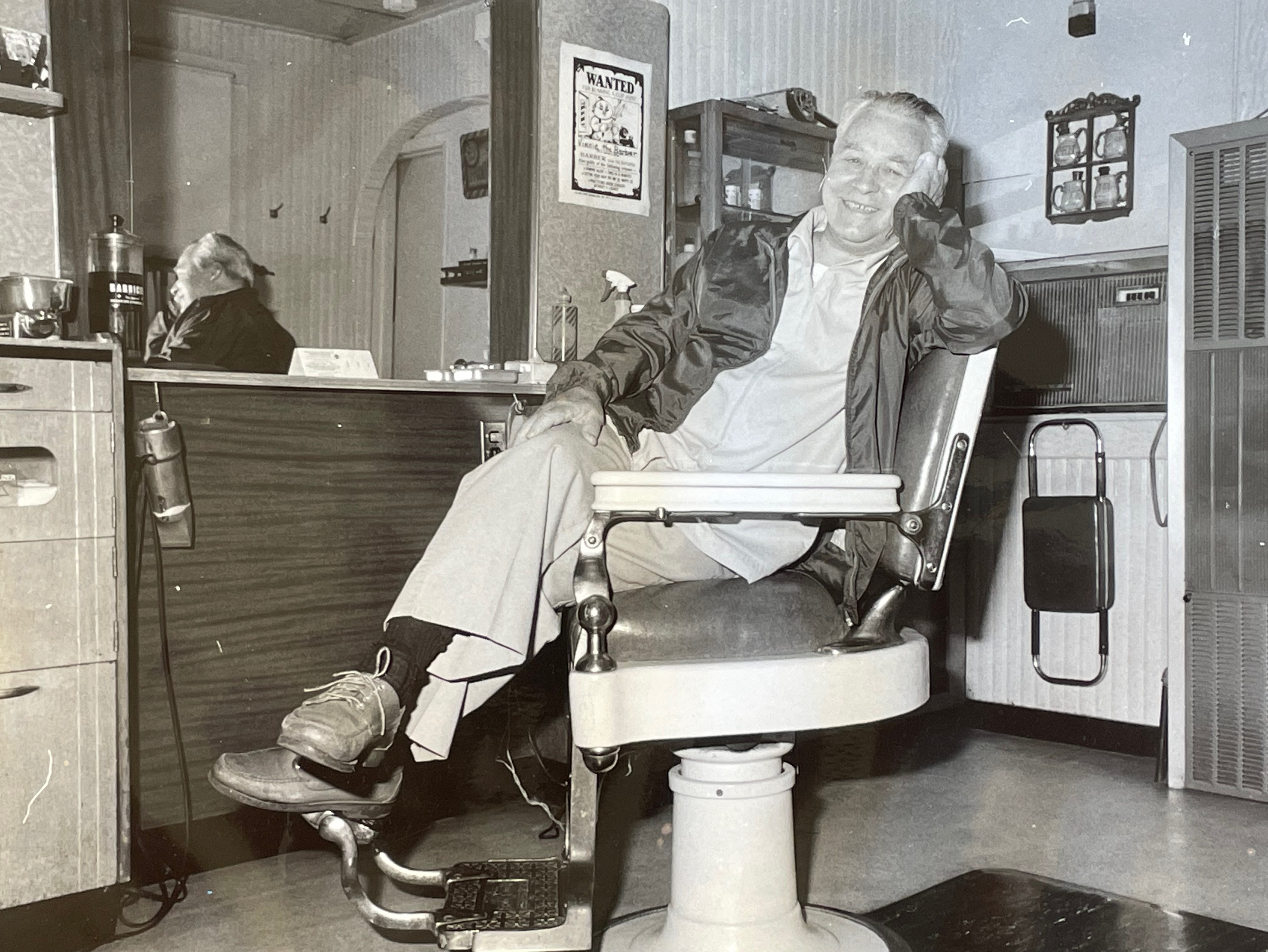
In 1969, the fire district proposed building an addition to the 1930 firehouse to accommodate its larger fleet of fire fighting equipment. District voters had rejected a proposal to tear down the 1930 firehouse. A second vote to acquire the Pedrick property and build an addition to the firehouse was approved by the voters.[31] To make room for the expanded firehouse, the Bennett/Pedrick store was demolished, and the barbershop building was moved to the east of where the Bennett/Pedrick store had been. The new firehouse addition was dedicated at an open house held for the community on January 31, 1971.[32]
Jennifer Hayes continues to cut hair as the fourth proprietor of Cold Spring Harbor’s historic barbershop. Like any good barbershop, it is the place to catch up on the latest local news and gossip, notwithstanding tales of a wealthy woman conspiring to keep her husband from wandering into the City to get a haircut.
[1] The Brooklyn Daily Eagle, August 7, 1892, page 15
[2] The Times Union (Brooklyn), August 11, 1891, page 2.
[3] The Times Union (Brooklyn), September 15, 1891, page 5.
[4] See https://huntingtonhistory.com/2011/03/30/the-stuart-block/
[5] The Times Union (Brooklyn), February 29, 1892, page 5; the building stood at what is now 257 Main Street.
[6]The Long-Islander, August 27, 1892, page 2.
[7] Brooklyn Daily Eagle, August 7, 1892, page 15; The Sun, August 10, 1892, page 3; Brooklyn Daily Eagle, August 11, 1892, page 4; The World, August 11, 1892, page 1; Brooklyn Daily Eagle, August 18, 1892, page 10.
[8] The Long-Islander, August 27, 1892, page 2.
[9] The Long-Islander, October 8, 1892, page 2.
[10] The Long-Islander, March 18, 1893.
[11] Suffolk County Clerk’s Office Deed Liber 240, page 384
[12] The Long-Islander, October 21, 1892, page 3 and March 17, 1894, page 3.
[13] The Long-Islander, November 21, 1896
[14] The Long-Islander, March 20, 1897, page 1
[15] The Long-Islander, March 13, 1897
[16] The Long-Islander, July 22, 1910, page 7
[17] The Long-Islander, December 17, 1892, page 3, his named is spelled Slater.
[18] The Long-Islander, November 24, 1894, page 3
[19] The Long-Islander, August 19, 1899, page 4
[20] The Long-Islander, June 15, 1934, page 12; The Long-Islander, June 5, 1925, page 4 (report of Mrs. Sloter’s brother’s death identifies their parents).
[21] The Long-Islander, February 1, 1918, page 7; The Long-Islander, February 5, 1948, page 15
[22] The Long-Islander, November 6, 1908, page 7
[23] The Long-Islander, April 1, 1921, page 11. The burglar turned out to be George Hawxhurst, a 27-year-old blind man who lived where the current post office is located, New York Herald, March 30, 1921, page 1.
[24] Brooklyn Times Union, September 2, 1924, page 3
[25] The Long-Islander, November 9, 1895, page 2
[26] The Brooklyn Daily Eagle, October 3, 1929, page 58
[27] The Long-Islander, January 31, 1952
[28] The Long-Islander, March 13, 2003, page 7
[29] Suffolk County Clerk’s Office Deed Liber 1054, page 480
[30] The Long-Islander, June 15, 1906
[31] The Long-Islander, April 24, 1969, page 6; Suffolk County Clerk’s Office Deed Liber 6607, page 184.
[32] The Long-Islander, January 28, 1971, page 20
 Huntington History
Thank you for this nostalgic piece on Cold Spring harbor. I have fond memories of fishing on that location back in the early 1960s. My parents bought the first house in Harbour Park Estates in 1959 from builder Nicholas DeMartini. Those who live in the surroundings of Little Neck and Cold Spring Harbor have much to be grateful for. // Bob Sturm, Olney MD
I was always curious about this shop and building. Nice to finally know about the owners and the building’s use in Cold Spring Harbor history.