A long abandoned and neglected building on Jericho Turnpike was recently torn down. That fact, in and of itself, would not usually be worthy of comment. But those remains had an interesting history about a man and his love for his wife.
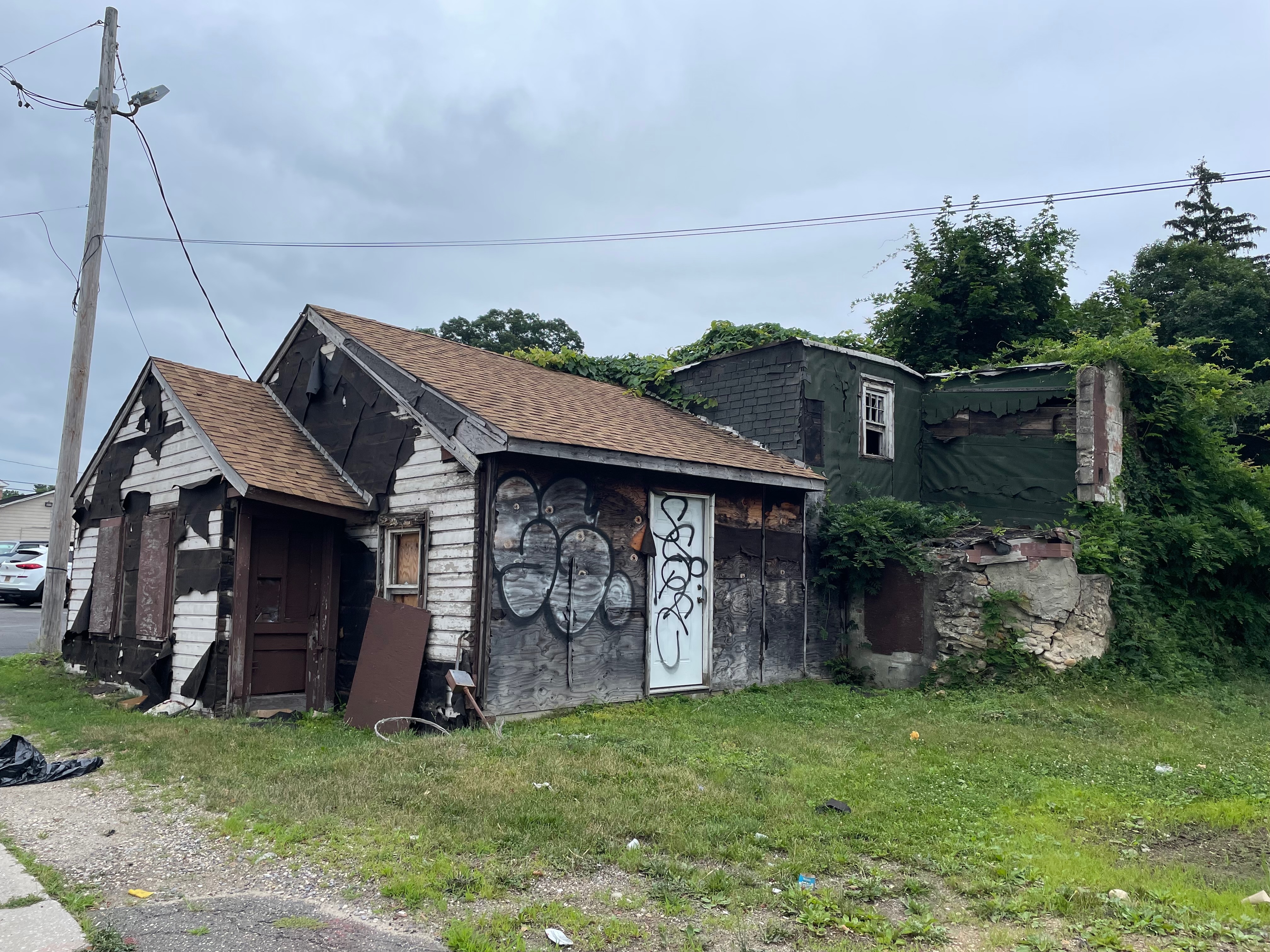
George Eckert moved to Huntington from Brooklyn in 1909, joining his parents who had moved here seven years earlier, when they purchased land on the south side of Jericho Turnpike at Melville Boulevard. His parents, George and Kunienda Eckert, operated a chicken farm and opened the first gas station in that part of town. In 1918, George, Jr. purchased a large plot of land on the south side of Jericho Turnpike between Oakcrest Drive and Melville Boulevard.
The Eckerts ran a small general store known as “Camp Idle Hour.” In addition to providing household necessities, the store telephone was available to local residents who did not have their own telephone lines. Mrs. Eckert ran the store, while Mr. Eckert operated a trucking company between Huntington and New York City. Previously, George had worked for the Long Island Rail Road as a tool and die maker. His son Robert also worked for the railroad. George Eckert was active in the South Huntington Protective League, a civic association formed in 1925 shortly after the merger of the South Huntington and West Hills School Districts and the announcement of plans for a new water district.
Tragedy struck in October 1932, when Mrs. Eckert was hit by a car while helping a little girl cross Jericho. She sustained fractures to her legs and skull as well as internal injuries. She was rushed to Huntington Hospital, but died a few minutes after arriving.
George and his son continued to run the store and gas station until 1934. They then rented the store to various businesses. For many years, it was the location of The Lobster Inn, which remained in business through the late 1950s.
After his wife’s death, George Eckert built a castle as a shrine in memory of his wife. First, he dug a 50-foot diameter moat. Next, he gathered rocks from near and far in his truck to mix with cement to form the walls of the circular castle. In the middle of the three-story castle was a 70-foot tall tree. The first floor of the castle was used for storage and for the coal furnace. The second floor contained a kitchen, bedroom and library. The third floor was partially enclosed and included a roof top garden for Eckert’s plants. The grounds around the castle were described as park-like.

In later years he would retreat to his library, which included hundreds of books on a variety of topics. His family sometimes wouldn’t see him for days. His son Robert lived nearby on the property.
Tragedy struck again in the early hours of February 25, 1950 when a newspaper truck driver noticed flames coming from the castle. He called in the alarm from a nearby restaurant, but by the time the firefighters arrived the fire, which had started in the coal furnace, was out of control. The fire fighters could not enter the building. When they finally were able to gain entry, the 75-year old recluse was found slumped outside his bedroom. He had apparently suffocated.

George’s son Robert continued to live on the property until his death in 1963. Later generations still live in the area.
 Huntington History
Leave a comment