Sometimes, in the telling, history gets muddled. People from different generations are mixed up, dates are wrong. Details and accuracy are lost, but the overall narrative remains. Case in point: the history of Huntington’s Senior Beach House at Centerport Beach.
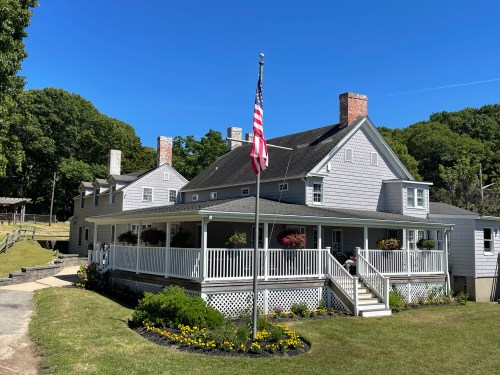
The Senior Beach House at Centerport
The story that is told is that the house was built around 1782 (the stone foundation under section of the house supports an eighteenth century construction date) and was purchased by Phineas Sills around 1850. Sills is identified as a man who was “active in Revolutionary War affairs and owned the Northport Fire, Sand and Brick Company.” This account is suspect, mainly because if Sills were to have been active during the Revolution, he could not have been born later than say 1760. That would make him 90 years old when he supposedly purchased the property and started a new company to mine sand and clay. Not many nonagenarians are that ambitious.
There was indeed a man named Phineas Sylls who served in the First Regiment of Minute Men from Suffolk County.[1] However, this man did not own the land in question. In the eighteenth century, the owner was Noah Rogers. In 1770, he sold 257 acres at the north end of the Little Neck peninsula, including buildings, to Ebenezer Prime of Huntington.[2]
Prime seems to have lost the property because when Rogers died, he again held title to the land. In 1807, Rogers’ daughter Levinah Platt quitclaimed 100 acres to John Sills.[3] This deed was not recorded until 1850, just 6 days before a deed conveying the land from John Sills to his son Phineas was recorded. In that second deed, dated December 18, 1849, John Sills conveyed the 100 acres to his son Phineas upon the condition that Phineas “shall at all times at his own proper cost and expense properly maintain, support, clothe and with the necessities of life supply the said party of the first part during his lifetime and pay all bills for medical services and assistance by him properly contracted and shall also properly support maintain and clothe the two daughters of the said John Sills now living and pay all bills for their medical aid during the whole lifetime of both or either of them provided they remain unmarried, and in the event of them or either of their marriage, then the said Phineas B. Sills to give and pay unto such one as marries the just and full sum of one hundred dollars as a marriage portion.”[4]
John Sills married Jemima Rogers in 1804.[5] Jemima Rogers was the daughter of Joel Rogers and Elizabeth Jarvis and appears to be the granddaughter of Noah Rogers’ brother, Zophar. She died in 1847, which may explain the transfer of the property by her husband to their son Phineas in 1849. According to a Sills family tree on file at the Greenlawn-Centerport Historical Association, the grandfather of this Phineas was the brother of a Phineas who would have been of the age to be active during the Revolution, presumably the minuteman referred to above.
According to a friend, in his early years, the Phineas Sills who acquired the property from his father in 1849, “through Infidel books, . . . imbibed Infidelity.” But turned to Christianity in 1842 and joined the Methodist Church. When he was 34, he married Prudence S. Marchant of Martha’s Vineyard on January 2, 1849 in Edgartown on Martha’s Vineyard. Later that year, his father transferred the land on Little Neck to him.[6] Little Neck peninsula was also known as Sills Neck.
According to the 1850 census, Phineas was a coaster (i.e. he captained a ship that traded along the coast—he was referred to as captain in a eulogy written by a friend after he died). In 1860, however, the occupation for him and his 73-year-old father was “clay digger” (both their wives were dress makers). Five years later, John Sills was dead, and Phineas was listed on the State census as a farmer. It is unclear how extensive Sills’ clay mining endeavors were. The sand and clay on the Little Neck peninsula were noted for their variety and quality.
Phineas Sills defaulted on a mortgage held by Helen M. Butler, who sued to foreclose. In February 1867, the court ordered the farm to be sold at public auction.[7] The auction was held in December 1867,[8] but the deed for the “farm and clay beds” was not executed until October 1868. (Phineas Sills died in 1869.[9]) The purchaser was Israel Carll of Northport.[10] A month later, Carll transferred title to the Northport Clay and Firesand Manufacturing Company.[11] Fire sand is a type of sand used to make fire bricks to line furnaces.
Israel Carll is credited as the organizer of the Northport mining concern.[12] He died on November 27, 1878. In 1880, his half interest in the company was purchased by Captain Isaac Sammis (it is unclear who owned the other half).[13] Isaac’s son, John B. Sammis, took over the firm upon his father’s death. John B. Sammis sold the company to John Williamson in 1900.[14] The new owner built a new large dock into Northport Harbor and expected to employ 200 to 300 men. The operation would utilize steam shovels instead of digging by hand as had been done previously.[15]
Meanwhile, the old farmhouse was apparently converted to a boarding house called the Glen House. An advertisement in 1883 pointed out that the house is “Directly on the Beach” and offers “Free boating, bath house and croquet” for $7 to $19 per week.[16] An 1885 article on summer resorts in Centerport boasted that the Glen House provided “excellent accommodations for 50 guests—a place with the most excellent of situations.” Guests could “ramble over wooded hills” or take a “quiet rest in one of the many shady nooks.” They could also rent a boat to enjoy “one of the best fishing grounds.”[17]
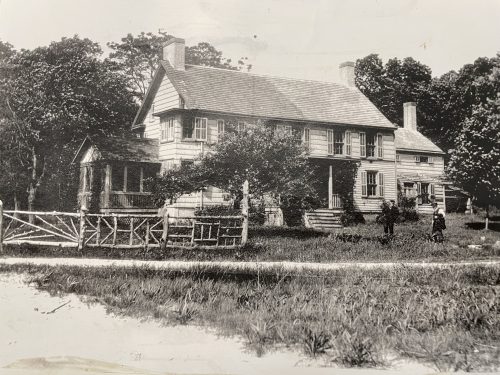
The Glen House
As it turned out, the Glen House would not be available to guests in 1885 because the Rev. Samuel T. Carter of Old First Church rented it for the season. Rev. Carter and his family rented the Glen House for a few summers before purchasing the house and five acres of land from the mining company in 1890.[18] Rev. Carter purchased additional land to the south from the mining company in 1893.[19] His brother Robert Carter purchased adjoining land to the north in 1898[20] and built the house that still stands at 245 Little Neck Road.
A friend of Rev. Carter’s granddaughter Cora describes visiting the house in the 1920s:
“Samuel T. Carter’s homestead was right on the beach in Centerport, and it was one of the favorite camping spots for my girl gang to visit in the summer. I also went there occasionally for Sunday evening sing-alongs; the Carters were a musical family and gathered from time to time to sing religious hymns. Most of the Carter women played piano.”[21]
Rev. Carter, who had 11 children,[22] served as pastor of Old First Church from 1868 to 1901, when he left the Presbyterian church over a theological dispute.[23] He planned to continue to spend four months a year in Huntington, presumably during the summer months at his beach house.
Eventually Rev Samuel Carter’s land and his brother Robert’s land were owned by Robert Carter’s daughter Jeannette Carter Miller.[24] The Town claimed ownership of the sand spit to the southwest. That land, which was only accessible by water, was quitclaimed to Carter in 1893. In the 1930s, the Town sought to acquire additional land for a public beach, which was met with opposition from neighboring landowners.[25] Eventually the town purchased a 24-acre parcel in 1949, but, as with the effort to secure other beaches in town, that was just the first step in a long process to provide beach access for town residents.[26]
Eventually, the old Glen House was acquired by Robert Kessler, who sold it to the Town in 1963 as part of a major parks acquisition bond approved by the voters in September 1962.[27] The town soon thereafter dedicated the house for the use of Senior Citizens in town.
[1] The Refugees of 1776 from Long Island to Connecticut, by Frederic Gregory Mather (Albany 1913), pages 996 and 1006.
[2] Suffolk County Clerk’s Office Deed Liber C, page 102
[3] Suffolk County Clerk’s Office Deed Liber 53, page 267
[4] Suffolk County Clerk’s Office Deed Liber 53, page 281
[5] Lineage Book: NSDAR, Volume 144 (1919), accessed on Ancestry.com
[6] The Long-Islander, May 21, 1869.
[7] The Long-Islander, August 9. 1867
[8] The Long-Islander, December 13, 1867
[9] The Long-Islander, May 21, 1869; April 16, 1869
[10] Suffolk County Clerk’s Office, Deed Liber 154, page 42
[11] Suffolk County Clerk’s Office, Deed Liber 154, page 342
[12] Times Union, November 22, 1900, page 8
[13] The Long-Islander, May 7, 1880
[14] Times Union, November 22, 1900, page 8. Alonzo E. Smith was reported to have been a co-purchaser of the property, but a later lawsuit vested title solely in Willimason, South Side Signal, February 23, 1901, page 2
[15] Ibid.
[16] Brooklyn Eagle, June 17, 1883, page 11
[17] The Long-Islander, May 29, 1885
[18] Suffolk County Clerk’s Office Deed Liber 335, page 202
[19] Suffolk County Clerk’s Office Deed Liber 397, pages 404 and 406
[20] Suffolk County Clerk’s Office Deed Liber 467, page 284. This property was sold by Robert Carter to his daughter Jeannette C. Miller in 1919 (The Long-Islander, September 19, 1919). Later the Miller family owned both pieces (see The Long-Islander, October 27, 1933, page 1
[21] The Memoirs of Mary Saylor Muhlhausen, by Mary Saylor Muhlhausen (Xlibris Corporation 2022), page 65.
[22] Previous accounts identify Samuel T. Carter, Jr., as the pastor and father of 11 children. Samuel Jr. was a lawyer, not a pastor.
[23] Ibid; The Brooklyn Daily Times, September 2, 1901, page 8
[24] The Long-Islander, January 2, 1920
[25] The Long-Islander, September 5, 1930, page 1
[26] The Long-Islander, March 10, 1949, page 1
[27] The Long-Islander, August 16, 1962, page 1 and September 27, 1962, page 1
 Huntington History
How I wish EOSPA would have approved and recommended to the Town Board the purchase of land directly next to the Sr Beach House. It would have given them more beach front property and room for expansion and possibly parking. The asking price was 1 million. It ended up being sold for 700K. It was a once in lifetime opportunity we missed.