After the Battles of Lexington and Concord in April 1775, the colonies were in a state of war with Great Britain, but it was not yet a war for independence. To help fight that war the Continental Congress authorized New York to raise as many as 3,000 troops to be paid by Congress. Even though most of these troops were from areas north of New York City, one Huntington man joined.
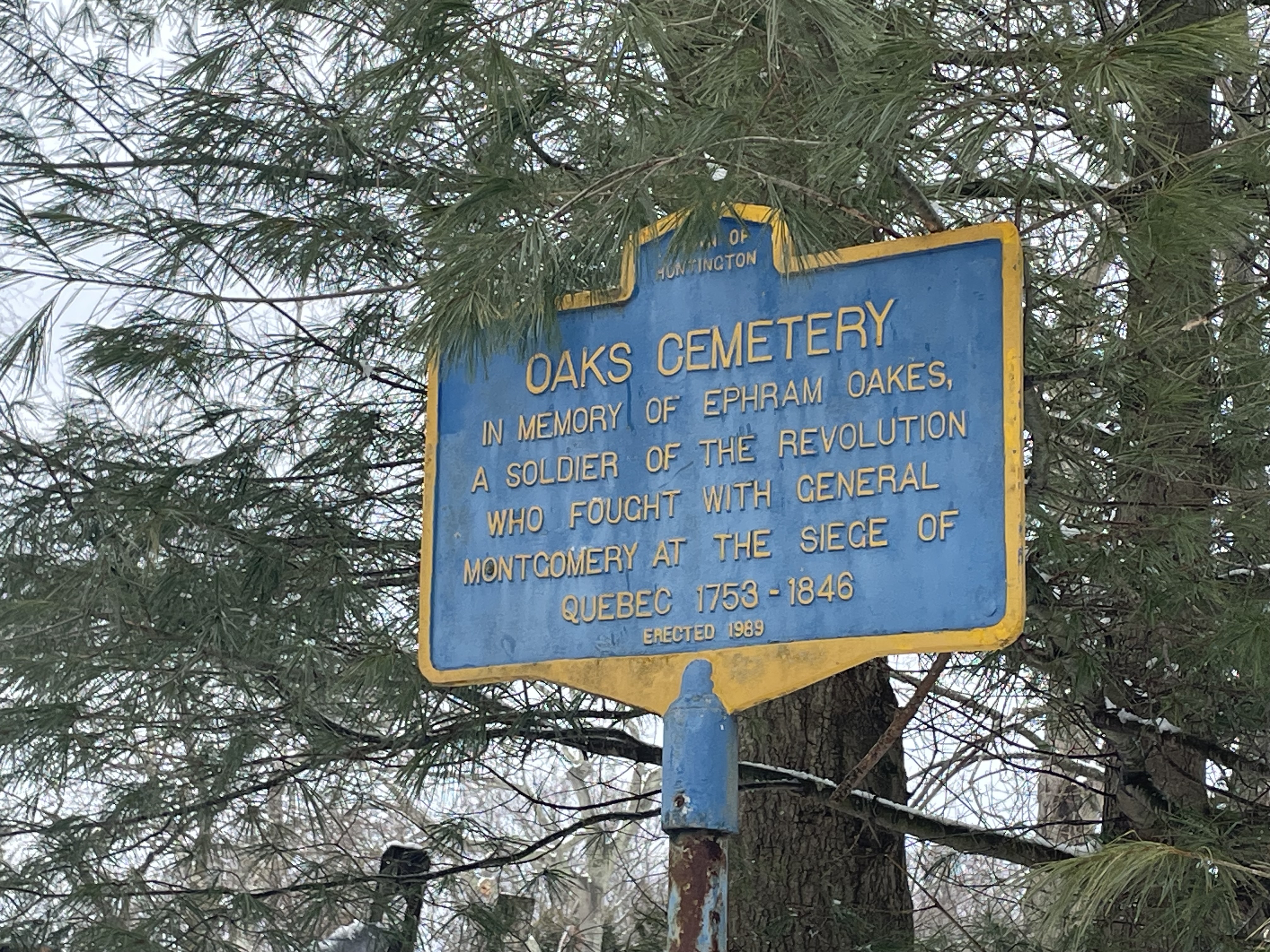
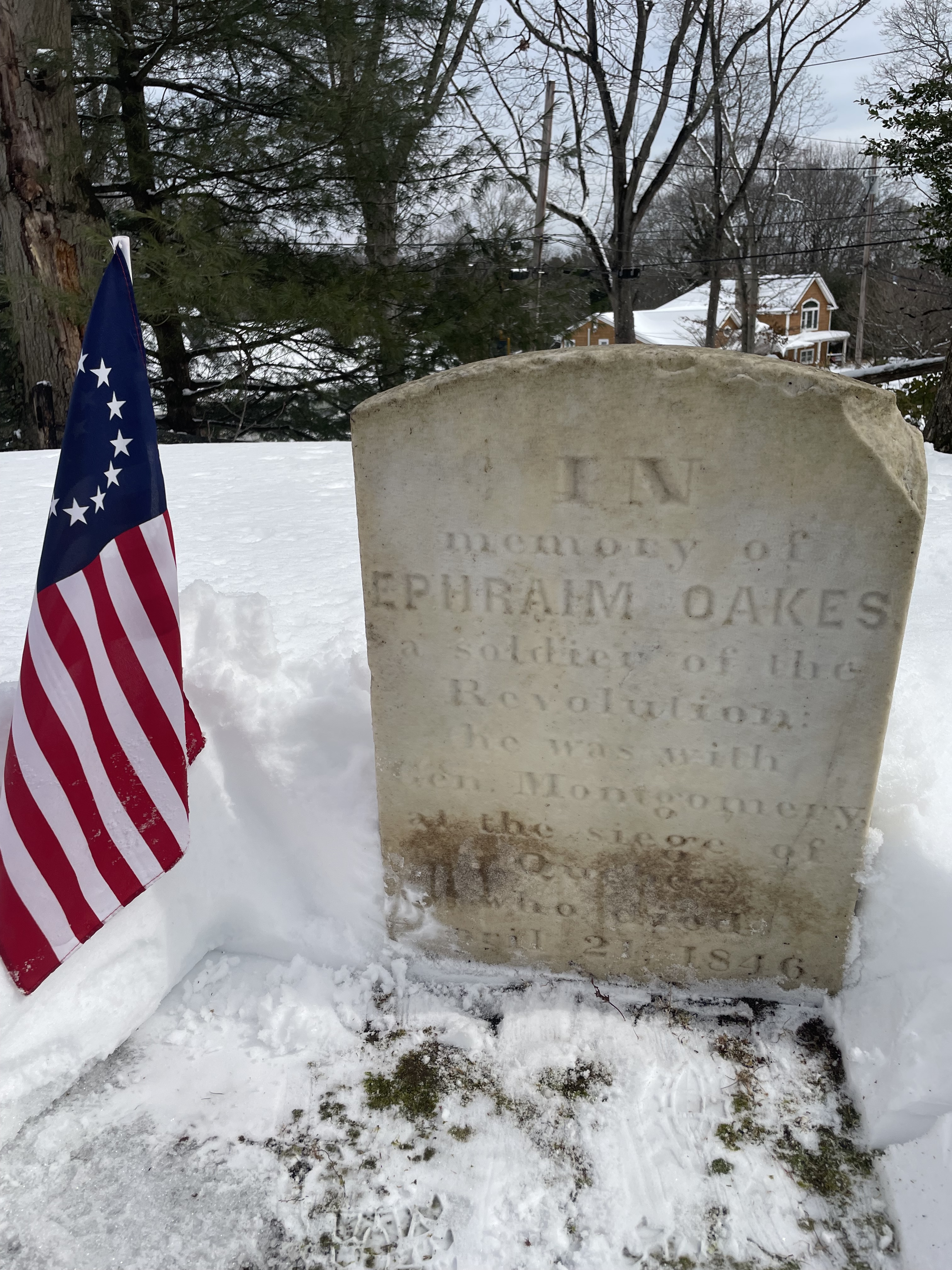
Ephraim Oakes was 22 years old when he “took a tour into Orange County in the Town of Goshen.” While there, a call for soldiers was issued and he enlisted for a five-month tour of duty in the Third New York Regiment under Colonel James Clinton around June 1, 1775. At around the time George Washington assumed command of American troops surrounding Boston, the Continental Congress authorized an invasion of Canada to forestall a British invasion of the rebellious colonies from the north and to try to convince the French settlers to join the fight against the British. The invasion force was made up mostly of New York and Connecticut troops under the command of General Philip Schuyler. Oakes and his fellow recruits marched to Albany and then to Lake Champlain. General Richard Montgomery assumed command when Schuyler fell ill. At the beginning of September, they arrived at Fort St. John, about 22 miles from Montreal. After a six-week siege, the fort fell. The Americans next captured Montreal in mid-November. By this time, Oakes’ enlistment had expired, but he re-enlisted for another six months.
Meanwhile, Benedict Arnold led a smaller contingent from Boston through the forests of Maine to join Montgomery in an attack on Quebec City. The Americans attacked the city in the midst of a severe snowstorm on December 31. Montgomery was killed and Arnold was wounded. The attack was a failure. The Americans besieged the city until May 1776 when Oakes’ second enlistment expired. Again, he re-enlisted even though he hadn’t been paid. The Americans gave up trying to capture Quebec and returned to New York. Oakes then retraced his steps back to Goshen and then to New York City, arriving in the city the same day the British fleet was spotted off Sandy Hook. He then returned to Huntington. Shortly after he arrived home, the British took possession of Long Island. Someone reported to the British that Oakes was a Continental soldier and he was taken prisoner. It is not known how long he was held as a prisoner, but he was back in Huntington by September 1778, where he worked as a blacksmith and was forced to sign the Oath of Loyalty to the Crown as were all men on Long Island between the ages of 15 and 70. Those who refused to sign would be fined £5 and forced to leave Long Island with their families.
Oakes lived the rest of his life in the Elwood section of Huntington. His homestead was near the corner of what is now Godfrey Lane and Wilder Lane. He died in 1846 a month shy of his 93rd birthday and is buried in the Oakes Cemetery, located about 650 feet south of his home.
Huntingtonians were quick to react to the first battle of the American Revolution when the local militia in Lexington and Concord, Massachusetts successfully repulsed a British attempt to seize their arms on April 19, 1775.
A week later in New York City, the Committee of Sixty, which had been created the previous November, expressed its opinion “That at the present alarming Juncture, it is highly adviseable (sic) that a Provincial Congress be immediately summoned.”[1] On April 29, 1775, the Freemen, Freeholders and Inhabitants of the city and county of New York adopted Articles of Association and transmitted the same to all the counties in the Province to be adopted by them. Through the Articles of Association, New Yorkers expressed their support for measures recommended “for the Purpose of preserving our Constitution, and opposition the Execution of the several arbitrary, and oppressive Acts of the British Parliament.”
In Huntington on May 8, 1775, 403 men signed the Articles of Association, while 37 refused to sign. Most of the signers were from Huntington, but some Islip residents signed as well.[2] Six days earlier, at a General Town Meeting, “it was Voted that there should be eighty men chosen to Exercise and be ready to March.” This is considered the first recorded preparations by Huntington for potential hostilities with Great Britain.
The text of the Articles is set forth below:
Persuaded, that the Salvation of the Rights and Liberties of America, depends, under GOD, on the firm Union of its Inhabitants, in a vigorous Prosecution of the Measures necessary for its Safety; and convinced of the Necessity of preventing the Anarchy and Confusion, which attend a Dissolution of the Powers of Government; We, the Freeholders and Inhabitants of [Huntington] being greatly alarmed at the avowed Design of the Ministry, to raise a Revenue in America: and, shocked by the bloody Scene, now acting in the Massachusetts Bay, DO, in the most solemn Manner, resolve, never to become Slaves; and do Associate under all the Ties of religion, Honour, and Love to our Country, to adopt and endeavor to carry into Execution, whatever Measures may be recommended by the Continental Congress; or resolved upon by our Provincial Convention, for the Purpose of preserving our Constitution, and opposition the Execution of the several arbitrary, and oppressive Acts of the British Parliament; until a Reconciliation between Great-Britain and America, on Constitutional Principles, (which we most ardently Desire), can be obtained; And that we will in all Things follow the Advice of our General Committee, respecting the Purposes aforesaid, the Preservation of Peace and good Order, and the Safety of Individuals, and private property.[3]
Substantially similar wording was adopted by the 98 delegates to the New York Provincial Congress on May 26, 1775. One of the six representatives signing for Suffolk County was John Sloss Hobart of Eatons Neck.
The widespread adoption of the Articles of Association indicates the strong support in Huntington for the Patriot cause. However, there are some who have questioned Huntington’s commitment to the Revolution, pointing to the later occupation of the town, and indeed all of Long Island, as well as the later signing by Huntington residents of the Oath of Loyalty to the crown.
In an attempt to get a better understanding of the extent of Huntington’s support for the Continental Congress, it is necessary to know how many households there were in Huntington during this period. Various lists of oath takers, assessments, and censuses gives some idea of the number of households in town, but not the total population because these records were generally limited to heads of household. During this tumultuous period, the population was in flux. After the American loss at the Battle of Long Island in August 1776, many fled Long Island. Others moved here. Young men came of age; old men died. Record keeping was inconsistent (for example, Samuel Bennet, 30-year-old weaver, appears twice and the list of men who signed the 1778 Oath of Loyalty as recorded in the Town Records contain 549 names, while the list on file at the Public Records Office, Colonial Office in England[4] includes 560 names).
The 1778 Oath of Loyalty list includes 96 men between the ages of 15 and 20. Assuming these young men were not heads of households, the number of households would be 464. The greater number of signers of the Oath of Loyalty is most likely due to the coercion involved in regard to this list. The Governor of New York, William Tryon, with a large contingent of troops, came to Huntington on September 2, 1778 to compel allegiance to the crown. All men between the ages of 15 and 70 were forced to sign. Those who did not sign on that day were ordered to “wait on [the governor] at New York on or before” September 10. Failure to do so would result in a fine of £5 and the refusers would be “Obliged To Quit The Island with Their families.”[11] One hundred and nineteen men who did not sign the oath on September 2, later signed the oath before Justice John Hewlett, apparently without having to travel to New York.
Of the 403 men who signed the Articles of Association in 1775, 269 also signed the Oath of Loyalty to the Crown three years later; but 132 did not (5 of those, however, appear on the Islip list). Those who did not sign, including Patriot leaders John Sloss Hobart and Gilbert Potter, had fled the Island; other may have died. Those who remained had no choice but to sign.
The percentage of men in 1775 who signed the Articles of Association compared to those who refused to sign was 91.5%. If one takes an average of four of the late eighteenth century lists[12], the population of the town would number 423 households. If we take that number, the percentage of Huntington households signing the Article of Association would be 95%. If we take the total number of households from the 1778 Oath of Loyalty, Patriot support would be either 87% (based on the number excluding those under age 21, 464) or 72% (based on the total number of 560).
In other words, it is clear that support for the Patriot cause was very high in Huntington, at least seven out of ten and perhaps as many as nine out of ten heads of household supported the Patriot cause.
Beyond providing an indication of local sentiment, this exercise also reveals that Huntington’s population was in a state of flux. Only 128 names appear on all three lists during the duration of the war: the 1775 Association list, the 1778 Oath of Loyalty list and the 1782 assessment list. A list combining the names on the Articles of Association list, the Oath of Loyalty List and the 1782 assessment contains 924 names. Of these, there are 71 duplicate names, which may or may not refer to different people. For instance, on the Articles of Association list, there are four men named Isaac Ketcham. Since they are on one list, they are most likely different people. When combining lists, it is not always possible to make that determination.
What this demonstrates is that while the number of households may have been around 400-500, the residents of those houses changed during the war years. The population was in a constant state of flux. It is possible that many Loyalists from Connecticut and elsewhere came to Huntington, increasing the population from 440 to 560 households. At the end of the war the population fell sharply from 406 households in 1782 to 224 households a year later. Indeed, 393 men who signed the Oath of Loyalty in 1778 were not listed on the1782 assessment, and 233 men who had signed the Articles of Association in 1775 were not listed on the 1782 assessment. The population then recovered by 1790 to the level it had been in 1764.
This analysis was made possible by the work of Brett Lafemina, a student at Syracuse University, in assembling and analyzing the data.
[1]The Refugees of 1776 from Long Island to Connecticut, by Frederic Gregory Mather, 1913, page 1049
[2] Five names from the Association list later appear of the list of those taking the Oath of Loyalty in Islip in 1778: Stephen Kelly (or Keley), Joseph Ketcham, Anning Moberry (or Mowbray), Samual Oakley, and James Smith.
[4] Photocopy of handwritten list created in 1779 available from the Long Island Collection at the East Hampton Public Library, “A list of persons in Suffolk County, on Long Island who took the following oath of allegiance and peaceable behavior before Governor Tryon 1778: Public record office, colonial office, class 5, 1109.”
[12] The four lists are the 1775 Articles of Association (440), the 1778 Oath of Loyalty (56-minus 96 men under 21 for a total of 464), the 1782 assessment (406) and the 1790 local census (382). The 1783 list of inhabitants was left off because it is not in line with the other lists. Including that list would lower the average to 383.
What’s in a name? When trying to promote development of an area, its name is important, especially if the name is not appealing. Think Mosquito Cove (now Glen Cove) or Drowned Meadow (now Port Jefferson). In Huntington, what had been known for over a century as Gallows Hill is now Fort Hill.
The story begins during the American Revolution when Huntington was occupied by the British. To guard their position in Huntington, the British built a fort at the eastern approach to the Town Common. The fort stood at the intersection of today’s East Main Street and Maple Hill Road, at the point where East Main Street descends to the Park Avenue valley. Traces of the fort could still be seen as late as a century after the war but are now lost.
At the end of the war, the area near the fort was the site of a hanging. Over the years, the identities of the men hanged and even which side they were on became confused. In one telling, the two men were British soldiers who rode to their execution on their coffins. The other version claims the men were American spies.
In 1975, Huntington’s Bicentennial Committee went with the American spies version of the story and erected a historic marker on Huntington Bay Road. The marker text: “Near this spot, two American Martyrs were hanged by the British during the Revolution.” Why that particular spot was chosen to place the marker is not known.
Recent research by David M. Griffin, who has written two books about the American Revolution on Long Island,* confirms that the Bicentennial Committee chose the wrong version. The two condemned men were Isaac Algar and Nathaniel Parker, who fought for the British. In August 1783, they were convicted of robbing and beating Platt Carll, who operated an inn on the north side of Jericho Turnpike between Manor and Warner Roads. The convicted men were hanged on September 10, 1783 (the executioner was Provost Marshal William Cunningham, who was also present at Nathan Hale’s hanging seven years earlier). Two and a half months later, the British evacuated from New York City.
The 1837 Coastal Survey Map
For generations, the hill east of Park Avenue and north of East Main Street was known as Gallows Hill. It was so labeled on the 1837 Coastal Survey map. Nineteenth century deeds described Maple Hill Road as the road to Gallows Hill. The area was sparsely settled, so no one much minded the name. But by the turn of the twentieth century, when more and more houses were built, it was decided a new name should be found. Reference to the fort, even though it was a British fort, was preferable to a reference to the site of an execution. Hence Gallows Hill became Fort Hill.
To correct the record on September 23, 2024, a new historical marker was placed at the intersection of Maple Hill and Fort Hill Roads.
*Lost British Forts of Long Island (The History Press 2017) and Chronicles of the British Occupation of Long Island (The History Press 2023)


 Huntington History