Feeds:
Posts
Comments

Archive for the ‘Uncategorized’ Category

Vernon Valley Violence

In the late nineteenth century many successful businessmen summered in Huntington and some retired here as well.  One was Bartley T. Horner.  Mr. Horner was working as a clerk in a New York tobacco shop by the time he was 18 years old in 1870.  Four years later, he married Ella Selvage in Brooklyn.  Mr. Horner eventually became the representative for the Lorrillard Tobacco Company throughout the South.  He lived in Galveston, Texas.  A loss of hearing forced him to retire early.

By the 1880s he had acquired a ten-acre tract (later enlarged to 17½ acres) overlooking Long Island Sound in the Crab Meadow section of Huntington for use as a summer residence.

The Horners’ daughter Julia—their only child—had married James Simpson in 1895.  Well over six feet tall, Simpson was a dentist from Virginia.  In September of 1900, Mr. & Mrs. Horner were at their “fine residence near the sound shore” in Crab Meadow.   While the Horners home sat atop a sixty-foot bluff, the Simpson home in Galveston was on low ground.  The Horners anxiously awaited word from their daughter when a category 4 hurricane hit Galveston on September 8 and claimed up to 8,000 lives.  The storm hit the city on a Saturday.  The Horners received no word from their daughter until a telegram arrived on Wednesday morning assuring her parents that the couple had escaped harm but had lost everything.  Horner sent a reply telegram advising them to come north right away.

It appears that the young couple moved to New York City where Dr. Simpson set up a dental practice at 434 Fifth Avenue, near the Waldorf-Astoria Hotel.   In 1902, Mr. Horner rented the house of C.W. Call, perhaps for his daughter and son-in-law to use that summer.

In February 1905, Mr. Horner sold his Crab Meadow property and moved to Vernon Valley.  His house on Vernon Valley Road, just south of Fort Salonga Road, still stands.  Dr. and Mrs. Simpson moved in with the Horners, and Dr. Simpson commuted to his dental office in Manhattan.

On Christmas day that year, Dr. Simpson went rabbit hunting with a friend.  Two days later, he retrieved the shotgun from the attic to clean it.  First he marched around the house performing the manual of arms.  Then he went into the kitchen to clean the gun.  He thought the gun was empty, but it wasn’t.  When Simpson pressed the gun against the table to open it, it discharged.  The bullet tore through his father-in-law’s abdomen.  Dr. Simpson hurried to the village to summon Dr. Heyen.  Dr. Donohue soon followed.  The two doctors tried everything to stop the bleeding, but were unsuccessful.  Mr. Horner died within two hours of being shot.

It was a horrible tragedy.  But was it an accident?

During the inquest held the following day, it was revealed by the dead man’s widow that Mr. Horner feared his son-in-law and had an appointment with his attorney scheduled for the day after the shooting to redraw his will so that Dr. Simpson would not receive a penny of his money.  The widow testified that she, her daughter, and her son-in-law discussed the will that night during supper before Mr. Horner came home.  At the inquest, Dr. Simpson denied that he knew Mr. Horner planned to re-write his will.  But he did admit that he had asked an attorney in New York about whether Mr. Horner could set up a trust that would include Mrs. Horner’s separately owned property.  When asked why he would make such an inquiry, he said he was concerned about his mother-in-law’s welfare.[1]

Mr. Horner’s funeral was held at his home on New Year’s Eve.  A large crowd heard the local Episcopal minister base the service on John 8:7, “What I do thou knowest not, but thou shalt know hereafter.”  This was perhaps a reminder to Dr. Simpson that even if the truth of the shooting was not revealed at trial, it would be revealed in the hereafter.  But Dr. Simpson was not at the funeral.  He was in the Riverhead jail, charged with murder.

Mr. Horner’s body was taken to Huntington Rural Cemetery and placed in the receiving vault there until a mausoleum could be built.

The following week, a preliminary hearing was held in Northport’s Union Opera Hall.  The county’s new district attorney, George H. Furman, and new sheriff, John F. Wells, began their terms in office with one of the most sensational cases in the County’s history.  Reporters and photographers from the New York papers descended on Northport and it was reported that “very little business was done that day in the village.”  Mr. Horner’s attorney testified that he left a paper with Mr. Horner the day of the shooting.  The paper was the outline of a new will.  Dr. Donohue, who came to the house after the shooting, testified that Mr. Horner had two wounds, showing that Dr. Simpson’s gun had been fired twice.

The victim’s widow testified that her husband and son-in-law frequently argued.  Mr. Horner was concerned about Dr. Simpson’s gambling on horse races and staying out all night.  Dr. Simpson had financial difficulties and had fallen three months behind on his share of the household expenses.  She thought that Dr. Simpson may even have been drinking on the night of the shooting—although the two doctors who came to the house after the shooting disputed that claim.    Julia Simpson also testified for the prosecution much to the surprise of her husband.  Both women testified that Dr. Simpson handled the gun roughly when he first retrieved it, marching around the house as if in a military drill.  He then went upstairs where the ammunition was kept.  When he came back down he was careful with the gun and then went into the kitchen where Mr. Horner had gone to get a drink of water.  A short time later they heard the gun fire.

At the conclusion of the preliminary hearing, Justice Partridge determined there was enough evidence to refer the case to the grand jury.  In March, the grand jury issued an indictment for murder in the first degree.  Dr. Simpson was confident that he would be exonerated.

Fortunately, there was an eyewitness to the shooting.[2]  Mr. Horner’s 26-year-old Polish stable hand Frank Wisnewski could surely help determine if the shooting was accidental.  But the young man was distraught, concerned that his poor English would be misunderstood and perhaps fearing that if he testified against Dr. Simpson, he also would be killed.  He was put to bed to calm down, but only grew agitated and violent.  Eventually, Mr. Wisnewski was admitted to the Kings Park Psychiatric Hospital.  In September he escaped from King Park, but was found two weeks later in the woods of Central Islip.  A month before the trial a habeas corpus hearing was held in Brooklyn.  Mr. Wisnewski was found incompetent to testify at the murder trial.  When he was called to testify during the trial, he could not even take the oath to swear to tell the truth.  He was dismissed without having testified.

A May trial was expected, but the judge assigned to the case died.  An October date was then expected.  Dr. Simpson spent his months in jail meticulously preparing for trial, reading over similar cases and providing his lawyers with hundreds of well thought out questions.

Dr. Simpson sat in jail for all of 1906.  In January 1907, his lawyer commenced a habeas corpus proceeding in Brooklyn seeking his release.  The Suffolk County District Attorney tried to argue that he could not get a justice to try the case.  The Brooklyn judge cut him off and ordered that the trial be held by the end of the month or Dr. Simpson would have to be released on $1,000 bail.

The trial began with jury selection on January 28, 1907 and was not without drama.  During jury selection, one of the potential jurors suddenly died.  Another juror was about to be accepted onto the jury when he told the judge he could not serve due to a death of a relative.  The judge asked how close a relative it was.  He replied that it was his brother-in-law.  A court attendant explained to the judge that the potential juror’s brother-in-law was the man who had died just minutes earlier.  One juror fell ill during the trial and the others complained of the unsatisfactory living conditions in the house where they were staying.[3]

Hundreds of spectators attended the sensational trial, including many women and girls, who apparently were enamored of the tall, good-looking dentist with jet black hair, dark eyes, and a soft Southern drawl.  They firmly believed in his innocence.

The trial repeated much of the testimony from the preliminary hearing.  A question arose as to whether the shotgun shells admitted to evidence were the same as those in the gun at the time of the shooting.  The gun and empty shells had been taken from the house on the night of the shooting by Dr. Isaiah Frank (who coincidentally was the man who had purchased Horner’s property in Crab Meadow).  Dr. Frank testified that the shells were maroon like the ones entered into evidence.  Meanwhile his brother and mother, who both lived with him, testified that the shells Dr. Frank brought home were yellow.  Expert testimony differed on whether it was physically possible for a shotgun to discharge when it had been “broken” or opened. Through it all, sentiment in favor of Dr. Simpson grew.  Wagers were taken on his acquittal.

At the conclusion of the week-long trial, it took the jury less than two hours to reach a verdict of not guilty.  Dr. Simpson was congratulated by the courtroom spectators.  He made his way to the hotel where his sister had been staying to retrieve her things before they took the train into New York.  At the hotel, the doctor ran into the judge who had presided over the trial.  He thanked the judge for a fair trial.  The judge replied, “Let this be a lesson to you to keep away from guns.”

Mrs. Horner, Mrs. Simpson, and their servant Marion Walsh boarded the same train, but rode in the rear car.  Mrs. Simpson made it clear that she and her mother had no interest in the prosecution, but had testified because they had been subpoenaed.  Dr. Simpson said he hoped he and his wife would reconcile.

Mrs. Horner and Mrs. Simpson continued to live in the house on Vernon Valley Road.   They had enough money from the estate to live comfortably, but they lived in fear of Dr. Simpson.  They kept the doors locked even though they lived in one of the most peaceful spots on Long Island.  And they always kept a loaded revolver in the house.

Dr. Simpson took up residence at 24 West 59th Street and resumed his dental practice with an office at 1181 Broadway.  He had initiated a lawsuit against his wife and mother-in-law claiming he was entitled to $5,000 from his victim’s estate.  But the suit was soon dropped.  Eventually he sought a divorce, but his wife refused.  He traveled to Northport on occasion to see his wife and once accosted her on the street in the village.

Then on Monday, July 13, 1908—18 months after his acquittal—Dr. Simpson took the 12:40 p.m. train to Northport, transferred to the trolley and went to his former home.  He rang the bell.  Mrs. Horner asked who it was.  Dr. Simpson replied, “It is I.”

“What do you want?” Mrs. Horner asked.

“I want to see Julia.”

Then two shots were fired through the glass door.  One hit the doctor in his lower lung and continued into his liver.  The other missed him.  Dr. Simpson went to a neighbor’s house and asked for a carriage.  He drove to Dr. Heyen’s office on Main Street.  He asked Dr. Heyen if the shot would be fatal.  Dr. Heyen said he wouldn’t know until he operated.  Dr. Simpson said he wanted to go to Roosevelt Hospital in New York for the surgery.

Before he left, Dr. Simpson explained to the magistrate what had happened, signed a deposition and then calmly boarded the trolley and took the one and half hour train ride back to Long Island City and from there boarded the 34th Street Ferry.  He took a taxi to Roosevelt Hospital, where the doctors decided to wait until morning to operate.   It was feared that the wound would prove fatal, but eventually it was determined that no operation was needed.

Meanwhile back in Northport, word of the shooting spread quickly.  It was some time before the authorities came to the house to arrest Mrs. Horner.  Her daughter accompanied her to the Magistrate’s office and posted the $5,000 bail.   Mrs. Horner claimed she had told Dr. Simpson he couldn’t come in and then went upstairs to get her gun.  When she came down he was shaking the door and beating on it trying to gain entry.  Mrs. Horner said that it appeared through the glass door that Dr. Simpson was reaching for a gun.  It was then that she shot him.

It was thought that the charge against Mrs. Horner might need to be raised to murder, but Dr. Simpson recovered.  In October, the grand jury refused to indict Mrs. Horner.

While still waiting for the grand jury to act, Dr. Simpson sued Mrs. Horner for $10,000.  He won a verdict of $1,500 in June 1910.

With the lawsuit behind them, mother and daughter left New York for a cruise to the Orient the following February.  They made an around–the-world cruise in 1923.  By and large it seems they lived a quiet live in their home on Vernon Valley Road.

In the 1930 census, Julia Simpson is listed as a widow.  But a Virginia born dentist by the name of James W. Simpson matching in age Julia’s husband is listed as living in Larchmont with his wife Pauline who was 16 years his junior.

Mrs. Horner died in 1944.  She left her entire estate to her daughter.  She also left instructions that if her daughter had pre-deceased her, she was to be buried in the family mausoleum, which would then be permanently sealed and the key destroyed.  She also directed that her horse, dog and cat be destroyed.  She left $2,000 to the cemetery to care for the mausoleum.

Julia Simpson died ten years later.  The obituaries for all three family members indicate that the family mausoleum is at Pinelawn Cemetery.  But the cemetery has no record of a Horner family mausoleum.


[1] When Mr. Horner’s estate was settled, it was valued at $40,898 (the equivalent of almost one million dollars in 2012).  Because he had cancelled his will, his widow received one third of the estate or  $13,496 under the laws of intestate distribution and his daughter received the balance.  Mr. Horner apparently transferred $100,000 of securities to his wife shortly before his death.

[2] The Horner’s cook Marion Walsh was also in the kitchen at the time of the shooting, but her back was to the men so she did not see what had happened.

[3] The 12 men on the jury were quartered at a cottage near the courthouse.  Some slept two to a bed.  Three of the men slept on cots in unheated rooms.  None were permitted to bathe because the bath was for the women of the house.  On the Saturday that fell in the middle of the trial, some of the jurors accompanied by deputy sheriffs were permitted to go to their homes, where they could bathe.  Others walked five miles to the Long Island Sound, but a north wind, twenty degree temperature, and lack of bathing suits compelled them to return to Riverhead unwashed.

Read Full Post »

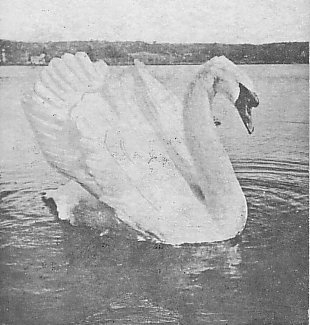
He was described by The New York Times as “one of Huntington’s most famous characters and dearly beloved friends.”[1]  He was “known to every man, woman and child living within a radius of several miles.”[2]  His death in 1906 was mourned by many and plans were soon underway to memorialize him.  His name was Tom.  He was a swan.

The story of Tom the Swan is one of those interesting tidbits of local history that are often forgotten after the last person with a memory of it passes away.  But Tom was so well loved that post cards bearing his image were printed; and these photographic memorials can still be found.  The descendant of one of Tom’s “owners” also remembers being told about Tom and was curious about his current whereabouts, but more on that later.

Tom was originally owned by P.T. Barnum, who had imported a pair of swans presumably for his Happy Family circus exhibit.  The exhibit of various animals living in harmony in the same cage was supposed to inspire humans to live in peace with their fellow man.  Apparently, the animals’ complacency was drug induced.[3]   This Civil War-era exhibit may have been the inspiration for Animal Crackers, which are still sold at circuses.

According to one account, Tom did not follow the script for the Happy Family exhibit.  He became agitated and attacked and killed other animals in the cage. [4] According to another account, one of the pair of swans imported by Barnum soon died and the survivor was given to Dr. John Rhinelander, who had retired to Huntington in the 1830s (his house still stands on Kane Lane in Huntington Bay).[5]  In the second account, there were in fact two pairs of swans.  One of each pair dying shortly after being imported and each of the survivors given to Dr. Rhinelander.

Dr. Rhinelander died before 1864.[6]  If Tom were indeed one of the swans given to Dr. Rhinelander by P.T. Barnum, he would have been at least 43 years old when he died (the story announcing his death conceded that his age was a mystery, but reports that “good authorities state that he was probably between 75 and 100 years of age”).  Swans typically live no more than 20 years, so it is more likely that Tom was the offspring of the pair given to Dr. Rhinelander.

In any event, Tom was well known around Huntington.  He—or his parents—decided that the waters of Huntington Harbor were more inviting than the fresh water ponds on Dr. Rhinelander’s estate.  He and a mate soon built a nest in Thurston’s Cove, the area we now know as Wincoma.  In light of the swans’ preference for that location, Dr. Rhinelander gave the swans to Lewis M. Thurston.  It should be noted that a third account credits Thurston with introducing the swans to Huntington’s waters.[7]

The swans reportedly hatched four to six cygnets each spring, which were sold by Thurston’s sons for as much as $60.  But once the nest was discovered local boys would steal the eggs and the flock dwindled to just the pair.  Tom may have had as many as three mates.  One was reportedly killed on her nest by a dog; another was shot by a group on a steamboat and the third abandoned poor Tom.

By the time Thurston died in 1895, just shy of his 91st birthday, the swans had not been seen since the year before.  It was assumed they had been shot.  But on that day in October 1895, the pair returned to the harbor and resumed their residency in Thurston’s Cove.  Tom’s mate—presumably his third—disappeared soon thereafter.

When Thurston’s property was auctioned off, Tom was purchased by Gustav deKay Townsend.  Although Tom was allowed to remain free, it was thought if he had an owner, his life would not be in danger.  In his old age, Tom did not appreciate the advent of motor boats.  He would fly straight at them flapping his large wings in an attempt to scare them off.

Tom wandered the waters of Long Island alone.  He spent the winter of 1899-1900 in Northport and had been seen as far east as Port Jefferson.  By November 1900, he was back in Huntington Harbor where Warren S. Sammis and Silas Ott made sure to feed him during the cold winter months.

Tom was found dead on the shore of the millpond in February 1906.  The original report did not indicate the cause of death.  Writing nine years later, The New York Times reported that he had been hit by a car.  Whatever the cause of his death, it was immediately suggested that he should be stuffed and placed on display in the library at the Soldiers & Sailors Memorial Building.  Mrs. John Caire was retained to do the work at a cost of $25.  Contributions to defray the expense were accepted at local drug stores.  Within a month $20 had been raised.[8]  Over the summer, the children of the village held a fair on the lawn of Charles N. White’s house on Carver Street.  They raised $5.76.

Two weeks before Christmas, Tom had been stuffed and was on display in a glass case in the library.  Since he stood fully four feet high when out of the water,[9] the library soon found that he took up too much room.  In July 1914, the library gave Tom to the Huntington Historical Society to display in the newly acquired Conklin House Museum.[10]

Even in death Tom remained a popular attraction.  A lengthy New York Times article about visiting Huntington to see sites associated with Nathan Hale thought the trip to Huntington would not complete without a stop to see Tom.[11]

In 2012, a descendant of Lewis Thurston wrote to find out whatever happened to Tom.  He remembered his mother telling him about Tom and how he had been stuffed and put on display in the library, but that he had eventually found his way to the basement of either the library or the Conklin House.  He is in neither place today.  The Huntington Historical Society’s accession records do not include a listing for a stuffed swan.  As popular and well loved as he was, over the years his story was forgotten and some time in the last several decades, it was decided that there was no room for a stuffed swan in the Historical Society’s collection.

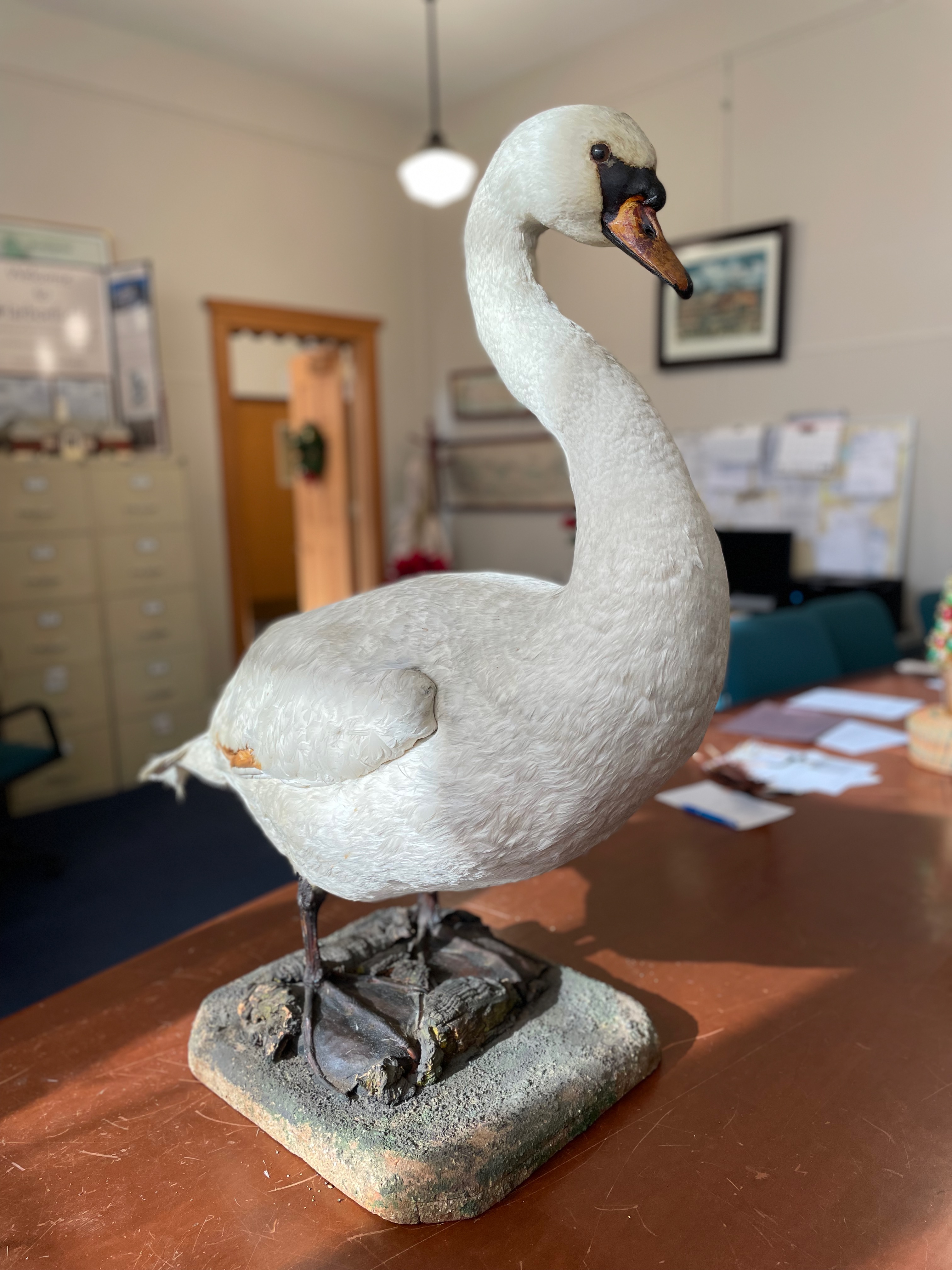
But where did he go? His whereabouts were a mystery until November 2022 when a Greenlawn resident asked Deanne Rathke, the executive director of the Greenlawn-Centerport Historical Association, if she knew about Old Tom.  She did.  The gentleman returned the next day with Tom himself.  He explained that he purchased the taxidermy swan some time between 1969 and 1971 at an auction held by the Huntington Historical Society.

Karen Martin, archivist at the Huntington Historical Society then found the minutes of the Society’s April 22, 1969 Board meeting.  The last item of business at that meeting was approving a list of items to be removed from the collection to be sold at an auction on May 24.  The first item on the list was “Swan.”  Unless the historical society had more than one stuffed swan in its collection, this was undoubtedly Tom. Earlier accounts report that out of the water, Tom stood four feet tall. Perhaps he was stretching his neck–the stuffed Tom stands three feet tall.

On May 15, 1969, The Long-Islander printed an announcement about a Country Auction to be held at the Kissam House on May 24.  “Among the items to be auctioned off are ruby glass, Empire lamps and sofa, old and new china, a picnic table set, and antiques.”  No mention of a swan!

Tom at the offices of the Greenlawn-Centerport Historical Association


[1] The New York Times, August 22, 1915.

[2] The Long-Islander, February 9, 1906

[3] The New York Times, September 21, 1924

[4] The Long-Islander, February 16, 1906

[5] The Long-Islander, February 9, 1906

[6] The New York Times obituary for his wife in the March 16, 1864 refers to the late Dr. Rhinelander.

[7] The Long-Islander, November 16, 1900

[8] The Long-Islander, March 9, 1906

[9] The Long-Islander, November 17, 1938

[10] The Long-Islander, April 9, 1964

[11] The New York Times, August 22, 1915.

Read Full Post »

Seventy years ago, the United States was drawn into a second World War when the Japanese attacked Pearl Harbor.  Although several Huntington men were stationed at Pearl Harbor or elsewhere in Hawaii at the time of the attack, it appears that only one was killed.  John Grubbs Little of Northport was a 1935 graduate from the Naval Academy stationed aboard the USS Utah.[1]

Eric Noeldechen, a Huntington Station resident, was aboard the USS Enterprise.  At the time of the attack, the aircraft carrier was about 215 miles west of Oahu.[2]  Noeldechen went on to see considerable action aboard the Enterprise over the course of the following year.  The ship sank 19 Japanese ships and downed 185 Japanese aircraft.  In 1942, Noeldechen transferred to the submarine service.[3]

Wilfred A. Ruland, Walter Schlossberg, Edgar and Donald Hazleton, Kenneth Babcock, Anthony Fusaro, and Kent Gale were stationed in Hawaii or somewhere else in the Pacific.[4]

On the home front, parents did not hear of the fate of their sons for weeks.  The papers even reported the death of one Hicksville native, who later was reported alive and well.[5]  People were nervous.  Just three days after the Pearl Harbor attack, the air raid alarm sounded in Huntington twice, once at 6:00 a.m. and again at 8:40 a.m.  Residents didn’t know what to make of the alarms and were especially concerned about their children.  School children were instructed to go home when the second alarm sounded, but parents were concerned about sending them back to school after the all clear was given.  The resulting confusion and calls from the merely curious jammed the phone lines preventing officials in charge of civil defense from getting their calls through.  Notices were placed in the newspaper instructing that when the air raid warning sounds, people should avoid the use of the telephone “for curiosity or any purpose except in case of an actual emergency.”[6]

The FBI instructed local police departments to interview all Japanese residents and order them to remain indoors until further notice.  The day after the attack, Lloyd Harbor police picked up two Japanese nationals for failing to abide by the alien registration law.  They were taken to New York later in the day.[7

Residents were asked to bring waste paper to the Defense Paper Depot on Stewart Avenue.  “Worthwhile” books were collected to provide to servicemen overseas.

More than one senior at Huntington High School left school before graduation to enlist.  Peter Campbell was a popular member of the Huntington High School football team who left school in May 1942, just a month before he would have graduated, to enlist in the Marine Corps.  He loved to hunt in the woods around Huntington.  He would often cut school to go hunting.  But he had a gentle side as well that led him to nurse an injured bird back to health and to care for homeless dogs.  He was engaged to get married.  But in November 1943, he was killed while scouting enemy positions on Bougainville Island, a part of Papua New Guinea.

His parents were presented with a Bronze Star Medal for Campbell’s heroic actions.[8]  But they were devastated by their loss.  Two years after he would have graduated, the high school planted an elm tree in his honor during an Arbor Day celebration.  The ceremony on the front lawn of the school included a rendition of the Marine Hymn by the high school band, a recitation of “Creed to My Rifle,” dedication of the tree in Campbell’s honor and the National Anthem.  The principal of the school, Robert L. Simpson, also shared a letter he had received from his former student:

You know I thought I’d be the last one in this wide world to miss the old school.  I guess it’s the company of all the kids I miss most and the football games.  Somehow or other I seem to connect hunting with my school.  I guess that’s because I cut school so much to go hunting.  I can still go hunting, though.  Pretty soon now I’ll be hunting with my buddies, for more dangerous game than I found at home.  It’ll be good hunting, though, and it will have more purpose behind it than just plain sport.  It will be so the people all over the world can keep going to schools like H.H.S. and so that the boys can keep playing football, and so that the girls can have their football heroes.  It will be to preserve our grand old American customs and traditions.  So that there will be lots and lots of kids going to those football games with minds free from fear or oppression.  They will be able to cheer with all their hearts, not because they have to but because something inside of them makes them want to.  Believe me, if I and all the other young Americans have anything to say about it, all these things will remain unchanged in our great country.

I’m not very good at putting down on paper what I feel inside me, but that’s just about how I feel about it, and I guess everyone else in this country feels the same.  We’re going to win this fray just like some of our school songs say.  It will be a big fray but not too big for good Americans to handle.  Good luck to all at home.[9]

 Eventually 3600 Huntingtonians would enlist—127 of them would be killed.


[1] The Northport Observer, November 24, 2011, page 3

[3] The Long-Islander, June 10, 1943, page 1

[4] The Long-Islander, December 11, 1941, page 1

[5] The Long-Islander, January 8, 1942, page 6

[6] 8:30 AMhe Long-Islander, December 11, 1941, page 1

[7] ibid

[8] The Long-Islander, August 3, 1944, page 1

[9] The Long-Islander, May 11, 1944, page 1

Read Full Post »

For Marcel Proust, the taste of a madeleine leads to a remembrance of things past.  Likewise the discovery of some lost object can lead to a rediscovery of the history of a place.  Such an event happened on a recent Saturday morning when members of the Cold Spring Harbor Fire Department and the Huntington Historical Society visited an old farm on Woodbury Road to transport a hundred year old bobsled that was being donated to the historical society.

The bobsled had been stored in the loft of a barn on the property.  The owner recently asked the Cold Spring Harbor Firehouse Museum if they would be interested in it.  Officials at the Firehouse Museum in turn contacted the historical society, which has a small collection of bobsleds.

In the early twentieth century, Huntington hosted a winter carnival, which featured bobsled races.  Bobsleds holding as many as 25 riders would complete to see who could go the furthest and the fastest starting on Lawrence Hill Road near Carley Avenue and down Main Street to as far as the old stone library a block east of New York Avenue.

The bobsled in question was the Huntington and was raced by the McKowen brothers.  It had apparently been placed in the barn after the last Winter Carnival in 1920 and remained there until the current owners decided to restore the barn.  The sled was placed outside while its ultimate destination was determined.  The historical society plans to restore the sled and display it.  The sled is in excellent condition, although missing its runners.  Some of the lettering that spelled out the sled’s name can still be seen.  Restoration will involve replacing the runners (luckily the historical society has some in its collection) and painting the sled white and recreating the lettering.

But what about the place where this sled was kept for the last 90 years?

To start at the beginning: The farm seems to have been developed around the time of the Civil War.  No buildings are shown at that location on the 1858 map of Suffolk County.   The map does show a house on Woodbury Road, about half a mile south of Main Street, owned by S. Rowland.  Smith Rowland was born in 1807.  According to information posted by family history researchers on http://www.ancestry.com, Smith Rowland’s great grandfather immigrated to New York from France.  Smith’s grandfather was born in Commack in 1738.  So Smith was a third generation Huntingtonian.  In 1838, he married Susan Taylor Roe (or Rowe).  They do not appear to have had any children.

In 1849, Smith Rowland was one of a party of four Huntington men who left to seek a fortune in California’s gold fields.  He returned eighteen months later, apparently not having found gold, but in poor health due to a fever contracted in Nicaragua on his way home.[1]

Ten years later, he offered his 15-acre farm on Woodbury Road for sale.  The farm was advertised as having a large two story dwelling, a tenant house, a good barn, cow house, corn crib and other out buildings.  The farm also boasted a young orchard of apples, pears and other fruits.  Moreover, the farm was “within a mile of one of the best schools in this part of the country, and in the immediate vicinity of churches, stores, post office, etc.”[2]

The 1873 atlas locates S. Rowland about three quarters of a mile further south of his location on the 1858 map indicating that he sold the farm as advertised in 1860 and purchased another farm.  According to the agricultural schedule of the 1880 census, Rowland’s farm was now 20 acres, on which he grew grass, buckwheat, Indian corn, rye, wheat, potatoes and apples.  Rowland was also a widower by 1880; his wife died in 1878.  Rowland sold the farm to Charles A. Van Sise in 1882.  Rowland died seven years later.

Although the farm was owned by Van Sise, it continued to be referred to as the Smith Rowland farm into the twentieth century.  For instance an advertisement in 1903 gave notice of an auction of “about 9 acres of standing grass on the Smith Rowland Farm on the Woodbury Road.”[3]  Van Sise died in 1901 and his son Peter inherited the farm.[4]

When John and William McKowen purchased the farm from Peter Van Sise in 1904, it was still referred to as the “Rowland Farm.”[5]  A couple of years later, the McKowen brothers purchased an additional 33 acres adjoining the farm from Mrs. Joel Titus.[6]

The McKowens appear to have been farm hands on various farms in town.  In 1868, they were on the Paulding farm in Lloyd Harbor and before their purchase of the Woodbury Road property, they worked on the Jones farm on Lawrence Hill Road, which is now owned by the Nature Conservancy.

The McKowen Brothers—William and James Edward[7]—operated a dairy on the property and had a milk delivery route serving the Cold Spring Harbor area.  By 1912, their herd numbered 32 cows.[8]   In 1911, three acres were divided from the property for John McKowen to build an “attractive cottage.”[9]

And, of course, the McKowen brothers entered their bobsled Huntington in the Huntington’s annual winter carnival as well as races in Oyster Bay.

William died in October 1950.  Just three months later, five men broke into the house and tied up 73-year-old brother Henry, 70-year-old Mary Elizabeth and a 53-year-old farmhand.   The gunmen cut the telephone wires and entered the house at around 6:45 on a Tuesday evening.  With their guns drawn and threatening bodily harm, they demanded money.  The occupants of the house refused to cooperate and they were tied up while the gunmen searched the house.  They eventually left with $200 in cash and silver.  The McKowen’s and the farmhand were rescued three hours later when brother Edward came to the house. [10]

Henry died less than two years later.[11]  Mary Elizabeth died three years after her brother.[12]  She left the bulk of her estate (after a $50 bequest to a niece) to the Central Presbyterian Church and Huntington Hospital.[13]

The property was subdivided in 1957 as “Woodbury Knolls” consisting of about 45 acres from Woodbury Road to Woodchuck Hollow Road.  A new street—Snowball Drive—was laid out through the property to join Woodbury and Woodchuck Hollow.

The family that donated the bobsled acquired the lot with the old farmhouse and barns in 1960.  They have recently acquired the lot to the south on the corner of Woodbury Road and Snowball Drive as well as the three-acre lot on which John McKowen built his home in 1911.


[1] The Long-Islander, November 29, 1850, page 2.

[2] The Long-Islander, December 7, 1860, page 4.

[3] The Long-Islander, July 3, 1903, page 2.  Similar notices appear in 1889 and 1901.

[4] The Long-Islander, February 15, 1901 and March 15, 1901.

[5] The Long-Islander, March 11, 1904

[6] The Long-Islander, January 5, 1906.  Pending a deed search, it is unclear if the purchasers were the brothers or their father.

[7] He seems to have gone by the name Edward rather than James.  He lived at 130 Soundview Avenue rather than on the farm.

[8] The Long-Islander, April 12, 1912

[9] The Long-Islander, August 4, 1911

[10] The Long-Islander, January 25, 1951

[11] The Long-Islander, November 20, 1952.

[12] The Long-Islander, November 24, 1955.

[13] The Long-Islander, June 14, 1956

Read Full Post »

Bells of Huntington

These days, many people carry a smart phone that gives them a private reminder of appointments and errands.  But before the advent of such devices, before the advent of wristwatches, and even before the mass production of affordable clocks, bells provided public reminders and alerts.

Huntington has had several notable bells intended to be heard far and wide.  The first was the bell procured to summon the faithful every Sunday morning to Old First Church.  The Town’s second church building was erected in 1715 on the site of the current Old First Church on Main Street across from Town Hall.  A small bell was soon acquired from England.

During the American Revolution, when Huntington was occupied by the British army, the bell was removed by the British troops.  Huntingtonian Zebulon Platt was a prisoner on the ship Swan in late 1777 and later reported having seen Huntington’s bell on that ship.  Nathaniel Williams arranged to retrieve the bell and in 1793, the bell was recast to include the motto “The Town Endures.”

While the bell was missing, the British had razed the church and used the timbers to build a fort in the Old Burying Ground.  The bell returned to service in the current church, which was built in 1784, and continued in use until the 1960s.  It is now on display in the church lobby.

About the time that the church bell was being restored, the Huntington Academy was built across the street.  The new schoolhouse included a tower for a school bell.  The Academy was replaced in 1858 by the Union School.  Since a new school needs a new bell, the small bell from the academy was retired.  It soon found a new use as a fire bell behind the firehouse on Wall Street.

Fast forward fifty years.  In 1909, the Union School was torn down to makee way for a new state-of-the-art brick high school (today’s Town Hall).   This new construction gave rise to some nostalgia: a committee was formed to create a display in the new building commemorating the old Academy.  The committee decided to hang a picture of the Academy in the new building and it was thought that the old Academy bell would be a terrific addition to the display.  The committee asked the fire department if they would part with the bell.

The old Academy bell had proved inadequate to alert fire fighters when they were needed—it could not be heard outside the heart of the village—and had been relegated to calling members to meetings.   The fire department, therefore, did not object to returning the bell.  The department decided to inscribe the bell with the years it served as a fire bell as well as the years it called children to the old Academy.  Newspaper reports in the 1950s indicate that the bell was on display in the high school building on Main Street.  But its current whereabouts are unknown.

The fire department had decided in 1898 to replace the old school bell with a bell loud enough to “awaken the soundest sleeper living within a mile radius of the village.”  The new 730-pound bell was hung in a new tower behind the Wall Street firehouse.

When the fire department moved to its new building on Main Street in 1911, a modern electric siren was installed.  It was later suggested that the 730-pound bell acquired in 1898 be used for brush fires and the electric siren for building fires.  With the advent of suburbia, the number of brush fires decreased.  The department decided to use the bell as a memorial.  On Memorial Day 1951, the fire department dedicated the new memorial to its members who had died in World War II.  Placed outside the Soldiers & Sailors Memorial Building, which at that time was the home of the Huntington Library, the bell was topped with a spread wing eagle that has since disappeared.

The bell used for fifty years in the Union School (1858-1909), can now be seen in the lobby of the current high school building on Oakwood Road.  When the Union School was torn down in 1909, its bell was moved to a school in Huntington Station.  It soon found its way into storage, however.  From 1967 to 1985, it was located in the courtyard of what is now the Jack Abrams School.  It then was moved to Woodhull School as part of the school district Heritage Museum organized by Jack Abrams.  Since 2004, the bell has been on display in the high school lobby.

Having three of the town’s oldest public bells is impressive.  But if only we could find the missing bell from the Huntington Academy.

Read Full Post »

People complain that Huntington is getting too crowded.  There’s too much congestion, too much traffic, not enough open space, we’re losing our small town character.  But how accurate are these sentiments?  With the release of the 2010 census records, we see that Huntington is, in fact, more crowded than ever.  But is it that much worse than it was 10 or 20 years ago?

A look at the numbers is illuminating:

Year

Population

Increase

% Increase

1900

9,483

2,521

26.58%

1910

12,004

1,889

15.74%

1920

13,893

11,689

84.14%

1930

25,582

6,186

24.18%

1940

31,768

15,738

49.54%

1950

47,506

78,715

165.69%

1960

126,221

73,265

58.05%

1970

199,486

2,026

1.02%

1980

201,512

-10,038

-4.98%

1990

191,474

3,815

1.99%

2000

195,289

7,975

4.08%

2010

203,264

Throughout the nineteenth century the town’s population grew a pretty steady rate of about 15% per decade.  But in the twentieth century things started to take off.  IN fact, most people associated suburbanization with the 1950s.  But with the advent of direct train service to Manhattan in 1910, commuting from Huntington became possible.  It took a few years, but between1910 and 1930, the town’s population doubled.  The growth continued even through the Depression years of the 1930s.

Of course, public perception about the 1950s is accurate.  With a 165% growth in population, Huntington was no longer a small country town.  In absolute numbers, the town’s population grew almost as much in the 1960s.  The increase in population between 1950 and 1970 was three times the town’s total population in 1950.

But contrary to population complaints, Huntington essentially reached its present population levels forty years ago.  But you would hard pressed to find many who do not think Huntington is more crowded today than it was in 1970.  The net population growth from 1970 to 2010 was only 3,778, or less than 2%.

Of course, the difference is that the average household size has fallen.  There are more homes today than there were forty years ago.  But now there are fewer persons in each of those homes.  In 1967, the average number of people per household in Suffolk County was 3.74.  Today it is 2.93.

So yes, it feels more crowded, but it really isn’t.

Read Full Post »

The Town House

The Huntington Town House catering hall, which was demolished the week of July 4, 2011, originated as roadside restaurant in 1937 and over the years grew to one of the largest catering facilities in the country.

The story of the Town House begins with Leo Gerard.  Leo’s father, William B. Gerard, operated three luxury hotels in Cold Spring Harbor in the late nineteenth century.  Leo continued the family’s success in the hospitality industry.

Leo was born in 1892 and served in the army during World War I.  In 1922 he married and began his own career in the restaurant business with the Gerard Inn on Park Avenue in Huntington.  In 1927 he was named steward of the Huntington Yacht Club, where among other things he was in charge of the dining room.  Starting in 1930, he would spend his winters operating the Hunter Arms Hotel in St. Cloud, Florida.

In 1932, he leased a restaurant overlooking the water in Cold Spring Harbor under the name The Oyster Bar.  It was later also known as Ye Olde Tavern Inn, but mostly was referred to as Leo Gerard’s.  In 1933, he also resumed his duties as steward at the yacht club.  Two years later he expanded his Cold Spring Harbor restaurant, but he still had to turn patrons away.

That same year, Alfred Bruns, the founder of the Liberty Can and Sign Co. of Brooklyn died.  Bruns had a large house on a wooded five acre estate on the south side of Jericho Turnpike, just east of the Huntington-Amityville Road (Route 110).  The house boasted an immense dining room that could seat over 100 people, as well as a large number of bedrooms.  Gerard purchased the estate in March 1937 and began making plans to relocate his restaurant to this larger building.

Leo Gerard’s new restaurant opened just three months later.  The Long-Islander predicted that “in view of Leo Gerard’s fine reputation, business in his new place will no doubt grow very fast.”  That prediction turned out to be correct.  Within a year, two additions were built and a third was being constructed.

In 1957, Gerard, now 65 years old, sold the restaurant to Thomas Manno, a New York caterer.  Manno converted the restaurant to strictly a catering facility for private parties—one of the first such establishments on Long Island—and named it the Huntington Town House.  Manno planned to refurbish the building (including the installation of air conditioning) and re-landscape the grounds.  By the end of the year, the Town House was advertising the picturesque country club atmosphere as the perfect place for wedding receptions.  Manno attracted clients from Brooklyn in the west to Riverhead in the east and hoped to cash in on the surge in weddings by war babies.

The Town House featured three ballrooms, each with its own kitchen and bandstand.  Dressing rooms for bides were located on the second floor and there was no bar, which reportedly pleased church groups looking to hold events there.  Within a couple of years, the Town House was hosting between 12 to 22 banquets a week and was being expanded with the addition of two new rooms that would increase the seating capacity from 900 to 1500 persons.   By 1972, the Town House had expanded to 11 rooms; and by 2000 it boasted 100,000 square feet of banquet space, 48,000 square feet for offices, kitchens and other support functions and parking for 2000 cars on a 20 acre site.

Rhona Silver purchased the Town House in 1997 from Thomas Manno’s estate for $7.6 million.  Silver hoped to transform the catering facility into a conference center with a 244 room hotel and 58,000 square feet of space dedicated to conferences.  Those plans were never realized.  Instead, in 2007 Silver sold the property to Lowe’s Corporation, which is in the process of constructing one of its home improvement stores on the site.

Read Full Post »

Only a hand full of buildings survived the Urban renewal initiative that devasted Huntington Station in the 1960s and 70s.  Now with the demise of the former auto repair shop at 1000 New York Avenue, there is one less.  Right next door to the now gone auto repair shop stands a surviror with a long standing conection to Huntington’s African American community.

The story begins in 1906 when Louis M. Brush filed a subdivision map for a large tract of land on the east side of New York Avenue, south of Olive Street.  The subdivision of 337 lots was known as Highland Park.  The subject property, 1006 New York Avenue, comprises lots 31 and 32 of the subdivision.

On August 23, 1909, Brush conveyed the property to Charles W. Fox (Liber 708, page 563).  Less than two weeks later, Fox conveyed the property to Emma Paulding pending payment of a $2,000 loan due in three years at an interest rate of 6%. (Mortgage Liber 346, page 124).  Under the terms of the transaction, Fox was obligated to insure the buildings on the property, indicating that buildings existing in 1909.  Although the 1909 atlas does not show any buildings, an item in The Long-Islander edition of October 2, 1908 indicates that Mr. & Mrs. Jurgensmaier had broken ground on a new residence in Highland Park.  The 1917 atlas identifies the owner of the property to the south of the subject property as Jurgensmaier.  The reference in the mortgage and the development of the adjoining property point to a construction date of about 1909 for the subject premises.

Over the next decade, the property changed hands several time among the children of builder George W. Fox[1].  Charles Fox sold the property to Elizabeth B. Gardiner (The Long-Islander, February 25, 1910, page 5).  She then sold the property to Oscar W. Fox (The Long-Islander, March 24, 1911, page 5), who then transferred it back to her (The Long-Islander, October 18, 1912, page 5).  Finally, she transferred it back to Oscar W. Fox one last time (The Long-Islander, March 17, 1916, page 4).  Interestingly, these transfers were all reported in The Long-Islander, but not found in the County Clerk’s records during a title search.

The property left the family in 1917 when Oscar sold the property to Cecelia Kehoe.  (The Long-Islander, January 26, 1917, page 4).  Apparently, George Fox had given the purchasers a loan to purchase the property and they defaulted on it because notice of foreclosure and sale of the property was printed in The Long-Islander on December 7, 1917, page 9.  However, it appears that the original mortgage from Emma Paulding had never been satisfied.  An action between Emma Paulding and members of the Fox family resulted in a judgment for Paulding in the amount of $2,532.36 on October 11, 1918 and the transfer of ownership of the property to George Fox (Liber 965, page 477).

George Fox then sold the property to Charles H. Ballton on April 19, 1920 (Liber 997, page 366).  The deed refers to a $2,000 mortgage, but the earlier mortgage had been discharged and no record of a mortgage given by Charles Ballton was found in the County Court records.  Charles H. Ballton was the son of the famous Greenlawn entrepreneur and farmer Samuel Ballton, known as the Pickle King.  Charles Ballton owned a moving and trucking company and also engaged in the sale of sand and gravel and refuse removal.  (Advertisement in The Long-Islander, September 11, 1925, page 17).

Less than two years later Ballton conveyed the property to the Crispus Attucks Lodge No. 9055 of the Grand United Order of Odd Fellows (John H. Plummer, George Allen and Charles H. Ballton, trustees) for $3,200 (Liber 1033, page 595).  The Grand United Order of Odd Fellows was a fraternal organization first chartered in this country in 1843 when a lodge in Philadelphia was established with a charter from the Grand Lodge in Manchester, England.  In this country, African American Odd Fellow lodges were generally associated with the Grand United O rder, whereas white lodges were affiliated with the Independent Order.  The Huntington lodge was established in 1913 with 30 members (The Long-Islander, August 22, 1913, page 4).  It was named for the African American who was one of the five people killed in the Boston Massacre in 1770.

According to Richard Robertson, the nephew of Charles Ballton, the building was known as Odd Fellows Hall.  The Odd Fellows met upstairs (the Elks Club met there as well).  Downstairs was an apartment in which Mr. Robertson’s aunt Maude Smith lived.  Maude Smith was the granddaughter of Benjamin Ballton, who was Charles Ballton’s brother.

According to Mr. Robertson, the Odd Fellows was made up of brick masons from the south.  The only young members were a man named Shakespeare and George and Willy King, who owned the biggest black construction company in Huntington.

Maude Smith moved out of the building in the mid-1930s.  After she moved out, two of Benjamin Ballton’s sisters operated a restaurant there, serving what would now be called soul food.  Mr. Robertson said that after the end of the World War II the Odd Fellows started meeting at Rosetta Hall on Church Street, which was behind the firehouse and also owned by Charles Ballton.  Mr. Robertson thought the upstairs of the subject property remained vacant for a long time after the Odd Fellows moved to Rosetta Hall.  This recollection coincides with the sale of the property by the Odd Fellows in January 1945 to Max and Clara Herman for $3,875.  (Liber 2419, page 139).

Max Herman was a kosher butcher, who had a shop two doors down from the subject property.  He was in town by 1924 when he advertised in The Long-Islander (May 23, 1924, page 4) (“If you have chickens for sale, communicate with Max Herman, Butcher”).  According to Adele Kalstein, whose parents operated a grocery store in the same building as Herman’s butcher shop, Herman was an exclusively kosher butcher and attracted customers from a wide area.  Next door to the north was the butcher shop of Samuel Levy, who arrived in town as early as 1917 (The Long-Islander, January 12, 1917, page 6 and April 6, 1917, page 6).  However, Levy sold both kosher and non-kosher meats and, therefore, did not attract as many kosher customers.

Herman apparently owned the subject property as an investment.  It is believed that the storefront has been used as a barbershop since the 1940s.  Mr. Herman died on February 7, 1965 (The New York Times, February 10, 1965, Obituary section).  Later that year, Sam Raskin, as executor of Herman’s estate, sold the property to Brun-Wal Corp. of 780 New York Avenue (Liber 5764, page 1574).  The corporation conveyed the property to James F. Straub in 1970 (Liber 6860, page 301).  The current owner, Rehab Investors, acquired the property in 1979 (Liber 8670, page 7).

ADDENDUM:  Odd Fellows Hall was demolished in the Fall of 2018 as part of Renaissance Downtowns’ Gateway Plaza Project.  See http://renaissancedowntowns.com/projects/huntington-station/


[1] George W. Fox had six children, Chauncey, Harry, Charles, Oscar, Lillian and Elizabeth. (The Long-Islander, October 31, 1924, page 8).  Elizabeth is identified as Elizabeth Romano in an item in The Long-Islander, November 30, 1923, page 8 and a year later as Elizabeth Gardiner, The Long-Islander December 5, 1924, page 18.

Read Full Post »

From Humble Beginnings

A typical Long Island three quarter house sits behind two early 1960s high ranches on the east side of West Neck Road about a quarter of a mile north of Huntington village.  The house provides a glimpse into the humble nineteenth century background of one of the leading Long-Islanders of the twentieth century.

Although no early deeds have been located, Joseph Warren Conklin and his wife Rebecca appear to be the original owners of the house.  When one of their daughters died in 1901, her obituary noted that she had lived in the house since her birth in 1850[1].  Her parents married in 1835 and their first child was born in 1836.[2] It is likely the house was built at about the time they married and started a family.

A construction date in the 1830s or 40s is consistent with the physical evidence.  All of the details of the house point directly to the Greek Revival Style in the second quarter of the 19th Century, including: a braced, pegged frame of sawn spruce, no ridge pole, a brick/stone foundation, side hallway, front entrance entablature with glazed sidelights, frieze (“lay on your belly”) windows over 6/6 windows, porch with square columns, a small rectangular chimney set crosswise to the roof ridge and a debased fireplace mantle.

The rear kitchen service wing is unusual for Long Island, where the service wing was usually placed on the side hallway end of the house during the Federal/Greek Revival Period (1790-1850).

Of the Conklin’s eight children, two died in childhood.  The only deed found in the Suffolk County Clerk’s records under Joseph Warren Conklin’s name is for a 14½ acre triangular parcel on the west side of West Neck Road, which he acquired in 1841.[3] Warren Conklin was a farmer, who in addition to his home lot and the parcel on the west side of the road, also owned 10 acres on the east side of Oakwood Road and 20 acres on the east side of Woodbury Road about three quarters of a mile south of Main Street.

Unfortunately, Warren Conklin died in 1854[4] at the age of 45 leaving behind seven children ranging from 1 to 18 years of age.  A mortgage he had taken out in 1841 and secured by the property on the west side of West Neck Road was foreclosed the following year.[5] His widow advertised the lots on Oakwood and Woodbury Roads for sale at auction a year after his death.[6]

It must have been difficult for his widow to raise seven children on her own—one died three years after Warren at age 10 and another died in 1866 at age 22.  Rebecca Conklin borrowed $700 from George Carll of Dix Hills in 1866 at 7% interest secured by the nine-acre homestead.  The following year the mortgage was released in part to allow for the development of houses along what is now known as Mechanics Street.[7] The Long-Islander noted the new development:  “We learn that several of our mechanics have made arrangements to purchase lots on a new street to be opened near the residence of Mrs. Rebecca Conklin on the North Bowery.  The locality to be known as Mechanicsville.”[8] The entire mortgage was cancelled later that year.[9]

In 1871, Rebecca Conklin again mortgaged her homestead, this time giving a mortgage to Mary P. Baldwin to secure a $500 loan for a three-year term at 7% interest.  Rebecca Conklin, who had been a founding member of the Central Presbyterian Church, died in 1880.  At the time of her death, her only personal property was a cow, which was sold for $40 to cover her funeral expenses.  She left debts of $613.56 for doctor’s bills, notes and merchandise from various local stores.[10] Her family sold at auction three building lots from the homestead property as well as five acres of woodland on the ridge between New York Avenue and Oakwood Road south of the village, which may be what was left of the ten acre plot Warren Conklin left.  The sale of these properties yielded $890.  It appears that the 1871 loan from Mary Baldwin—which was secured by a mortgage on the homestead—was still not paid off at the time Rebecca Conklin died.  The property was purchased at auction by Mary, Henrietta and Juliette Conklin for $697.28 a year after their mother died.[11]

The three sisters continued to live in the house for the rest of their lives.  Henrietta, who was sickly her entire life, died in 1901.  Apparently, money was still an issue for the family.  Henrietta’s two sisters placed a notice in The Long-Islander thanking “the many kind friends who so generously assisted in defraying the expenses attending the funeral of our sister.”[12]

As early as 1880, Mary advertised her services as a dressmaker.[13] Juliette also engaged in dressmaking and millinery.  To accommodate their business the room in the northeast corner of the house was enlarged.  They also continued to sell building lots along Mechanic Street.  In 1905, the remaining  property was surveyed and divided into 10 lots including the lot with the family home.

Juliette died in 1914 and Mary died in 1916.  The lot with the house, now about an acre and a half, was sold in 1920 to Paul Williamson.[14] The property had a series of owners until the current owners purchased it in 1979.  In 1961, two lots were created from the front yard of the property; thereby obscuring it from view.

One of the leading figures of twentieth century Long Island—if not the nation—traced his family tree to these humble beginnings.    Rebecca and Warren’s son Alonzo had five children, one of whom was Grace Ethel Conklin.  Grace married George Tyson Grumman.  George and Grace Grumman’s son LeRoy graduated from Huntington High School in 1911, served in World War I and after the war established the aerospace company that bore his family’s name.  The Grumman name became synonymous on Long Island with fighter jets and space exploration.


[1] The Long-Islander, January 18, 1901, page 3.

[2] Conklin Family Genealogy on file in the archives of the Huntington Historical Society.

[3] Suffolk County Clerk’s Office Deed Liber 35, page 10.

[4] He was the seventh person to be buried in the Huntington Rural Cemetery.

[5] Suffolk County Clerk’s Office Deed Liber 87, page 504.  He had purchased the land from Brewster Conklin and given the mortgage to Erastus Conklin.  Erastus Conklin died and his executors included Platt Conklin, Warren’s father, and Brewster Conklin.  The foreclosed land was purchased at auction by David W. Conklin.

[6] The Long-Islander, March 2, 1855, page 3.

[7] Suffolk County Clerk’s Office Deed Liber 144, page 227

[8] The Long-Islander, April 12, 1867

[9] Suffolk County Clerk’s Office Mortgage Liber 84, page 595

[10] Suffolk County Surrogate’s Court File.

[11] Suffolk County Clerk’s Office Deed Liber 256, page 242

[12] The Long-Islander, February 15, 1901

[13] The Long-Islander, May 7, 1880, page 3

[14] Suffolk County Clerk’s Office Deed Liber 1030, page 449

Read Full Post »

By Any Other Name

In October 1870, Evelyn Ketcham wrote a letter to her brother George to invite him to her upcoming marriage to Sydney Buffett.  Sydney was from an old Huntington family, but had moved to Nebraska a year earlier to seek his fortune.  Their great, great grandson would eventually become the world’s richest man, but that’s another story.  What’s intriguing is Evelyn’s postscript:  “They have changed the name of Dix Hills.  The name is Elwood now.”

The name Dix Hills—originally Dick’s Hills, named for Dick Pechegan—was given to the area on both sides of Jericho Turnpike.  The area north of the Turnpike was known as North or Upper Dix Hills.  On June 7, 1870, a post office was established in North Dix Hills under the name Elwood (the office was discontinued on October 31, 1902).  A notice in the February 10, 1871 edition of The Long-Islander advised that the Postmaster General had ordered the Dix Hills Post Office discontinued and all letters and papers transferred to the Elwood Post Office.

Where the name came from is a mystery.  Anna Singer, writing in The Long-Islander¸ speculated that the name was derived from Elkanah Wood, whose family owned a good deal of land in the area (The Long-Islander, May 23, 1974).  The name Wood cannot be found in the Elwood area on the 1873 atlas and, although there was indeed an Elkanah Wood, he wasn’t born until 1871, a year after the post office was established.

Around the same time that “they” were changing the name of North Dix Hills, the residents of the area we know as East Northport were debating what to call their hamlet.  Unlike the situation in Elwood, the residents were not subject to the dictates of the Postmaster General because they did not yet have their own post office.  Instead the residents of what was then known as Claypitts—for the plentiful deposits of clay to be found there—met in the local schoolhouse to discuss changing their hamlet’s name.  Fourteen names were suggested, but the top contenders were Delmont and Fairview.  The vote was reported in The Long-Islander on January 27, 1870 in verse:

The name “Clay Pitts” we bid adieu

For we have elected the name “Fairview;”

And that by a large majority, too,

Over the names some had in view!

But apparently not all were happy with the new name.  A group of residents put forward the name Genola, which was considered by some to be the efforts of a minority to impose its will on the majority who had openly and fairly voted for Fairview.  That name lives on in the place where the community buries its dead—Genola Rural Cemtery.

Residents’ wishes would soon be subjected to outside influences.  This time, it would be the arrival of the Long Island Rail Road.  The Rail Road terminated at Northport in 1867.  But plans were soon formulated to extend the line to Port Jefferson.  It was decided to follow an easterly route from the Greenlawn station, rather than extend the line from Northport.  When the line opened in 1872, trains stopped at a new station south and slightly east of the Northport station.  Although the station is officially known as the Northport station, the area around it became known, at least unofficially, as East Northport (probably because the more geographically accurate South Northport would be too silly a name).

The post office, however, decided on still another name.  In 1896, it opened the Larkfield Post Office.  The name Larkfield was apparently in honor of the meadowlarks that could be found on the open fields of the area.  According to East Northport, An Incomplete History, in 1909, residents circulated a petition to change the name of the post office to East Northport.  And thus the name became official.

But still there was dissention. In 1952, the East Northport Board of Trade announced an effort to revert to the name Larkfield.  The Board of Trade claimed that mail destined for East Northport often found its way to Eastport or Northport.  Moreover, the growing community should have an identity independent from the village to the north.  The effort was renewed in the 1960s, but the geographically inaccurate name persists.

Another hamlet of Huntington has had the same name for centuries, but how it is spelled and pronounced has changed.  Once known as Whitman’s Hollow, the name Commack comes from the Indian name “winnecomac” meaning “pleasant land.”  Originally the name was spelled Comac and the historic pronunciation rhymes with the word “comic.”  Now most residents pronounce the name Co-mack, with the emphasis on the first syllable.

The change in pronunciation has been attributed by some to the rapid growth of the area in the 1950s and city radio announcers’ unfamiliarity with the traditional pronunciation.  However, the earlier spelling of Comac seems to support the “modern” or outsider’s pronunciation.  Whereas the modern spelling Commack should be pronounced Com-mack with the emphasis on the second syllable—not exactly the same as “comic,” but closer than Co-mac.

But the change of spelling occurred much earlier than the suburb boom of the mid-twentieth century.  In fact, the Commack spelling appears in the Brooklyn Eagle as early as 1868.  In The Long-Islander, Commack appears as early as 1891; and the last time Comac appears is 1894.  Therefore, locally it would seem the change in spelling was made in the 1890s.  And it would seem reasonable to assume that the “modern” pronunciation was being used as early as the 1890s—if not earlier.

It is unclear why the modern pronunciation seems to follow the old spelling of the name and why the change in spelling did not reinforce the traditional pronunciation.

These are but three examples in the Town of Huntington of the sometimes fleeting nature of place names.  We tend to think that places are given names and that those names stick.  But ask the residents of Fairground, Oldfields, Cow Harbor, Horse Neck, Fresh Ponds, and Sweet Hollow about the permanence of place names.

But a community by any other name . . .

Read Full Post »

« Newer Posts - Older Posts »