Feeds:
Posts
Comments

Posts Tagged ‘August Heckscher’

A century ago, a thirst for water led to the formation of the village of Huntington Bay in the East Neck section of Huntington.

In 1923, residents of East Neck joined with other Huntingtonians to petition for a municipal water district covering the territory from Huntington Bay to Jericho Turnpike.  Seemingly having second thoughts about the expense of a water district in which they would probably bear the greatest financial burden, a second petition was circulated among the wealthy residents of East Neck to incorporate the area as a separate village.  This was necessarily a novel concept.  Twelve years earlier residents angered by the condition of roads in the area, the lack of street lights, and the need for better water supply met to discuss incorporation.  They pointed out that only about 10% of the money paid Huntington Bay residents for highways was spent in their area.  East Shore Road in front of St Andrews by the Sea chapel was so flooded that boys would sail boats on it.  However, after meeting with the Town Supervisor and Superintendent of Highways, where complaints about the condition of area roads dominated, the residents were mollified. (Brooklyn Eagle, September 23, 192, page 10; The Long-Islander, September 27 and October 4, 1912).

Under State law, a municipal water district could not include a separate municipality within its borders.  The incorporation petition, signed by 36 residents, was filed before the petition for the new water district.  A vote on incorporation was held on February 4, 1924 and was approved 29-10. Subsequent village elections typically attracted only about two dozen voters.

The first meeting of the Board of Trustees of the new village was held on March 12 at the Transportation Club in Manhattan.  William J. Taylor was elected president; and George Adamson and Mansfield Snevily were elected trustees. 

The first ordinance, covering streets and roads, motor vehicle, sewage, swimming and bathing, and landing of boats was adopted on April 1.  Most village functions focused on improving roads.  In the first year, sixty percent of the village budget was dedicated to road maintenance and improvement. Within just two years, the village also saw the subdivision of its two large estates into residential neighborhoods with a more suburban layout, Wincoma and Bay Hills.

Early meetings of the trustees of the Incorporated Village of Huntington Bay were held in Manhattan because many of the trustees and villagers had their primary residence in Manhattan or Brooklyn.  Still, they recognized a need for a Village Hall.  In June 1925, the trustees agreed to purchase land from the Halesite Company for that purpose.  The new Village Hall, described by the Brooklyn Daily Eagle as “one of the prettiest little municipal buildings in one of the smallest incorporated villages in the State,” opened in the summer of 1926.

The new village included several distinct tracts of land that had been farmland, then became estates for city residents and finally were subdivided into the neighborhoods we know today.  Through the centuries, these distinct tracts have remained easily identifiable.  Below is a brief history of those tracts.

Bay Crest

Willett Bronson, the son of a wealthy doctor, was East Neck’s first land speculator.  For generations, land in East Neck had been farmed by early Huntington families.  Later wealthy New Yorkers, looking to escape the calamities of city life, purchased large tracts to serve as their country homesteads.  When Bronson purchased the sixty acres that would become known as Bay Crest, it is unclear if he intended to use the land as a summer retreat or if he intended to subdivide it into “villa lots” where wealthy New Yorkers could erect summer cottages, which is what he eventually did.

Bay Crest was not Bronson’s first foray into real estate development.  Bronson was born in Hudson, NY in 1840.  His grandfather, Isaac Bronson, served as a surgeon during the American Revolution.  After the war he gave up the practice of medicine and along with his son Arthur founded the New York Life Insurance and Trust Company, which pioneered the use of life insurance and in 1822 merged with the Bank of New York, and Ohio Life Insurance and Trust Company, the collapse of which led to the Panic of 1857.  Isaac Bronson became one of the wealthiest men in New York City and purchased vast tracts of land in several states. 

Willett Bronson served in Company F of the New York 7th Infantry Regiment during the Civil War.  After the war, he studied law, but it is unclear if he pursued a legal career.  When his father died in 1875, Bronson inherited a large fortune.  Using his inherited wealth, he soon became engaged in real estate speculation in Manhattan. 

Bronson had a home in Huntington village by 1877.  The home on New York Avenue was considered one of the showplaces of the village.[i]  By 1880, Bronson was offering building lots on land between New York Avenue and Nassau Road along a new road known as Hudson Avenue.[ii]  Although it appears that the new road was laid out and fences erected along its sides, today there is no Hudson Avenue running between New York Avenue and Nassau Road; nor does it appear on any of the early maps.  Earlier the property had been owned by Stephen C. Rogers and by 1891, it was described as being “lately owned by Willet Bronson.”[iii]  In 1894, it was sold to Mary Cantrell,[iv] whose son in 1910 subdivided the property under the name Villa View Heights—the area surrounding Central Parkway.

In 1882, Bronson purchased sixty acres between Bay Avenue and Huntington Bay from former Congressman William Roberts.[v]  Unfortunately, soon after he purchased the land, the 45-year-old house on the property burned to the ground.  But he quickly rebuilt. [vi]

Bronson’s misfortune soon extended to his Manhattan real estate holdings.  Bronson had borrowed heavily to develop his holdings.  He also made building loans to developers building on speculation without knowing enough about the business himself.  In 1883, he and the builder with whom he worked to develop properties on the East Side had a falling out.  Bronson was unable to cover the payments on the money he had borrowed and by December had to make assignments for the benefit of his creditors. Poor management and bad advice were blamed. He had invested a million dollars, and after some initial success, it was claimed that he got in over his head.[vii]

How, or if, his misfortune in Manhattan real estate effected his Huntington holdings is unknown.  Perhaps he had purchased the land in East Neck as a country seat as so many wealthy New Yorkers before him had done.  There is certainly enough evidence that Bronson had strong connections to Huntington.  He was actively involved with St John’s Church, serving as a vestryman and hosting fund raising teas at his East Neck property.  In both the 1880 and 1900 censuses he is enumerated as living in Huntington.  Finally, perhaps the best evidence of his intention to make Huntington his home rather than just a place to invest is the fact that both he and his wife are buried at Huntington Rural Cemetery.

Whatever his original intentions were, just a month after assigning his Manhattan properties, Bronson hired local surveyor Oscar Darling to prepare a plan dividing the East Neck property into building lots.[viii]  The result was a plan for 11 building lots from 3 to 6 acres each and 11 small beach lots.  In October 1886, it was announced that three men from New Jersey would be purchasing a considerable portion of the Bronson property.[ix]  James B. Dill purchased two building lots and two beach lots on the west side of Beach Avenue.  Albert W. Palmer purchased the building lot on the east side of Beach Avenue and his father, also Albert, purchased the adjoining lot to the east.  The Palmers also purchased the two eastern most beach lots.[x] Three months later, Albert Palmer purchased the 90-acre Moses Jarvis farm.[xi]

Dill and the Palmers were neighbors in East Orange, NJ, and their wives were sisters.  When he purchased property in Bay Crest, Dill was a young lawyer just starting to concentrate on corporate law.  He later would write the New Jersey’s Corporation law and establish the Corporation Trust Company, which profited from the new law.  In 1905, he was appointed as a judge on New Jersey’s highest court. 

Albert W. Palmer was the head of Albert Palmer & Co, a publishing firm that printed trade publications.  He had assumed control of the company when his father retired in 1883.  Palmer and Dill were both in their early thirties when they came to Huntington.  Dill had rented a house on Fairview Street the summer before his big purchase.  The sale was hailed as “some of the most important transactions that have taken place in this town for some time.”[xii]  The purchasers promised to erect houses costing not less than $6,000 by the end of the next summer.  And, in fact, by the following February construction had begun.  It was anticipated that the construction would mark a new era in Huntington “and that the ‘boom’ will not stop until every one of the beautiful hills about the village are crowned with scores of handsome residences.”[xiii]

Dill and Palmer also planned to build a club house with hotel accommodations for 40 to 50 guests.  They planned to subdivide the Moses Jarvis property into villa plots.[xiv] 

The year after the sale to Dill and Palmer, Bronson subdivided his remaining property into 22 smaller lots and named his subdivision “Bay Crest.”[xv]  He retained about 15 acres in the southwest corner of the property for himself.  But in 1896, this piece too was further divided into 24 lots.[xvi]  Bronson continued to spend summers in Huntington and sold off additional lots.  He also rented furnished cottages for the summer season.  In 1901, a ten-room cottage with all the modern conveniences, an unsurpassed view and private beach and bathing house rented for $400 for the season (about $15,000 in 2024 dollars).

The Huntington Company & Hale Site

A little over a year after Dill and Palmer purchased lots in Bay Crest as individuals, a new company was formed to make substantially larger purchases.  The Huntington Company was incorporated in February 1888 “to lay out and subdivide lands into building lots and villa plots, to improve and sell the same and erect buildings thereon.”[xvii]   Dill was one of the trustees.  The others were John W. Aitken and George Taylor.  Aitken was the senior partner in the firm of Aitken Sons & Co, Inc., a high-end clothing store started by his father in 1835.[xviii]  George Taylor was the president of Aitken Sons & Co.

            The company purchased a substantial amount of land in East Neck starting with 53 acres of the Titus Conklin Farm, which bordered Bay Crest to the east.[xix]  Titus Conklin had acquired the farm from the estate of Stephen V. Hendrickson in 1838.[xx]  His son, also Titus, and daughter Lucinda continued to live in the farmhouse on the west side of Vineyard Road after they sold the farmland east of Vineyard Road to the Huntington Company.

            Plans were made for a public water supply, proper drainage and sewerage, electricity and even telephone service to New York.  The company purchase land in Huntington Station on which to build a barn and stables to accommodate residents’ horses and carriages while the owners were in the city.[xxi]  The company also provided livery service to the train depot via a large four horse stage with a driver and two footmen.[xxii]

The Company applied for a lease from the Town’s Board of Trustees of the underwater land in front of its property—in order to exclude excursions from the city or “roughs” from landing on its beach. [xxiii]

            Dozens of men were hired to clear the land and build cottages with expansive views.  By 1889, the Company offered villa sites and cottages for sale and also for rental for the summer season.  Inducements included a complete water and sewerage system; excellent inland and shore front drives; and the finest sailing, bathing and fishing.  Houses came with modern conveniences such as hot and cold water, bath, and water closets.[xxiv]

            The project was met with enthusiasm.   The Long-Islander claimed that the “property [was] unsurpassed by anything on the Island, or, for that matter, anything within 100 miles of New York City.  With high rolling ground, affording land and water views, most striking in form, successfully rivaling the world-famous views of the Bay of Naples, it only needs seeing, to convert the most skeptical as to the beauty and desirability of our town as a place of residence.”[xxv]  A couple of weeks later, the paper asserted that “The improvements, which they are placing here, are permanent and of a right character and are to be occupied by parties who will naturally fall in with the town and are likely to become permanent residents.” 

            Likewise, The Brooklyn Eagle remarked that Huntington “is particularly favored in the class of people that make it their home.  The absence of cheap hotels and boarding houses prevents an influx of undesirable summer people.  All this is appreciated by the people of the better class, who are naturally drawn to such a locality.”[xxvi]

            Summer visitors were attracted to “one of the loveliest spots on earth, a very garden of Eden.  It has been so improved as to abound in fine drives and shaded roadways.  Sweet bits of landscape and magnificent water views are on all sides. … From the bay the land rises gradually to the table land.  The inland drives over good roads are invariably delightful.  The views of the harbor, bay and sound as obtained from the hills miles away is one long to be remembered.”  And, of course, “The absolute freedom from malaria and mosquitoes, the unexcelled still water bathing, making the fine anchorage for yachts, all tend to make it popular.”[xxvii]

Although Dill was credited with “discovering” East Neck, George Taylor became the driving force behind the Huntington Company’s efforts.  It is difficult to untangle the inter-relationships among the investors and the company, which often led to inaccurate reports of who was making a particular land purchase. For example, in its May 19, 1888 edition, The Long-Islander reported that The Huntington Company had purchased the 55-acre farm of Frederick G. Sammis and that the farm “will afford room for a whole avenue of handsome villa plots and building sites.”  In fact, the land was purchased by George Shaw, whose connection to The Huntington Company is unknown, but who was a partner in Aitken Sons & Company and that company’s European buyer.  The dry goods merchant seems to be a common denominator among many of the players behind the development of East Neck.  Shaw did not develop the farm into villa plots.  However, the old farmhouse was converted into a hotel known as the Huntington Bay Inn.   The Inn was discontinued three years later.[xxviii]

Within a few years, Taylor purchased most of the Company’s land.  By the turn of the century, Taylor owned half a dozen cottages that he would rent for the summer season.  Taylor was enamored by an earlier visitor to East Neck—Nathan Hale.  Nathan Hale began his spying mission for George Washington on the shores of Huntington Bay in September 1776.  Although the question is in dispute, it has long been believed that he was also captured in the area a few days later.  In any event, in 1894 Huntingtonians memorialized the town’s connection with the country’s first spy by dedicating a memorial to the patriot outside the public library on Main Street in Huntington village.  The plans also called for a granite boulder to be moved to the beach to mark the spot where Hale landed.  Taylor completed that part of the plan three years later when he had a large boulder moved from the back of his house to the beach.  For more , see Nathan Hale Memorials

Taylor’s devotion to Nathan Hale extended to the naming of his estate.  He christened the estate Hale Site.  When local residents petitioned the postal service for a local post office in 1899, the estate’s name was condensed to one word.

Beaux Arts Park

In the late nineteenth and early twentieth century, Huntington was as popular a place for a summer vacation as the Hamptons are today. An epicenter of the Huntington summer resort scene was at East Neck. Starting in the 1870s, summer visitors could avail themselves of a waterfront inn established by the famous and colorful, bare-knuckle, bantamweight boxer and Brooklyn saloonkeeper William Clark on the shores overlooking Huntington Bay.

In 1891, the property was sold to Nelson May, who was connected with the Huntington Company, the firm that had developed summer cottages in Hale Site, just west of the hotel property.  After the old hotel burned down, May built a larger hotel. In 1906, May sold his hotel and the 50-acres it sat on to three of the Bustanoby brothers who planned to create a Long Island compliment to their successful midtown restaurant, Café Des Beaux Arts.

The hotel was renamed the Chateau des Beaux Arts, and the brothers hired the prestigious architectural firm of Delano and Aldrich to design a waterfront casino in the beaux-arts style that would accommodate diners at the water’s edge with broad terraces and a rooftop garden. A long pier extended into the bay to accommodate yachts of any size.

When it opened, the Chateau des Beaux Arts was a hit. The brothers soon announced plans to develop the property beyond the hotel and casino. They hired local surveyor Conrad P. Darling to lay out 34 residential lots on the 50 acres south of the hotel. Only five houses were built in accordance with this plan.  

The roaring success of the brothers’ enterprise came to a screeching halt when there was a falling out among the brothers. Eventually it was acquired by Huntington Bay Heights Association, a venture organized by prominent real estate investor and East Neck resident Milton L’Ecluse. A succession of clubs called the casino home—the Huntington Golf and Marine Club, then the Huntington Bay Club and finally was leased to the Huntington Crescent Club. In the 1950s, the Crescent Club gave up the property and Head of the Bay Club took over.  For more , see Playground on the Bay

Bay Hills

In the nineteenth century, Raymond Selleck farmed this land.  When he died in 1847, his son William B. Selleck inherited two-thirds of the farm, while his brother Charles inherited the other third.  William died at 54 years old in 1860, leaving behind his widow three children aged 10 and under.  In 1865, Charles sold his third of the farm to William’s widow Harriet, who mortgaged the property to Frederick G. Sammis and Solomon Oakley and incurred several other debts as well.  The mortgages, debts and complex questions related to ownership of the property among the family members led to William R. Selleck commencing an action against his mother.  The referee’s opinion settling the dispute took up the entire front page of the April 6, 1877 edition of The Long-Islander newspaper.  The referee, after determining the appropriate allocation of the debt, decreed that the entire property should be sold because it could not be equitably divided. 

On July 14, 1877, the property was auctioned off on the steps of the Huntington House hotel.  Frederick G. Sammis was the high bidder.  He took possession in September and immediately began to improve the property.  Seven months later, The Long-Islander remarked, “It is astonishing what a difference . . . lumber and paint and a great deal of hard work will make in the looks of a neglected farm.”  Extolling the virtues of the site, the newspaper claimed that “The green fields, fringed with a wide strip of gravelly beach, dotted with beautiful trees, make this slope one of the finest spots in America.”  Sammis commissioned Elwood artist Edward Lange to paint the restored farmstead in 1880.  (A copy of the painting is posted at The Edward Lange Project)

Sammis did not hold the farm long.  In 1888, he entered an agreement to sell it to Charles S. Longhurst, who assigned the agreement to George Shaw.  Shaw was a partner in the firm of Aitken Sons & Co.  Other partners of the firm were the principals in the Huntington Company which had developed land to the west of the Selleck farm.  The old farmhouse was converted into the Huntington Bay Inn in time for the 1888 summer season (even though the property had not been formally conveyed yet).

Uphill from the Inn, Shaw built a new house, which he named “The Oaks.”  The inn was removed in 1891 to open the view from Shaw’s mansion.  Shaw died in 1900, and the property was sold to John Cartledge, whose family had been summering at the Locust Lodge next door since 1893.

During World War I, the Cartledge family leased his property to the Yale Unit, a precursor to the Navy air corps comprised of students from Yale University.  The estate was converted into a military base with hangars, runways, a machine shop, a radio shed, and docks—although the airmen slept in the Cartledge mansion and had their meals prepared by a private chef.  During the training exercises, there were a few crashes and one tragedy when a sailor was hit by a propeller he had been cranking. The engine backfired and his arm was caught in the end of the prop knocking him into the spinning propeller. He died later that night. For more about the Yale Unit, see What Huntington Did in the Great War

John Cartledge, who was president of Brooklyn’s American Linoleum Company, had died in 1910.  The estate was inherited by his four children, who placed the property on the market, but it did not sell until 1924 when it was purchased by a syndicate of local investors who formed the Huntington Bay Hills, Inc.  The property was subdivided into quarter acre lots.  An eighteenth-century barn near the water, the Shaw Mansion, and the old water tower survive.  All other outbuildings made way for new homes.

Wincoma

In the early nineteenth century, the peninsula extending between Huntington Harbor and Huntington Bay was composed of three farms.  The stunning views from these properties were enjoyed by a series of wealthy New Yorkers. 

Louis M. Thurston owned what is now Lower Wincoma along the shore of Huntington Harbor.  He had been a broker on Wall Street.  He retired to Huntington at age 32 in 1836.  Here he farmed his harbor front land and became active in the affairs of St. John’s Episcopal Church.  He died in 1895, a week shy of his 91st birthday. 

Another tract of 16 acres along the Bay to the north of Thurston was purchased by physician Thomas Ward in 1851.  He was the son of a congressman and enjoyed a substantial inheritance; he also married into wealth.  Ward died in 1873. 

The third tract, which was east of Dr. Ward’s property, was owned by Captain Edward Stout, a wealthy, retired sea captain.

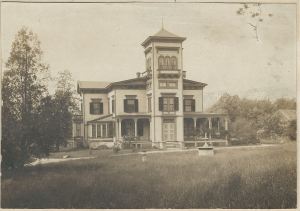
The Ward and Stout farms were purchased by Alfred Mulligan, who in 1865 built a magnificent mansion on a bluff overlooking the bay.  Mulligan was another Wall Street financier.  The view from the top of the cliff looking north over the bay and through to the shores of Connecticut is “one of the finest water views in the world,” according to The Brooklyn Eagle in 1899.[xxix]  Mulligan named his estate Cedarcliff.

In 1898, August and Nannie Heckscher purchased the Mulligan property and a year later the Thurston property as well.  The Heckschers were two of Huntington’s most generous philanthropists, donating the park and museum that bear their name among other things (see Mr. Heckscher’s Most Generous Gift To Huntington).  The Heckschers made improvements to the Mulligan mansion and rechristened the estate as Land Ends and later Wincoma.

Nannie Heckscher died in 1924.  Within a year, August Heckscher sold the estate to local real estate developer William E. Gormley, who divided it into 200 lots, most were a quarter acre; some up to 2 acres.  Gormley pledged to preserve the beauty of the property, especially its trees.

The mansion was purchased in 1926 by Henry R. Frost, a lawyer for the Long Island Lighting Company. He lived across the Sound in Greenwich and used the mansion as a summer home. Ten years later, during the Great Depression, the mansion was the subject of a foreclosure action. Frost and his family stayed at Wincoma for the summer of 1936 (the foreclosure was to be in May of that year). It is unclear when the foreclosure was finalized. But in November 1940, the mansion was being offered for sale by real estate broker Charles E. Sammis, Inc. Two months earlier, August Heckscher had returned to Wincoma. His friend and fellow real estate investor Charles Noyes hosted a 92nd birthday party for Heckscher at Noyes’ Wincoma house, two doors east of the mansion. Heckscher died the following April.  At the time of his death, his old mansion, now owned by his friend Noyes, was being demolished.

East Point

East Point enjoys one of the most spectacular settings in the Town of Huntington. 

In 1888, Dr. Daniel E. Kissam, a direct descendant of Dr. Daniel W. Kissam (whose 1795 house on Park Avenue is now a museum preserved by the Huntington Historical Society), purchased the peninsula and 10 acres of uplands from the Scudder family and built a rambling mansion

After Dr. Kissam died in December 1903, John Green, a 24-year-old millionaire owner of a Colorado mine, purchased the property. Green had the house remodeled and modernized and christened the house Point Siesta. Shortly after his wife’s death in 1911, Green sold the property to his brother-in-law James Elverson but continued to live there.  When Elverson died in January 1929, he was deeply in debt.  To pay the debts, the contents of the home were auctioned off, including hundreds of cases of wines and liquors bottled between 1840 and 1850.

In the 1960s, Arthur and Ruth Knutson owned and restored the house.  Later Gloria Smith, who owned the Yankee Peddler antiques shop, and her husband purchased the house and it was once again restored. After her husband’s death, Mrs. Smith made the house and property available for photo shoots.

The house was demolished in 2018 and a new home built in its place.  For more, see No More Second Chances

Rhinelander Estate

One of the earliest wealthy city dwellers to establish a country home in Huntington was John R. Rhinelander, a doctor from a wealthy New York family who fought cholera outbreaks in New York and Montreal.  Rhinelander built his magnificent mansion on a hill on East Neck between Huntington Bay and Huntington Harbor in the mid-1830s.  The home commanded spectacular views as well as attention from the surrounding community.

Dr. Rhinelander was active in Huntington affairs.  He died in 1857 at the age of 62.  His wife Julia died seven years later.  The house passed from one wealthy New Yorker to another, including John P. Kane, a partner in a large mason and building supply company in Manhattan.   The street on which the house sits was named for Kane.  Later, the house was owned by Frederick L. Upjohn of the pharmaceutical company and then by Thomas H. Roulston of the eponymous grocery store chain.

More recently, the house was owned by sculptor Joseph Mack and his wife, the painter Jean Mack.  In the early 1970s, after Mr. Mack suffered a life-threatening car accident, the couple started the Huntington Fine Arts Workshop in their home.  Five rooms in the basement were converted into sculpture studios and drawing and painting were taught in the ballroom.  In 1978, it became the Huntington School of Fine Arts and eventually moved to a former boathouse on Huntington Harbor.   For more, see High Lindens

Research for this post was conducted in partnership with Toby Kissam, who has written extensively on the history of Huntington Bay.


[i] The Long-Islander, June 1, 1877

[ii] The Long-Islander, March 26, 1880

[iii] The Long-Islander, April 4, 1891

[iv] The Long-Islander, June 29, 1895

[v] Suffolk County Clerk’s Office Deed Liber 261, page 59.  The land was held in his wife’s name.

[vi] The Long-Islander, April 7, 1882, July 7, 1882

[vii] New York Times, December 21, 1883 and February 11, 1884.

[viii] The Long-Islander, January 18, 1884

[ix] The Long-Islander, October 2, 1886

[x] Suffolk County Clerk’s Office Deed Liber 300, pages 483, 487, 492 and 498

[xi] Suffolk County Clerk’s Office Deed Liber 302, page 470

[xii] The Long-Islander, October 2, 1886

[xiii] The Long-Islander, February 5, 1887

[xiv] The Long-Islander, October 2, 1886

[xv] Suffolk County Clerk’s Office Map No. 66, filed January 18, 1888

[xvi] Suffolk County Clerk’s Office Map No. 454, filed July 15, 1897

[xvii] The Brooklyn Daily Eagle, February 13, 1888, page 2

[xviii] New York Times, September 4, 1915

[xix] Suffolk County Clerk’s Office Deed Liber 310, page 86

[xx] Suffolk County Clerk’s Office Deed Liber 56, page 120

[xxi] The Long-Islander, April 14, 1888

[xxii] South Side Signal, June 30, 1888

[xxiii] The Long-Islander, April 28, 1888

[xxiv] The Long-Islander, April 27, 1889

[xxv] The Long-Islander, March 10, 1888

[xxvi] Brooklyn Eagle, June 9, 1900

[xxvii] Brooklyn Eagle, June 9, 1900

[xxviii] The Long-Islander, September 26, 1891

[xxix] The Brooklyn Eagle, April 30, 1899, page 27
Read Full Post »

In 1906, August Heckscher purchased a large part of the Prime property at the northeast corner of Main Street and Prime Avenue (see the previous post, Mr. Prime’s Thimble Factories).[1]    Mr. Hecksher’s initial plans for the property are not known.  Eventually, the bulk of this land would become one of the greatest gifts the people of Huntington ever received.

Mr. Heckscher’s first philanthropic use of the property came two years after his purchase.  In 1908, a proposal to replace the wooden 1858 Union School building across the street from Mr. Heckscher’s property with a modern brick building was being considered.  The new building (which today is Town Hall) would be in the same location as the old building.  Moving the old school building to a different part of the property was impractical.  Mr. Heckscher offered a solution: classes could be held in the old Prime mansion free of charge.  The large rooms and wide halls of the mansion were big enough to accommodate the high school classes and perhaps one or two grammar classes until the new building was ready.[2]  The new high school building was completed in January 1910.[3]

At the east end of the old Prime farm along Sabbath Day Path, a baseball field was laid out and as early as 1910 the Huntington Baseball Club played their home games there.

A few years later, Mr. Heckscher, working with the newly formed YMCA of Huntington, transformed the eastern side of the Prime property into a more diverse mix of athletic facilities including tennis courts, a running track, baseball diamond, and soccer field.[4]  The six acre fields were made available to the residents of Huntington during the summer of 1914.  In September, Mr. Heckscher announced plans to give the fields to an incorporated, self-perpetuating organization, which was made up of the same men who organized the local YMCA.  The property was transferred in 1915 to the Recreation and Playground Association, which immediately announced plans to raise funds to make improvements and to hire an athletic director.[5]

The Prime Mansion made available by Mr. Heckscher for use by the High School and the North Shore Holiday House.

Meanwhile Mr. Heckscher made the old Prime mansion available for use as part of the Fresh Air Fund organized by the New York Tribune.  The two week camp gave underprivileged girls from the city a two week stay in the country.  Five sessions were held, accommodating 25 girls in each session.   This effort eventually grew into the still operating North Shore Holiday House, which utilized the Prime Mansion during the summers of 1914 and 1915.

In 1914, when Huntington’s leading citizens were exploring options for a hospital in town, Mr. Heckscher suggested transforming the old Prime mansion for that purpose.[6]  A few months later Cornelia Prime settled the question of where the new hospital would be located by purchasing land nearby on Park Avenue and making it available for a new hospital.

Then in August 1915, Mr. Heckscher announced plans to transform most of the remaining property (other than the athletic fields) into a park. The pond that Ezra Prime had created fifty years earlier as a trout pond and a source of ice, would be deepened and enlarged, and stocked with fish.  Small islands in the pond would be connected to the mainland by rustic bridges.  A Swiss chalet would be built.  A driveway would transverse the park from Sabbath Day Path to New York Avenue.  It was anticipated that when completed Mr. Heckscher would present the park to the town.[7]

The man chosen to lead the physical transformation of the land was Roland Von Waldburg.  He was born in Brunswick, Germany in 1873.  He came to the United States in 1897.  He became a citizen in Pennsylvania in 1900 and was living in North Hempstead in 1910.  He had an engineering and contracting business in Flushing before coming to Huntington, where he was superintendent of Rosemary Farm, the Roland Conklin estate in West Neck that is now the Seminary of the Immaculate Conception.[8]  He also later worked on the Roosen estate in Greenlawn known as Laurel Lodge.

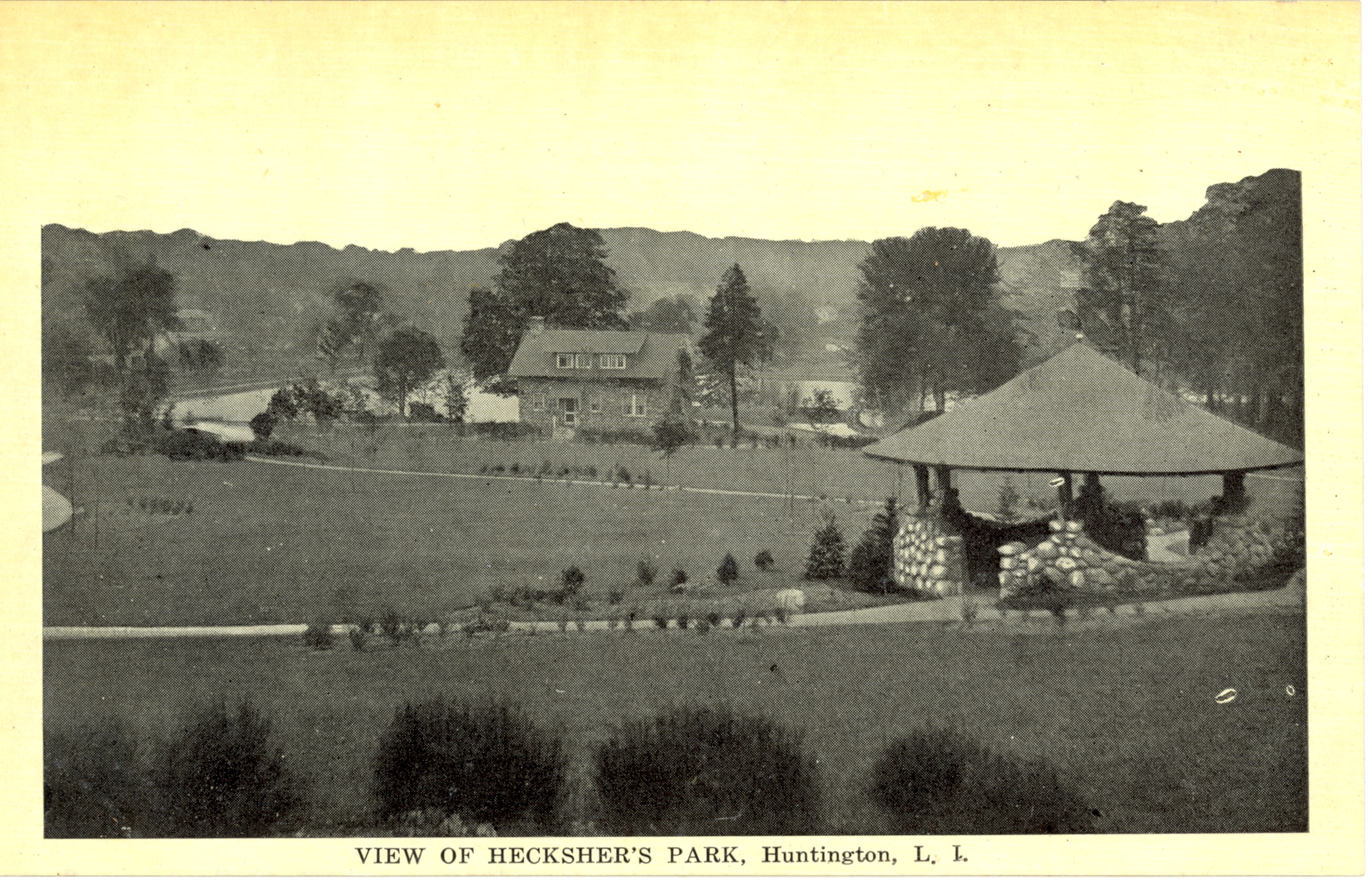
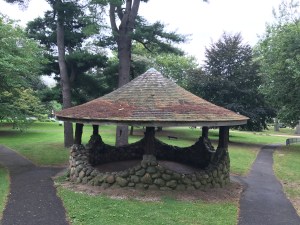
Mr. Von Waldburg favored the use of large boulders to create rustic landscapes as can be seen in the amphitheater at Rosemary Farm, the stone entrance gates at Laurel Lodge, and most significantly at Heckscher Park, which features stone entrance gates, a stone cottage, a stone gazebo, and a stone fountain.  The landscape designer is credited with planning and carrying out “to the minutest detail the wonderful amount of labor which makes possible the feast to the eye of those who visit this delightful pleasure resort.”[9]

View of Hecksher’s Park showing the stone gazebo and the stone cottage.

Workmen excavating the park to realize Mr. Von Waldburg’s design found silver coins, some with Napoleon’s image engraved on them.  It was supposed that these coins had been intended to be melted down by Ezra Prime to be turned into thimbles.[10]

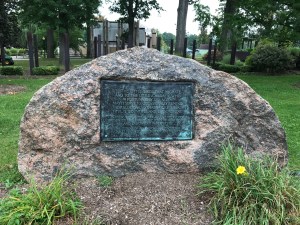
A specific opening day for Heckscher’s Park, as it was originally known, has not been determined, but the July 28, 1916 edition of The Long-Islander included a poem by F.W. Webber extolling the virtues of the park.  Two lines from that poem were placed on a bronze plaque affixed to a boulder near the entrance to the Park from Main Street and Prime Avenue:

Here coming generations, seeking rest,

Mid verdure, bloom and overarching trees,

From Nature’s loveliness will draw new zest,

New inspiration from the perfumed breeze.

The park was opened to the public by the fall of 1916, but the work was not completed.  The stone fountain was not completed until May 1917.[11]  Work on the stone retaining wall around the shores of the pond was also continuing.  And the planting of trees from the Heckscher estate at Wincoma continued in the spring of 1917.[12]  Even in its incomplete state, at least two postcard views of the park had been published.

Mr. Heckscher hired Lars Reitan, an immigrant from Norway, to be superintendent of the park.  Mr. Reitan, who lived in the stone cottage by the lake, quickly became well-liked by the residents of town.  One Huntingtonian was even moved to write a poem about the new Superintendent:

Lover of Nature, with her, hand in hand

Amid her work he toils from day to day,

Rendering service neath her gentle sway

Such as will make more beautiful the land.


Rich in the skill that makes the soil obey

Each order that his busy mind has planned;

In leaf and bloom, tree, plant and flower stand

Thriving apace in beautiful array;

And Heckscher Park he makes a Paradise.

None can behold save with admiring eyes.

That the first letter of each lined spelled out the Superintendent’s name impressed him even more.[13]

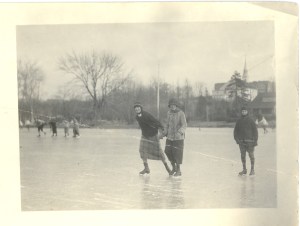
Ice skating on the pond.

Ice skating on the pond was very popular that first winter of 1916-17.  When Superintendent Reitan hoisted the red ball, it was safe to skate.  The next summer, fresh water swimming was the attraction.[14]  There were ten bathhouses (five for women and five for men) available for a small fee and a diving platform.  Swimmers could also rent a bathing suit from the Superintendent.  Row boats were also available for rent.

Boating on Heckscher Pond.

Mr. & Mrs. Heckscher invited the Town Board to dinner for the Town Board at his estate at Wincoma, where he would outline an offer to donate the new park to a Trust to be established for that specific purpose.   He promised to provide an endowment of $70,000 (about $1.465 million in 2017).  He suggested giving 700 preferred shares of the American-La France Fire Engine Company, which paid 7% for an annual income of $4,900 ($102,000 in 2017 dollars).  Mr. Heckscher offered a list of alternative stocks or bonds, but the suggested stock was met with favor.[17]  The offer of an endowment was very welcome in light of the difficulty in raising funds to maintain the adjoining athletic fields.  Heckscher had set aside $12,000 as an endowment for that property, expecting residents to raise a matching amount.[18]

The actual gift of the park was made a day after Christmas 1917.  In a deed signed by August and Nannie Heckscher, the new 12.372-acre park was transferred to nine of Huntington’s leading citizens, including Supervisor Field (Town Supervisors were ex officio members of the Board), as trustees of the Heckscher Trust. The purpose of the trust was to hold and maintain the new park “exclusively for charitable and educational purposes in the form of a park or playground for the use and benefit of the public and especially of the school children of said Town of Huntington.”  Among other things, the board was authorized “to provide occasional music for the pleasure and instruction of the people.”

The trustees were to submit an annual report to the Town Board and the Town Board was given some say on filling vacancies on the Trust’s board.  The deed also specified that the park was to be known as Heckscher Park.  Reportedly, Mr. Heckscher’s original intent was to use the name Huntington Park, “but the popular sentiment overruled his intention and Heckscher Park is so called because the people would call it by no other name.”[19]

The most interesting provision of the deed was the right given to the trustees “to cut and collect ice from the lake in said park, and arrange for the storage thereof, and it shall distribute the same free of charge to the poor of the Town of Huntington.”  It is unknown if this power was ever exercised by the trustees.

The 1917 map of the area shows the Park and Community Fields as two distinct entities.

As promised, Mr. & Mrs. Heckscher donated 700 preferred shares of American-La France Fire Engine Company, Inc. at $100 par value per share, or $70,000 in total.  Mrs. Heckscher later added another $100,000 to the endowment.[20]  Following his wife’s death in 1924, Mr. Heckscher donated an additional $50,000 in the form of 500 shares of Anahma Realty Corporation, the company through which Mr. Heckscher owned his income producing properties in Manhattan.[21]  It should be noted that these values represent the par value of the stock, not necessarily the market value.  Long term government bonds issued to help underwrite the cost of World War I yielded 3% interest.  Assuming the yield on these shares would be the same, the market value of the initial gift would have had a market value of $163,333.  The endowment was further augmented by a bequest in the will of Willard Baylis, a prominent Huntington attorney who had served as president of the Heckscher Trust.  Mr. Baylis left $1,000 to the Trust.[22]  The market value of these gifts may have been as much as half a million dollars, the equivalent in today’s dollars of about $7,000,000.

The Long-Islander greeted the gift enthusiastically and predicted that “The character of the trustees named in the deed are a guarantee that the trust will be administered wisely and with care and diligence.”[23]

The formal dedication of the park took place on Decoration Day (May 30), 1918.  The morning was filled with the usual Decoration Day activities, e.g. a parade and decorating of veterans’ graves.  The afternoon was devoted to a celebration of the new park with speeches by the donor, Supervisor Field, School Superintendent Robert Toaz, and Dr. S. Parker Cadman.  Mr. Heckscher modestly deflected the praise heaped on him:

In the evolution of this little Park which to-day goes to our people and most of all to the little children, I have had so much satisfaction and so much pleasant anticipation that I am entitled to no praise; and I believe I am speaking for Mrs. Heckscher also when I say that the gift has been for both of us one of unalloyed gratification.[24]

The Park’s dedication rock.

A bronze tablet affixed to a large boulder had been placed in the park in time for the dedication.  The tablet repeated the words Mr. & Mrs. Heckscher had used when they first made the offer to donate the park to the people of Huntington the previous summer.  Their letter had said the park would be for the little birds that migrate and the children who, fortunately, do not.

One important feature of the park was still missing.  The Heckschers’ plans for a museum of fine art had to be put on hold due to material and labor shortages arising from the American entry into World War I in April 1917.  By August 1918, with the war winding down, Mr. Heckscher announced that he had completed plans for the museum.  Construction on the $128,000 ($2.25 million dollars in 2017) building would begin “as soon as the rush of war work is over so that the material needed may be had.”[25]

At the same time, it was also announced that the Park and the Community Field would be united under the ownership of one board.  This combination made the income from the Heckscher Trust endowment available to maintain the Community Field, where the grandstand was in need of repairs.[26]  The Recreation and Playground Association transferred the Community Field to the Heckscher Trust in April 1919.

The Fine Arts Museum

The corner stone for the classical style museum building designed by Maynicke & Franke[27] was laid on May 21, 1919.  The following year, on July 10, 1920, it was dedicated as a gift to the citizens of Huntington on a perfect summer day during which thousands of people came to hear speeches and thank Mr. & Mrs. Heckscher for their continuing generosity.  According to William McAdoo, former secretary of the Treasury and a summer resident of Huntington Bay, in the aftermath of the destruction of the Great War, the gift was not just to the people of Huntington; “it is made to the whole country, to the entire world in fact, for it is an example and an inspiration.”[28]

Perhaps memories of the recent war affected reactions to the gift, but the museum was seen as much more than a building in which to hang pictures.

If the lesson of the occasion is taken to heart the people of Huntington, now and in the future, will accentuate the broad significance of the Heckscher gift by striving to make the town, even more than the Heckschers have made it, a center from which will radiate the spirit of human brotherhood and social uplift.[29]

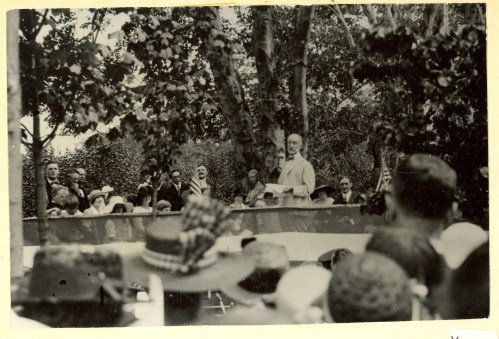
August Heckscher speaking at the July 10, 1920 dedication ceremony.

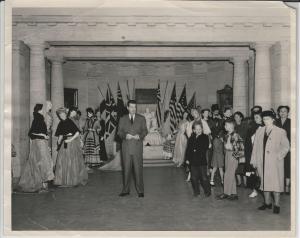
August Heckscher accepted the gratitude of the crowd with characteristic modesty.  At 3:00, as the dignitaries took their seats after a 90 minute concert by the 35 piece Seventy-first Regiment band, they were greeted to a surprise fireworks show.  The aerial bombs from high in the air released a large American flag and a streamer that bore the inscription “Heckscher Park.”  When Mr. Heckscher rose to speak, the band played “Hail to the Chief.”  Mr. Heckscher referred to his modest collection of paintings that he did not wish to see scattered to the four winds.  He almost made it sound like Huntington were doing him a favor by keeping the collection together.

Of course, the Heckschers were always mindful of the children.  It is not surprising that while the adults toured the new building, the children “were treated to ice cream, cake and orangeade.”

Museum Interior

The fountain, “Youth Eternal” that sits in the circular alcove at the west end of the museum lobby was not completed until two months after the dedication.  The three children in the sculpture represent the Heckschers’ grandchildren.[30]

Lars Reitan continued to serve as superintendent of the park.  In fact, he would oversee the park until his retirement in 1948.  In 1935, he was also appointed to the Board of the Heckscher Trust.  But the intervening years were not without their share of conflict.  Financial pressure on the endowment brought on by the Great Depression put a strain on the park’s operations.

The Depression eroded the value of the Trust’s endowment.  In the early 1930s, the income produced by the endowment had fallen too low for the Trust to maintain the park and museum.  August Heckscher asked Town Supervisor William Watt to make up the shortfall with town funds.  The Supervisor refused, arguing the Town could not spend taxpayer money on property it did not own.  Mr. Heckscher promised to repay the Town when the investments recovered.  Based on the opinion of Town Counsel Fred J. Munder (later to be a county judge), the Supervisor reluctantly allocated $3,000 to help maintain the Trust’s property.[31] The Huntington School District, which used the athletic fields for its teams and physical education classes, also allocated funds for maintenance of the park.  An income and expense report for 1933 shows dividend revenue from the endowment of $1,125.85 and $3,000 from the Town.  Tennis Court rentals brought in another $360.50.  Expenses were $3,787.82, including $1,500 for the Superintendent’s salary.

By 1935, the Town’s allocation increased to $5,000; along with $1,000 from the school district.  The 1935 report showed no income from the endowment.[32]  In fact, no income from the endowment was reported between 1935 through 1937.  In 1938, endowment income amounted to only $618, less than 10% of that year’s total expenditures.  The value of the endowment by the end of 1943 had been reduced to $18,230.  Without access to the records of the Trust it is impossible to determine how much of this reduction is a result of the sale of some investments to cover expenses, or simply a loss of value caused by the Depression.  The value of the 500 shares of Anahma Realty Corp that Mr. Heckscher donated in 1924 in memory of his wife had fallen from $50,000 to just $2,750.

Supervisor Watt was also able to allocate WPA funds for improvements to the athletic fields in 1934.  Two years later, however, Mr. Heckscher was concerned about a $12,000 project to complete the tennis courts as a WPA project.  He asked Ira Lewis, the Supervisor of Local projects for the WPA, to hold off on that project because he feared the Trust would not be able to repay such a large amount.[33]

Nonetheless, with the Town’s support, which grew to $6,000 a year, the Park remained open throughout the Depression.  The doors to the museum, however, were kept locked; “but there is an obliging curator [i.e. Park Superintendent Reitan] who will unlock them cheerfully and with no desire for gain.”[34]

August Heckscher, who had sold his Huntington Bay estate in 1923, died in 1941.  By that time the Park seems to have become somewhat overgrown and visitation was down.  In June, the Trust’s Board “felt that steps should be taken to increase the public interest in the splendid gift of the Park and the Museum which Mr. Heckscher had established for the benefit of the people of Huntington.”[35]  Three sub-committees were formed, each aligned with one aspect of Mr. Heckscher’s gift:  The Fine Arts Committee, Parks Committee, and Playground and Athletic Field Committee.

The most far reaching recommendations seem to have come from the Fine Arts Committee, which was headed by Albert Delmont Smith, a painter turned art historian.  Mr. Smith was the first professional associated with the care of the museum’s collection.  Previously that responsibility had fallen to the Park Superintendent Reitan, who had a background in landscaping, not paintings.  Residents were incensed to learn that the committee proposed changes to the museum displays and, even worse, holding public art sales in the museum.  In 1944, a petition submitted to the new Town Supervisor Walter Fasbender demanded that the paintings moved to storage “be returned to the walls of the Fine Art Building in Heckscher Park, in the manner in which Mr. Heckscher left them and desired them to be hung there in their entirety permanently.”[36]  William Hartmann, claiming to represent 2,000 residents as the Managing Director of the Huntington Civic Planning Association, sent a letter to Charles Noyes, president of the Trust, claiming that August Heckscher “declared himself emphatically averse to permitting the use of the walls of his museum for any exhibit of paintings other than those of his own collection.”[37]

Despite the objections, the Trustees voted at their January 2, 1943 meeting to allow the exhibit of paintings on loan from other museums.  The first exhibit of loaned paintings opened on May 22, 1943 with 21 paintings from American artists, including Winslow Homer, John Singer Sargent, Childe Hassam, and William Merritt Chase, on loan from the Metropolitan Museum of Art.[38]  Perhaps to help assuaged the hurt feelings of those opposed to the display of loaned art, the Trustees used the opening of the exhibit to unveil a portrait of August Heckscher that had been in storage at the museum for 20 years.[39]

The Park Superintendent was also unhappy with some of the proposed changes, even though he was also a member of the Heckscher Trust Board of Trustees.  Although Mr. Reitan apparently did not share his disagreement with his fellow trustees at Board meetings, he did share his displeasure with fellow residents.  After he abruptly left a meeting at which his status as an employee and trustee was discussed, the Board voted to remove him as Superintendent.  At a subsequent meeting to consider removing Mr. Reitan from the Board, he voluntarily resigned from the Board, but asked to be retained as Superintendent.[40]  He worked four more years until his retirement in April 1948 due to ill health.[41]

Mr. & Mrs. Reitan in the stone cottage

Mr. Reitan, who had favored maintaining the beauty of the Park over increasing visitation, was given a $75 a month pension by the Trust.  The Town Parks Department assumed responsibility for maintaining the park and the cottage, in which Mr. Reitan had lived for over 30 years, was to be made available to the Town Recreation Committee, otherwise known as the YMCA.  It was reported that refreshments would be available at the cottage for park visitors.[42]   Mr. Reitan moved to a house on Madison Street across from the entrance to the park.  He died in 1954.

By 1948, J. Taylor Finley, chairman of the Athletic and Park Committee, could report “that the park was being used as never before.”  It was used even more in 1949.  The uses included the first High School commencement in the park, the Police Athletic Association’s annual boxing matches, the Municipal Band Concerts on the steps of the museum and musicals held in the museum.  The YMCA ran its summer camp for 210 children between the ages of 7 and 11.  Baseball leagues and a basketball league rounded out the frequent users of the park.  “Also,” Mr. Finley reported, “more people are ‘just visiting’ the park, all of which I believe was intended by Mr. Heckscher when he gave this beautiful spot to the town.”[43]

Use of the park continued to increase.  It was estimated that in 1952, 100,000 people would visit the park, including the average of 50 children a day who made use of the new wading pool donated by the Huntington Rotary Club.[44]  The park was truly a center of activity in the Town of Huntington.  When plans were being made by the Huntington Tercentenary Committee to celebrate the Town’s 300th anniversary in 1953, the logic place to hold the anniversary pageant was in Heckscher Park.  The committee, chaired by Robert L. Simpson, secured permission from the Heckscher Trust to use the park from June 25 to July 7.[45]

A year before the Tercentenary Committee requested use of Heckscher Park, a local attorney raised serious objections to the use of Town funds to maintain the park.  Albert M. Levert of Centerport had earned a reputation as a gadfly with his lawsuit challenging the Town’s purchase of 22 acres in Centerport for use as a Town beach.  Mr. Levert was such an irritant to the powers that be that someone in Town Hall prepared a summary of the nine lawsuits initiated by Mr. Levert against the Town between 1951 and 1955.

In the midst of the Centerport beach lawsuit, Mr. Levert appeared at the Town Board’s budget hearing on November 1, 1951.  The meeting at the Woodbury Avenue School was sparsely attended and lasted all of 15 minutes.  Yet Mr. Levert managed to strike fear in some Town employees, who worried he might take steps that would tie up their salaries.  His main complaint about the 1952 budget was that it continued to allocate taxpayer money for the maintenance of the privately owned park.  Since 1936, when the Town first adopted formal annual budgets, the Town Board allocated $6,000 a year for maintenance of Heckscher Park.  By 1946, the allocation was $8,000; and the 1952 budget included $14,500 for the park.  Not only was the use of taxpayer money for non-town owned property illegal on its face, Mr. Levert also objected because as a private park, the Heckscher Trust could exclude anyone it wished from the park.  Mr. Levert threatened to put someone in jail if such illegal expenditures were not removed from the budget.[46]

The Town Board ignored the attorney, noting that no one else objected to the use of Town funds to maintain the park.  The following spring, Mr. Levert made good on his threat by commencing legal action against Town Supervisor Walter Fasbender and the Heckscher Trust.  The plaintiff in the case was Mr. Levert’s wife Louise.  The suit sought an injunction against spending the $14,500 included in the 1952 budget and recovery of the $72,000 spent by the Town for maintenance of the park since 1944, the year Supervisor Fasbender took office.[47]

At the initial hearing, William Titus appearing as counsel for the Supervisor, pointed out that the Leverts were the only ones who ever raised an objection to the Town’s support of Heckscher Park.  And that their share of the expenses spent on maintenance of the park amounted to only 82 cents.[48]  The court did not grant Mr. Levert’s request for a temporary injunction barring the continued use of Town funds while the lawsuit was pending.[49]

At the semi-annual meeting of the Heckscher Trust in July 1952 held at Linck’s Log Cabin restaurant in Centerport, the Trustees rejected Mr. Levert’s suggestion that the Trust transfer ownership of the park to the Town (according to Mr. Levert, the suggestion to transfer ownership was made by the Supervisor’s attorney, Mr. Titus).  The trustees were confident that they would prevail.[50]

Meanwhile, the park continued to be used more than ever by the high school, the new Little League, the YMCA, the Boy Scouts, and the Township Concert Band.  The museum also saw increased visitation.

But that all came to a screeching halt as 1953 began.  On January 6, Supreme Court Justice Percy D. Stoddart ruled in favor of Mrs. Levert as against defendant Fasbender and enjoined the Town from spending any more taxpayer money on the park.  The court based its decision on the previous ruling in the Centerport Beach case.  The court also entered a judgment against Supervisor Fasbender personally for $101,534.54, which was the total amount spent by the Town since 1944 plus interest to December 31, 1952.[51]

A week after the court’s decision, the Trust closed the gates to the park and posted signs:

WE REGRET

That this Park has been temporarily

~ CLOSED ~

as a result of a lawsuit instituted by

Mrs. Albert Levert which has cut off the

Funds necessary for the maintenance

of this park.

HECKSCHER TRUST


Mr. Levert admitted he had seen the signs, but would not say if he planned to take action against the Trust because of the signs. [52] 

Supervisor Fasbender at the opening of a historical exhibit in 1948.

Supervisor Fasbender sought leave, which was granted, to amend his answer to assert a cross-claim against the Trust seeking reimbursement for the judgment against him.  Mr. Levert also filed a motion to recover attorney’s fees.

In February, the Trust announced that without Town funds the park would be open only one day a month—the third Saturday of the month.[53]  The Town’s Tercentenary pageant was relocated to Squadron C Farm at the other end of the village.  The Park was open during the summer thanks to the volunteer efforts of the YMCA.[54]

By July, the Town was considering a settlement along the lines proposed the previous year—transfer of the Park to the Town.  Supervisor Fasbender and the Town Board appointed a committee to consider such a settlement.  The committee recommended that the Town purchase the property, including the museum and the art collection, for the amount of the judgment against the Supervisor.  Of course, no money would actually change hands.  The Trust would transfer the park property in lieu of reimbursing the Town for its past expenses for maintenance.[55]

On December 29, 1954, the Town Board—at the last meeting with Mr. Fasbender as Supervisor—approved a resolution “arranging for the conveyance of Heckscher Park with its buildings, improvements and appurtenances to the Town of Huntington.”  The Heckscher Trust soon agreed to the transfer and a further Town Board resolution adopted on February 2, 1954 authorized the Supervisor, now Joseph Cermak, to execute the contract of sale.[56]  As part of the settlement, Mr. Levert received $12,000 in attorney’s fees.

Heckscher Trust conveyed the park, including the art collection in the museum, to the Town by deed dated May 12, 1954.  Under the terms of the deed, the Town was required to hold the property “in perpetuity exclusively for charitable and educational purposes, in the form of a park and playground to be known as “Heckscher Park,” for the use and benefit of the inhabitants of the Town of Huntington and especially of the school children of the said Town of Huntington, and shall carry out as nearly as possible the purposes for which the Trust was established by August and Nannie A. Heckscher by Indenture dated December 26, 1917.”  If the Town failed to honor this requirement, “then title to the whole of said premises shall . . .  revert to the parties of the first part [i.e. Heckscher Trust], their successors and assigns, and the party of the second part [i.e. the Town] shall forthwith convey said premises to the parties of the first part.”[57]

The Town Board soon realized that it owned a building full of artwork, but it was not technically authorized to operate a museum.  The building was not open on a regular schedule and the art was being neglected.  To remedy this situation, the Town Board in April 1957 appointed a five member Board of Trustees to manage the building and collections.[58]  The new organization, known as The Heckscher Museum, was chartered by the New York State Education Department in June 1957.  Previously the building was called the Huntington Fine Arts Building.  Now with an organization named Heckscher Museum, that name was also applied to the building.

The Heckscher Trust continued to exist and continued to hold the endowment left by Mr. & Mrs. Heckscher.  Income from the Trust was used to make improvements to the park.  For example, in 1963, the Trust spent $3,325 for a new fence around the ball fields; in 1964, it allocated $3,540 to repair the museum’s roof; and in 1966 the Trust purchased a bandstand for the park for $5,785.

The 1966 band stand.

Fifteen years after conveying the park property to the Town, the Trust petitioned the court to terminate the Trust and distribute the remaining endowment funds—now with a value of $111,368—to the YMCA.  The trustees of the museum intervened in that proceeding arguing that the endowment should be conveyed for maintenance of the museum that Mr. & Mrs. Heckscher created, not to the YMCA, which was an unrelated organization.  In her affidavit urging the court to transfer the Trust’s assets to the Museum, Priscilla Williams pointed out that six of the nine trustees of the Heckscher Trust were also trustees of the YMCA, who may have suggested transferring the endowment to the YMCA to meet their fund raising obligations to that organization.

No one disputed that the Heckscher Trust should be dissolved.  The only question for the court was where the endowment should go—the YMCA or The Heckscher Museum.  The court decided in favor of the Museum “as the sole remaining private organization which is an offshoot of the original gift.”  The court found that while the YMCA was a worthy organization, it is, “except for accidents of geography and a partially interlocking board of directors, a complete stranger to the Heckscher Trust and the Heckscher Park.”  Clearly the court was not made aware of the fact that the YMCA had played a pivotal role in the creation of the athletic fields and had conducted most of its activities in the park until it acquired its own property nearby in the early 1950s.

Even with that historic connection to the Park, the YMCA’s claim would not have been as strong as Heckscher Museum’s.  The latter organization was formed specifically to oversee the fine arts collection on behalf of the Town.  In 1964, that relationship was formalized in an agreement between Heckscher Museum and the Town of Huntington.  The agreement provided that while the museum building and the original Heckscher collection are owned by the Town, Heckscher Museum (the organization) will have control of the maintenance and operation of the building and collections.  Any art works acquired by the Museum for display will be the Museum’s separate property.  The Town will provide funding to pay the salary of a professional museum director.  Perhaps the most important provisions of the agreement and the ones that probably gave rise to the agreement in the first place were those that authorized Heckscher Museum to raise funds and develop plans for an expansion of the museum building.  It was recognized that “the present buildings of the Museum have become overcrowded because of inadequate space to store and exhibit its collections.”[59]  It is unclear what buildings other than the 1920 museum are being referred to.

The Museum’s trustees announced its plans for expansion and a fund raising drive a week after the agreement was signed.[60]  The new addition would be built north of the museum.  It was hoped that the addition would be completed in time for the museum’s 50th anniversary in 1970.  Press coverage of the 50th anniversary celebration does not make any references to the plans for expansion, which had not been realized.

The question of expansion seems to have lain dormant until the American Association of Museums issued an accreditation report in 1983.  The Association expressed concerns about the museum’s overcrowding and indicated that if improvements were not made the museum may lose its accreditation.  The museum revisited the issue and announced new plans for an expansion in 1986.[61]  A 19 member town-wide advisory group had been formed to explore options, but the museum’s immediate neighbors opposed the loss of green space that would result from the expansion.  “If there’s a choice between the park and the museum, it’s very obviously the park,” said Elaine Capobianco, the head of the Huntington United Civic Association.[62]

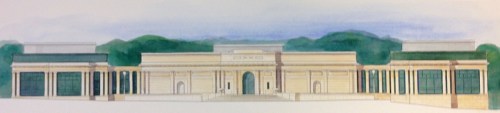
The initial plans called for the new addition to be to the south of the museum building.  But the State Historic Preservation Office rejected the plan because it would adversely affect the symmetry of the original building.  A new plan with two wings on either side of the original building and each equal in size to the original building was approved by the State in 1993.[63]  The State Historic Preservation office described the plan as an “outstanding proposal” that is “completely compatible with both the historic Heckscher Museum and the surrounding park.”[64]

Fund raising efforts received a boost when the Museum’s chairman, John B. Hadley, pledged $3 million towards the project’s then $8 million budget.[65]  The National Endowment for the Arts also helped by making available an earlier $200,000 grant that the Museum feared it might lose because of the delay in construction.[66]

The proposed expansion.

After the Town Board adopted the Environmental Impact Statement, Huntington United Civic Associations, Inc., representing 20 civic associations, filed an Article 78 proceeding attacking the validity of the environmental study.[67]  The suit was dismissed five months later because the plaintiff lacked standing to sue.[68]  Three weeks after the suit was dismissed, the Town Board voted to approve the project.  Almost half of the construction budget had been raised.[69]  Other hurdles remained.  State legislation was needed to allow the conversion of parkland; and a wetlands construction permit from the State Department of Environmental Conservation was also needed.[70]  Those hurdles have been cleared, but the fund raising finish line has moved from $8,000,000 to $13,500,000 to probably more by now.

As any visitor to the park today can see, the expansion plans were never realized, although a new entrance plaza to provide handicapped accessibility to the museum was built in 1997.  While the museum expansion plans stalled, other changes were made to the park, which by the 1970s had fallen into such state of neglect that a local newspaper referred to the park as “Wreck”-scher Park.[71]

A shopping cart and garbage can were some of the debris found in the pond.

In 1978, the Town commenced a $500,000 improvement project.  One of the first tasks was to stabilize the sides of the pond, which had begun to cave in.  Boulders were shipped from upstate New York to replace those placed some 60 years earlier and that had sunk into the ground. The work required draining the pond so that only three feet of water remained.  In the process workers found two old garbage cans, a shopping cart and “enough beer bottles to pay off the capital debt.”[72]  Fish were removed from the pond and given a temporary home at the Cold Spring Harbor Fish Hatchery.[73] 

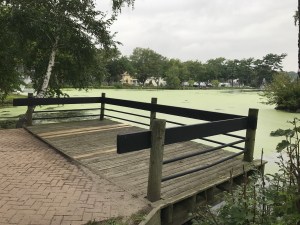
New viewing platforms added to protect the lake’s edge from erosion.

The playground, which had been located to the west of the current bathroom building, was moved to its current location at the west end of the ball fields.  A maintenance garage was converted to accessible restrooms, replacing restrooms built in 1947.  New wood decks were installed as viewing platforms around the lake.  The white Pekin ducks that were always a favorite recipient of stale bread were removed as an environmental hazard.  Surprisingly, it was reported that “Canada geese will be encouraged” to return.[74]  Be careful what you wish for.

The Rainbow Stage

The most expensive part of the project was the construction of a new amphitheater to replace the bandstand installed by the Heckscher Trust in 1966.  The new $300,000 amphitheater was officially opened on July 6, 1979 when the Huntington Summer Arts Festival began its 14th season.  The program was a jazz concert by Clem DeRosa, featuring soloist Town Supervisor Kenneth Butterfield on the trumpet.[75]  Apparently, the site lines to the new amphitheater did not get good reviews.  The following spring 3,000 cubic yards of fill from a parking lot project at Huntington Hospital were brought in to help the audience see over the railing around the orchestra pit in front of the amphitheater.[76]  Raising the grade did cause some concern that 11 trees might be adversely impacted.  To lessen the impact wells were built around the trees.[77]

Shortly after his death in a car accident on the Long Island Expressway in July 1981, the Town Board voted to name the new amphitheater the Rainbow Stage in honor of singer and Huntington resident Harry Chapin.  The name refers to Mr. Chapin’s song “Flowers are Red,” which includes the line, “There are so many colors in the rainbow.”

The collapsed roof of the gazebo.

One structure in the park that did not fare well over the years was the stone gazebo, popular for its echo.  By the early 1990s, the roof had collapsed.  There was evidence of a fire at some point in the past.  Working with the Huntington Historical Society, the Town undertook a reconstruction project with plans by local architect Neal Hoffman.  The original roof timbers were too far gone to be re-used.  A template was made from the most intact of the beams and the laminated wood tension ring that supports the roof was supplied by an upstate silo manufacturer.[78]  As promised, not only was the gazebo restored, so was the echo.

The gazebo after restoration

In December 1999, the pond was again drained to dredge the muck and litter that had settled on the bottom.  The project was part of a $1.25 million effort to restore the park to its previous glory.  The project also included new asphalt walkways around the pond and additional landscaping.[79]  In addition to the expected muck, visitors found two guns in a plastic bag encased in cement; and a woman found her $15,000 engagement ring that she had dropped into the lake by accident a month earlier.[80]

The park continues to attract tens of thousands of visitors every year.  The work to maintain such a well-used park never ends.  While no major projects are planned, in anticipation of the Park’s centennial, the Town has applied for grant funding to replace the chain link fence around the park with a more historically appropriate steel fence.

And the 50-year old dream of finally expanding the museum lives on.


Thanks to Jess Beck, Heckscher Museum, John Coraor, Huntington Director of Cultural Affairs, Karen Martin, Huntington Historical Society, and Antonia Mattheou, Huntington Town Clerk’s Archives for their help with the research for this post.


[1] Suffolk County Clerk’s Office Deed Liber 589, page 14.

[2] The Long-Islander, July 31, 1908.

[3] The Long-Islander, February 4, 1910.

[4] The Long-Islander, September 25, 1914.

[5] The Long-Islander, March 26, 1915; Brooklyn Daily Eagle, March 28, 1915.

[6] Brooklyn Daily Eagle, September 23, 1914, page 8.

[7] Brooklyn Daily Eagle, August 12, 1915, page 6; The Long-Islander, August 13, 1915.

[8] The Long-Islander, December 18, 1914, page 2.

[9] The Long-Islander, June 7, 1918, page 1.

[10] The Long-Islander, June 2, 1916, page 10.

[11] The Long-Islander, May 11, 1917.

[12] The Long-Islander, April 20, 1917, page 3; May 4, 1917, page 1.

[13] The Long-Islander, May 18, 1917.

[14] The Long-Islander, June 29, 1917.

[15] The Long-Islander, June 29, 1917.

[16] Brooklyn Daily Eagle, June 22, 1917, page 8.

[17] Brooklyn Daily Eagle, July 19, 1917, page 8; The Long-Islander, July 20, 1917.

[18] The Long-Islander, July 20, 1917.

[19] Ibid.

[20] Remarks of Willard N. Baylis at the Memorial Service for Anna Atkins Heckscher held at the Palace Theatre on August 31, 1924.  In the collection of the Huntington Historical Society.

[21] New York Times, November 9, 1924, page 20.

[22] New York Times, March 4, 1932, page 13.

[23] The Long-Islander, January 4, 1918.

[24] The Long-Islander, May 31, 1918.

[25] Brooklyn Daily Eagle, August 14, 1918, page 4; The Long-Islander, August 16, 1918.

[26] Ibid.

[27] The Long-Islander, March 21, 1919.

[28] The Long-Islander, July 16, 1920.

[29] Ibid.

[30] Brooklyn Daily Eagle, September 24, 1920, page 9.

[31] The Long-Islander, January 15, 1953, page 1.

[32] Statements of the Heckscher Trust in the collection of the Town Clerk’s Archives, Box 43.

[33] Letter dated May 8, 1936 from August Heckscher to Ira Lewis, in the Town Clerk’s Archives Box 0661A.

[34] William Oliver Stevens, Discovering Long Island, (NY 1939), page 31; quoted in August Heckscher: The Elusive Collector, by Megan Sniffin, on file with the Huntington Historical Society Archives.

[35] The Long-Islander, December 30, 1943, page 1.

[36] Petition address to Town Supervisor Walter Fasbender dated February 1, 1944 in the Town Clerk’s Archives, Box 43.

[37] Letter dated June 1, 1943 from William Hartmann to Charles Noyes in the Town Clerk’s Archives.

[38] The Long-Islander, May 13, 1943.

[39] The Long-Islander, May 20, 1943, page 1.

[40] The Long-Islander, December 30, 1943, page 1.

[41] The Long-Islander, April 1, 1948, page 1.

[42] The Long-Islander, April 1, 1948, page 1.

[43] Report of the Park and Athletic Committees, July 13, 1949 in the Town Clerk’s Archives, Box 0499C.

[44] Report on Heckscher Park Activities dated July 10, 1952, in the Town Clerk’s Archives, Box 43.

[45] Letter dated November 15, 1952 from Robert L. Simpson, chairman of the Huntington Tercentenary, Inc. to Arthur Smadbeck of the Heckscher Trust.

[46] The Long-Islander, November 8, 1951, page 1.

[47] The Long-Islander, April 17, 1952, page 1.

[48] The Long-Islander, April 24, 1952.

[49] The Long-Islander, July 17, 1952, page 1.

[50] Ibid.

[51] Huntington Times, January 14, 1953, page 1.

[52] The Long-Islander, January 15, 1953, page 1.

[53] New York Times, February 8, 1953, page 38.

[54] New York Times, December 13, 1953, page 135.

[55] The Long-Islander, September 3, 1953, page 1.

[56] Town Board Resolution adopted February 2, 1954 on file in the Town Clerk’s Archives, box 0187A.

[57] Suffolk County Clerk’s Office Deed Liber3693, page 204.

[58] The Long-Islander, April 18, 1957, page 1.

[59] Agreement dated July 28, 1964 between the Heckscher Museum and the Town of Huntington.

[60] The Long-Islander, August 6, 1964, page 3.

[61] New York Times, September 29, 1991 (Long Island section).

[62] Ibid.

[63] The Long-Islander, August 26, 1993.

[64] Newsday, August 25, 1993.

[65] The Record, January 15, 1992.

[66] Newsday, August 25, 1993.

[67] The Long-Islander, July 8, 1993, page 1.

[68] Newsday, December 9, 1993.

[69] Newsday, December 22, 1993.

[70] The Long-Islander, December 30, 1993, page 3.

[71] Sunday Digest, November 12, 1978, copy in the Huntington Historical Society archives.

[72] Long Island Press, July 11, 1975.

[73] The Long-Islander, June 21, 1979, page 3.

[74] Ibid.

[75] The Long-Islander, June 28, 1979.

[76] Newsday, April 22, 1980, page 27.

[77] The Long-Islander, April 17, 1980, page 7.

[78] The Long-Islander, August 5, 1993.

[79] Newsday, January 14, 2001.

[80] The Long-Islander, January 13, 2000, page 3.

Read Full Post »