As we anticipate the celebration of 250 years of American Independence, those old enough to remember fondly recall the Bicentennial celebration—Bicentennial Minutes on television, tall ships in New York Harbor and closer to home, reenactments of Revolutionary War incidents in Huntington such as the reading of the Declaration of Independence on July 22, 1776 and the Battle of Fort Franklin in 1781.
But what about the Centennial in 1876? To paraphrase a famous poem, not a man is still alive who remembers that famous celebration.
In March 1876, Congress passed a resolution that was later promulgated by President Ulysses S. Grant. The president’s proclamation encouraged every county and town in the country to “cause to have delivered on such day an historical sketch of such county or town from its formation.” In Huntington that task fell to the Honorable Henry Clay Platt, a local lawyer who had served in the State Assembly and would later serve as U.S. Attorney for the Southern District of New York.
According to a commemorative booklet published after the event, the celebration began on July 3 with 100 gun salutes at regular intervals from sunset to midnight, which probably would have kept everyone up late, but they couldn’t sleep in because the bells of the town were rung at dawn. The Long-Islander newspaper, however, reported that the day began with cannon fire at the break of day, while “the fusillade of small arms was kept up almost continuously till the middle of the forenoon.” The church bells and schoolhouse bell were rung for 15 to 20 minutes starting at 6:00 a.m. And, of course, there was a salute of 13 guns fired from the cannon the committee had procured for the day. However and whenever, it was loud, early.
By 7:00, everyone in the village must have been awake. “All was hurry and confusion, each one rushing about to prepare for his or her part in the grand procession of the day.” The village stores and hotels were decorated and almost every home was festooned with a flag.
By 10:00 the parade got under way. Participants marched from Prime Avenue through Main Street to Prospect Street, then up Prospect to High Street to New York Avenue, back to Main Street to Carley’s Grove at the brow of Cold Spring Hill (near the present location of the Christopher Columbus statue).
The parade was led by a 12 piece brass band, which was followed by, among others,
- The day’s speakers
- Town officers and invited guests
- Representatives of the U. S. Government
- Young women representing the Angel of Peace guarding the Liberty Bell, the Goddess of Liberty, the thirteen original States, and Justice
- The Board of Education and Trustees of the various school districts of the Town, Principals, Teachers and Children of Schools, with their school banners
- Fire Companies of the Town
- Representatives of The Press, Agriculture, Commerce, Trade, Manufacturing
Bringing up the rear were the citizens of the Town.
They reached Carley’s Grove by 10:30. The band played Hail Columbia, followed by an opening prayer. Douglass Conklin read the Declaration of Independence, as his grandfather had done fifty years earlier. There was more music followed by speeches and then Mr. Platt’s historical address. Twenty-five hundred people (out a town population of less than 8,000) attended the ceremonies, which concluded with a 38-gun salute in honor of the number of states that then comprised the Union.
Mr. Platt’s address is considered the best source of information about life in Huntington during the Revolution. It is believed that from a young age, he spoke with old timers whose parents or grandparents experience the Revolution first hand. In retrospect, he seems to have downplayed the horrors of six-and-a-half years of British occupation and instead focused on the plucky resistance of the townspeople, especially the women. Consistent with the Congressional recommendation, Mr. Platt included the earliest history of the town, tracing the genealogies of many of the original settlers.
At the conclusion of the program, it was resolved to have the address printed and filed with the County Clerk and the Library of Congress. Copies were also made available to the public. In the 1990s, Town Historian Stanley Klein had the address reprinted.
This year’s semi-quincentennial features no such parade or address (or small arms fire). Instead, we have undertaken a wide variety of initiatives to mark this milestone. Libraries and historical societies throughout the town have presented and continue to present dozens of programs and exhibits focusing on not only the events of 250 years ago, but also the progress of the as of yet still unfinished Revolution—Emancipation, Civil Rights, Women’s’ Suffrage, Gay rights and more.
The Huntington Historical Society created a series of short videos highlighting Revolutionary War incidents and people that are accessible on the Bloomberg Connects app. The Town of Huntington, likewise, produced a series of Liberty Minutes. Volunteers cleaned historic cemeteries where Patriots of the Revolution are interred. The Huntington Historical Society asked residents from throughout the town what Liberty means to them. These interviews are being compiled into a video to be premiered on July 18. The Town Clerk’s Archives organized a trolley tour of Revolutionary War sites. In September, the local chapter of the Daughters of the American Revolution will rededicate the Nathan Hale Memorial on Main Street.
The replica whaleboat built by volunteers for the Bicentennial will be placed on permanent display behind the Arsenal on Park Avenue. New historic markers related to the Revolution have been ordered. Artists have created a series of original artworks focused on the theme of Liberty, which will be on display in Heckscher Park through the end of August.
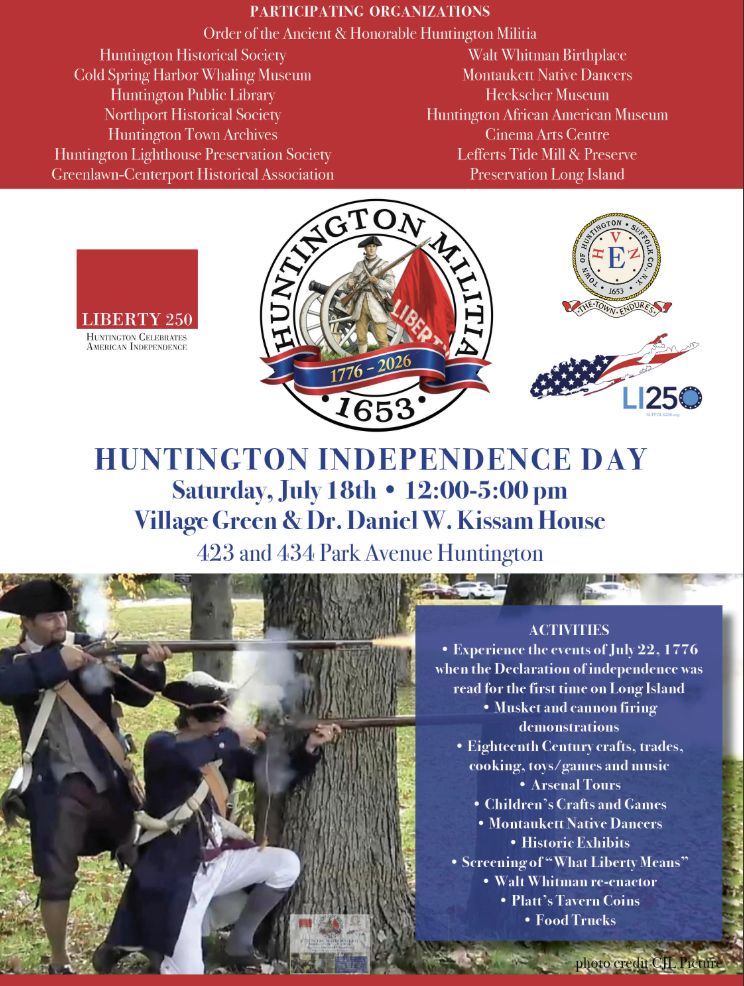
But the biggest event of the year will be Huntington Independence Day on July 18. As it has done every year since the Bicentennial, the Huntington Militia will reenact the events of July 22, 1776, when the Declaration of Independence was read aloud to the people of Huntington—the only documented public reading of the Declaration on Long Island in 1776.
Two hundred and fifty years ago, after the Declaration was read and received by Huntingtonians with great enthusiasm, the crowd modified the flag flying on the Liberty pole to create Huntington’s Liberty Flag, which was designated as the official flag of Huntington during the Bicentennial. The people created an effigy of George III which was hung and set afire. To top off the day, they retired to Platt’s Tavern where they drank thirteen Patriotic toasts.
These events will be reenacted once more along with displays and activities from local history organizations and museums and a showing of the “What Liberty Means” video at the Cinema Arts Centre.
In 2026, we may not have gun salutes or the ringing of bells at dawn or parades or lengthy speeches, but the event is being well marked to demonstrate that 250 years on, Liberty Endures.
 Huntington History