Feeds:
Posts
Comments

Archive for the ‘Uncategorized’ Category

Squadron Hill is a 1960 subdivision located about a half mile west of Huntington village.  Most of its inhabitants have been led to believe that the property was used by Theodore Roosevelt to train his Rough Riders prior to fighting in Cuba during the Spanish American war in 1898.  One of the streets in the development is even named Rough Rider Court.  There was once a sign on Main Street welcoming visitors to Huntington, “Home of the Rough Riders.”  In fact, some residents talked about Rough Riders coming back after the houses had been built to view their old training grounds.  But if anyone had stopped to do the math, they would have realized that a veteran of the Spanish American War would have been quite old by the time the houses were built.

The story isn’t true.

In 1898, Theodore Roosevelt was living in Washington, D.C.  After receiving permission to form an all-volunteer cavalry force to fight in the Spanish American War, he went to San Antonio, Texas where the First Volunteer Cavalry trained and was given the nickname the Rough Riders.  The closest Roosevelt’s Rough Riders actually came to Squadron Hill was Camp Wikoff in Montauk, where the unit camped after their tour of duty in Cuba.  Prior to the publicity surrounding Roosevelt’s unit, the term “rough rider” appears to have been a generic reference to cavalry men.

In later years, Theodore Roosevelt did visit Squadron Hill, but in 1898 the land that now comprises Squadron Hill was being farmed by Alfred Rogers, a member of a large and prominent family in the Cold Spring Harbor area (in fact, Turkey Lane was once known as Rogers Avenue).  One hundred years ago Squadron Hill comprised the bulk of the Rogers’ 100 acre homestead, which was made up of two parcels—twenty acres north of Lawrence Hill Road and 82.5 acres south of Lawrence Hill Road, bounded on the west by Peabody Road, on the south by Saw Mill Road and Woodbury Road, and on the east by the land of various neighbors.  The Rogers’ house, a five bay 2.5-story gable roofed house, still stands at 97 Lawrence Hill Road.  The north wing of the house is estimated to have been built in about 1820 and the main house in about 1860.  The house has recently been renovated and enlarged by its present owner.

Alfred Rogers had inherited the farm from his father, Moses Rogers. Moses Rogers’ father, Zebulon Rogers, was a Revolutionary War veteran.  Although the early records are unclear, it appears that Zebulon Rogers owned the homestead when he died intestate in 1820.  An inventory of Zebulon Rogers’ personal property includes among other things, a house (valued at $60), four cows and six sheep.  Moses Rogers appears to have acquired the homestead from his siblings following their father’s death.

Known around town as “Uncle Moses,” he was born on April 25, 1784 in the old homestead.  Moses Rogers, a wealthy but unpretentious man, was a farmer his whole life, working the farm up to within a few months of his death in 1878, just eleven days shy of his 94th birthday.  The Rogers farm was diversified.  According to the 1860 agricultural census, Rogers grew a variety of crops:  wheat, rye, oats, Indian corn, Irish potatoes, barley buckwheat and hay.  They also had 5 milch cows (producing 500 pounds of butter), 12 pigs and 50 sheep (producing 150 pounds of wool).   In addition to farming, Moses Rogers owned several ships, including at the time of his death “an interest in almost every coal schooner that went out of Cold Spring and many of the Northport vessels.”  He also served as the town’s Overseer of the Poor for several years.  On Moses’ death, the homestead passed to his son Alfred, who was born in 1820.

At his death 81 years later, Alfred was eulogized as one of Huntington’s “oldest and most respected residents.”   Two months before his death, Alfred conveyed the farm to his son Franklin P. Rogers for one dollar, reserving a life estate for Alfred and his wife, Phebe Ann.

Frank Rogers was the last of his family to farm the homestead.  In 1905 Frank, his wife Esther, and Frank’s mother Phebe Ann sold the 82.5-acre parcel south of Lawrence Hill Road to a Brooklyn-based National Guard cavalry unit for $15,000 (including two mortgage notes, each in the amount of $5,500; one payable to Frank, the other to Esther).

Frank apparently continued to farm the twenty acres of the homestead north of Lawrence Hill Road until about 1914 when he sold the remaining parcel to Jerome A. Suydam and moved to a house on Woolsey Avenue in Huntington.      Frank and Esther had no children.

TROOP C

The cavalry unit that purchased the farm was formed in 1895 after several unsuccessful efforts to organize a cavalry troop in Brooklyn.  But the 1895 trolley strike in Brooklyn, during which Troop A of neighboring New York City was called in to help control, “demonstrated the value of cavalry for State service, and the need of an organization in Brooklyn.”

In the spring of 1895, authorization was given by the Adjutant-General of the New York National Guard to organize a troop.  On August 27, 1895, the North Portland Avenue Armory in Brooklyn was converted from infantry use to cavalry use.  On December 16, 1895, Troop C was mustered into the service of the National Guard (the letter B was claimed by a troop forming in upstate Geneseo at about the same time).

The troop was composed of well-to-do gentlemen of Brooklyn—businessmen, lawyers, doctors and college students.  By 1898 the troop achieved full membership and when war was declared against Spain, the troop volunteered as a body to join the fight.

In May 1898, the troop trained for three weeks at Camp Black on the Hempstead plains, after which the troop was mustered into federal service as Troop C of the N.Y. Volunteer Cavalry and eventually saw combat duty in Puerto Rico.

By 1909, Troop C had a membership of 150 and a waiting list twice as long.  The troop was expanded into a squadron with the same letter designation under the command of Major Charles I. DeBevoise.  Following reorganizations and re-namings understandable only to the military mind, the Fourth Platoon of Troop C became Troop 6 of Squadron C and eventually Troop K of the First New York Cavalry.

SQUADRON C FARM

Membership in this National Guard unit was not strictly a military matter; There were social and recreational aspects as well.  In 1905, a few of the wealthier members of the unit formed Troop C Armory Auxiliary, Inc. and purchased the 82.5 acres of the Rogers homestead south of Lawrence Hill Road.  The farm was to be used as a riding club for members of the troop.  The troop members also opened a clubhouse across the street from the armory in Brooklyn.  The clubhouse was operated by Squadron C Cavalry Club of Brooklyn, Inc., which was formed in 1915 and was open to members of Troop C of the N.Y. Volunteers, Troop C and Squadron C of the N.Y. National Guard, and the First Cavalry of the N.Y. National Guard who were quartered in Brooklyn.

Squadron C's Sleeping Cabins:  One survives today

Squadron C’s Sleeping Cabins: One survives today

The purpose of the club was “to provide a Club House [in Brooklyn] for their meetings and social intercourse; and to promote their interest in the Cavalry service of the National Guard of the State of New York and preserve the traditions of their own past service.”

In 1929, the club’s charter was amended to include among its purposes the encouragement of recruits to join the cavalry service.  In 1921, members of the squadron formed Squadron C Farm Inc. to manage the squadron’s stock farm in Huntington.  The specific purposes of the corporation were “to breed and raise horses for military purposes and otherwise, and to keep, rent and deal in same, to sell its produce, to own the farm buildings and equipment thereon … and to have the farm used as a place of recreation, athletic exercise and military drills.”

The unit had always raised its own horses because, while the State of New York supplied saddles, bridles and other equipment, it did not provided horses.  The unit would buy and breed horses and sell those they didn’t want on the open market.  They started with only a handful of horses and by 1912 had 300 of the finest quality military horses in the country.  Representatives from the War Department came out to the Farm to inspect the horses and were impressed with their quality.


THE GREAT WAR

The Brooklyn men were mobilized in July 1916 for federal service on the Mexican border chasing Mexican revolutionary Poncho Villa after his attack on Columbus, New Mexico.  In March 1917, the unit was mustered out of federal service but remained as a National Guard unit.  Just four months later, the New York National Guard was called into service to fight in World War I.  By military alchemy, Troop K was transformed into Company A of the 106th Machine Gun Battalion and the cavalrymen were accordingly relieved of their horses.

While the Brooklyn men were preparing to fight in France, where they would be credited with helping to break the Hindenburg Line, the men of the Huntington Rifle Club met to consider forming a Home Defense Reserve, which would train at Squadron C Farm.

At the initial meeting on July 13, 1917 at the Masonic Hall, 24 men enlisted in a Home Defense League.  Sixty more joined at a meeting the next night.  Two volunteers had to be rejected from membership—Eugene Johnson, a veteran of the Civil War, was ten years over the age limit; and Thomas Miranda, an Italian immigrant, was not yet fully naturalized.

The League started drilling eleven days after its inception and made its first public appearance in the Town’s Labor Day parade that year.  A similar unit in Cold Spring Harbor mustered in as a Home Defense Corps under regulations promulgated by the Adjutant General of the National Guard.  The Huntington group intended to do the same, but Major C.S. DeBevoise of Squadron C recommended that they join the National Guard whose ranks had been depleted when its members were federalized.

The National Guard was now unable to perform its traditional duties, such as riot control or suppression of an uprising by the alien population (considered a real threat at the time).  Moreover, a trained force was needed as a back-up to federal forces engaged in Europe.  On September 26, 1917, 52 members of the Huntington group agreed to take the State’s oath of enlistment and became members of Troop K of Squadron C.  Troop K trained through the winter in Huntington village and along its highways.  The following June, horses arrived from the Armory in Brooklyn and cavalry training commenced at the squadron’s farm.  Huntington residents drove out to Squadron C Farm to observe the military preparations.

The local troop reached its greatest number in January 1918 when it had 64 members. The number dwindled as some joined the federal army and others dropped out as their enlistments expired and the Armistice obviated the need for the Guard.  After the war, the National Guard was reorganized and small, isolated units were transferred to armories throughout the state.  On October 30, 1919, Troop K was transferred to Brooklyn. The remaining 18 Huntington members were given Honorable Discharges on February 9, 1920.

A PART OF THE HUNTINGTON COMMUNITY

Despite being based in Brooklyn, the troop became a part of the Huntington community.  Huntington was becoming a popular summer resort for New York’s wealthy.  In 1909, The New York Times noted, ”with the arrival of Squadron C of Brooklyn at its summer camp here there will be a whirl of activity.  This crack military organization makes things hum when it comes here for its summer maneuvers.  Its presence also adds an element of activity to the general air of the resort.”

Squadron C donated a trophy awarded to the winner of the annual bobsled race held on Main Street (from the top of Cold Spring Hill to as far as New York Avenue) between 1907 and 1920.  In 1909, the Troop escorted the first car on the inaugural run of the Huntington-Amityville trolley line and participated in Fourth of July parades.  The troop also entertained local residents with monthly exhibitions and polo matches.  According to legend, the cavalry was once called to quell a riot caused by an armed robbery.  However, they also annoyed local merchants by galloping down Main Street.

It was during the early years of the Farm that Theodore Roosevelt was a visitor.  In August 1908 when he was President, Roosevelt rode an automobile over from his home in Oyster Bay to inspect the troops.  Later visits were unofficial.  According to William Stefurak, who joined the Squadron in 1936, older members mentioned Roosevelt’s visits.  The President would “sit on the porch with the guys and swap lies.”  The memories, records and photographs of some of the members, such as Bill Stefurak, provide a fuller description of the Farm and its activities from the late 1930s onward.

The entrance to the Farm was on Lawrence Hill Road, more or less where Donovan Drive now begins. A sign near the main gate read, “Ladies will please not pass this point.”  Ladies were thus deprived of visiting the race track to the right of the entrance road.  To the left was a practice polo field, followed by two clay tennis courts behind which stood two cement handball courts (which stood until recently in the yard of one of the houses on Donovan Drive).  South of the tennis courts were twenty bungalows, each equipped with six spring beds and with shutters on all sides that could be opened in the warmer weather.
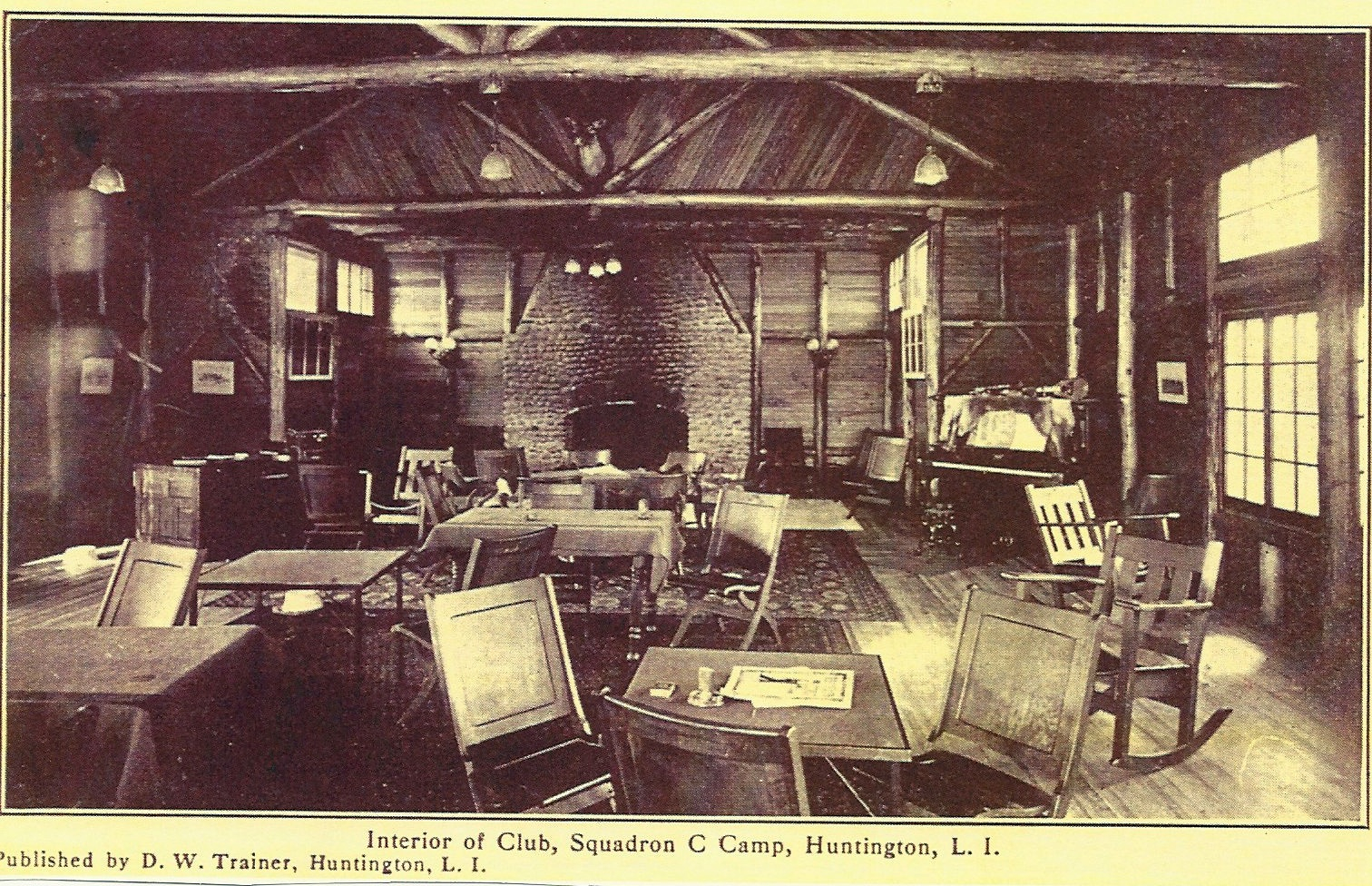
The Club House is gone, but the fireplace still stands

The Club House is gone, but the fireplace still stands

To the east of the bungalows stood the mess hall (which could accommodate 125 to 150 at a sitting) and the clubhouse. The stone fireplace for the clubhouse still stands in the yard of a house on Squadron Court.  The mess hall, which was at a right angle to the club house, stood more or less where Squadron Court is now.  Further south was the wash house or locker room and a water tower.

The road ended in a T intersection.  To the left (east) it led behind the wash house to a parking area.  To the right the road led to the stable complex which stood approximately where Donovan Drive and Rough Riders Court now intersect and consisted of a shed, four stables, a barn, a water tower and pump house.

To the south and west of the stables was the polo field.  The Farm was open from early July to early September.  From September to June the men trained once a week in the armory in Brooklyn.  During the summer months, the horses were stabled at the Farm.  Although the Farm was established for the benefit of the men, the horses seemed to be rejuvenated after two months in the fields eating fresh grass.

Some members lived at the Farm all summer commuting to their jobs in the city.  Most, however, came out just for the weekend.  Although there was no charge to stay in the bungalows, the men were charged for breakfast (50¢) and dinner ($1) whether they ate on the Farm or not.  Lunch was 75¢.  Active members of the squadron, who paid $4.25 a month in dues, were charged 50¢ to ride a horse at the farm.  Veteran members, who paid annual dues of $9, paid $1 to ride a horse.  The dues paid for the upkeep of both the Brooklyn clubhouse and the Farm.
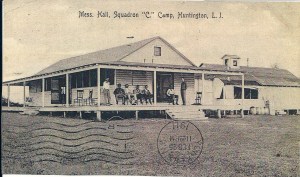
The Mess Hall

The Mess Hall

In the summer, the cooks from the clubhouse and the staff from the armory would come out to tend the horses and maintain the farm.  Members would arrive by car or take the train to Cold Spring Harbor, where they would be met by the farm bus.  Although the farm had tennis courts, handball courts and baseball diamonds, most men spent their time on horseback.  They could ride a trail with jumps through the hilly wooded section of the property along Peabody Road.  This area was known as the “Russian ride.”  The origins of that name are lost, explained Stefurak:  “There was an Italian jump on it.  Figure that out.”

There was also a sabre course in the southwest corner of the Farm where Peabody and Saw Mill Roads intersect.  Some members would organize races on the racetrack near the entrance to the Farm.  The track, which was in a hilly area, “was all up and down, the damnest thing you’d ever want to ride on,” remembers Stefurak.

The men would wear racing silks and odds would be placed, but it was all done for fun.  “You make a couple of bucks here, lose a couple of bucks.  And if you made it, you’d buy beer anyway,” explains William Hurley, who joined the squadron in 1938.

Members would also ride out through the surrounding countryside.  A brochure for the 1937 season boasts of “the diversity of scene found in this charming wooded, rolling country. . . .   The region abounds in bridle paths, so that little or no riding need be done on main highways.”  Destinations included the Otto Kahn estate, Eagle Dock Beach in Cold Spring Harbor, and a German beer garden in Melville.  “We always went up to Melville,” recalls Bill Hurley.  “At that time, the property around the Farm was farms; potato farms and so forth.  You could ride right from the Farm itself right to Melville.”

Polo matches between the squadron’s team and teams from the U S. Army and local polo clubs were held every Sunday.  Spectators would enter through the white gate, which still stands, on Woodbury Road just east of Saw Mill Road.  The members, most of whom were single, rode hard during the day and raised hell at night.

Some went into town on dates with the nurses from Huntington Hospital, but most spent their evenings on the Farm.  While the Farm was run like an exclusive country club, Hurley says, “the men themselves came from all walks of life.  You had attorneys and you had draftsmen and you had bus drivers.  You name it.

“We lived like millionaires.  We were the working class of Brooklyn and we lived very well,” adds Stefurak.

But on the eve of World War II, the Farm was once again used for military training.  Members enlisted in the federal service for one year from January 1941 to January 1942. That one year enlistment was soon extended for the duration of the war.

The Farm fell into disuse and was leased to a local farmer to graze his cows.  Reportedly the turf at the Farm was so good that during the war some of the sod was transplanted to Ebbets Field in Brooklyn, which was three blocks from the Squadron’s armory.  To help commercial farmers work their fields in the face of labor shortages during the war federal and state agricultural agencies proposed using the Farm to house 250 Bahamans, who would work on local farms.  The Huntington Town Board denied the request because it would violate local zoning laws.

World War II also saw the demise of the cavalry.  Horse fighting was deemed incompatible with modern warfare and both the U.S. Army and the New York National Guard abolished their cavalry units.  During the war, there were no active members paying their $50 a year in dues, so “the Board of Governors had to make a choice between the Farm and the clubhouse. Most felt under the circumstances it was better to hold on to the Farm and to sell the clubhouse, which they did,” explains Hurley.

While the men were training at Fort Devens in April 1942, club officials came up and told them to sign their rights to the Farm over to Squadron C Cavalry Club.  In May 1942, Troop C Armory Auxiliary conveyed the farm to the Squadron C Cavalry Club of Brooklyn, Inc. for a nominal sum.  In August 1942, the club’s charter was again amended,

this time to allow the club to hold real property and thus legitimize the purchase of the Farm.  To be sure of good title, the club also received a quitclaim deed from Squadron C Farm, Inc., which had been managing the property for over twenty years.

AFTER WORLD WAR II

In the summer of 1946, after returning from service in the Pacific theatre, Stefurak took his wife Ruth out to see the Farm.  They found the buildings intact but surrounded by four-foot high grass.  Some of the grass was trampled down in a path leading to one of the bungalows.  Inside, Stefurak found three other members of the cavalry club, John Delapina, Arty Campbell and Bill Sloan.  Stefurak asked, “Why don’t we get some of the guys together and get the farm going again?”

And that’s what they did.

They cut the grass, painted the buildings, rebuilt the tennis courts, planted flowers around the clubhouse and maintained the pump house, which according to Stefurak, produced “the sweetest water you ever tasted.”

Still missing were horses.  Since the cavalry unit was disbanded, there were no horses to bring out from Brooklyn.  Squadron A, in Manhattan, did manage to hold onto its horses.  Squadron A loaned the horses for the summer in 1947, but someone let them loose and the privilege was not extended the following year.   Instead, the club entered into a month-to-month lease with John and Francis Rice to operate a horse farm on the site.   In addition to receiving rent from the Rice brothers to pay the property taxes, club members could ride the horses for $2.  Weekends at the Farm were now more do-it-yourself.  There was no staff to cook meals and no set schedule of fees.  Instead those who came out put up five dollars and shopping details were organized.  The shoppers would drive into Huntington village, buy some steaks at Berger’s Butcher Shop on New Street and then stop at Finnegan’s for a drink before driving back up to the Farm.  The steaks, or sometimes lobsters, were barbequed on Saturday night.  “At night we got dolled up and we went out,” remembers Stefurak.

Enjoying the Club House after the war

Enjoying the Club House after the war

In addition to tennis, the men, and now their wives as well, would continue to ride horses out into the countryside.  The Melville beer garden was still a popular destination.  They would also visit the Marshall Field estate to swim in the Long Island Sound (the club members were admitted to the still private estate by the stable hands who knew them from the pre-war period).

Sunday dinner was at Ma Glynn’s on East Main Street or Rothman’s in East Norwich.

Bill and Ruth Stefurak were post-war regulars at the Farm.  “It was a great weekend.  I’d come out here. I’d ride, play tennis, swim, have a good drink, good eatin’.  What more could you ask for?  We had everything for nothing.”  Immediately after the war, 50 to 60 members would regularly gather at the Farm for picnics.  But as time went on and families grew, the number dwindled to about twenty, then to only 10 or 12.

The Rice brothers converted the polo field into a show ring and gave riding lessons and organized horse shows there.  In 1949, the Irish American Club held its first Irish Field Day at the Farm.  Four years later, tens of thousands of visitors took part in the Town’s three day Tercentenary celebration at the Farm.

Starting in 1950, members of the New York Greyhound Owners and Breeders Association transformed the old saber course into a dog racetrack complete with starting gates and an electric rabbit.  Non-betting races were held every Sunday until 1966.

DEVELOPMENT

Almost as soon as the Farm was up and running again after the war, efforts to sell the land began.   Despite the desire of World War I era veterans to sell the Farm, the younger members kept the Farm going for 15 years.  Eventually, club membership, which due to charter restrictions could not be replenished, was dwindling due to deaths.  Furthermore, the club stopped accepting new members from among those who were eligible to join.  Some members quit the club because of this change in policy.  The older members argued that the purpose of the club—to encourage enlistment in the cavalry—was impossible because the cavalry no longer existed.  Moreover, they argued, why keep the place going for the select few “who raised hell” on the weekends.  The younger members, not all of whom used the Farm regularly, disagreed.  They claim that the old-timers got greedy.

“They saw a good plot of land on which they could build and make some money on it.  And they wanted to take advantage of it,” explains Stefurak, who vehemently opposed the sale.  Stefurak didn’t see it as simply a question of the club maintaining a playground for just a few members.  He asked, “What are you going to get out of it?  A few hundred dollars?   Doesn’t it make more sense to donate it to the Town of Huntington and establish an open preserve and maybe have horses there so your grandchildren can see it?  Wouldn’t that be worth a couple of hundred dollars a piece to you?”

Members opposed to the development of the Farm suggested donating the land to the Huntington School District, which was looking for a site for a new high school, or to the boy scouts.  In fact, the Huntington school district in 1955 had a referendum to approve the purchase of 54 acres of the Farm to build a new high school to replace the crowded Main Street school (now Huntington Town Hall).  The voters rejected the proposal by a vote of 1162 to 848.  The new high school was built just a few years later on Oakwood Road.  New York State approached the club about acquiring some of the land for an armory, but was refused.  Another suggestion to re-route the proposed Bethpage State Parkway extension to Caumsett State Park from the shores of Cold Spring Harbor through the farm and Huntington Country Club was also not pursued.

Bill Hurley, who did not visit the Farm much after the war, felt “there was an awful lot of skullduggery going.”  He believed that many of those pushing the sale were also part of the group that sought to purchase the property.  “They didn’t own the property.  They didn’t put a penny down for the purchase price,” Hurley complained.  Moreover, the club could afford to keep the Farm.  In 1960, the annual real estate tax, insurance and maintenance costs for the property amounted to about $4,000.  Dues from 144 members (there were also 22 life members who did not pay dues) netted the club $1,300 and the Rice brothers lease brought in $3,480 a year.

However, if the Rice brothers, who had a month-to-month tenancy, decided to vacate, the club would have an annual deficit of about $2,700, an amount that could quickly deplete the club’s liquid assets of $10,500.  The club’s Board of Governors, which considered the land underutilized and thought the club could benefit more from the money than from continued use of the land, approved the sale to Rough Riders Farm, Inc., the president of which was George R. Tollefsen, a member of the cavalry club.  The purchase price was $290,000.

Although not required, the sale was also voted upon by the membership at large which also approved of the sale by a vote of 79 to 33. Considerably more than the handful of members who used the farm regularly voted against the sale. The opponents of the sale were extremely bitter. “It kind of broke our hearts,” Stefurak recalls.

Proceeds of the sale were divided among the club members, each receiving $1,800 (about $13,500 in 2012 dollars) in two or three installments as the mortgages were paid off.  A fund was set up to establish an endowment to be given to the Brooklyn Historical Society to preserve materials and artifacts that the club had donated to the society.  Each member was asked to give $100.  Hurley gladly gave to the fund: “I felt this is for a good cause.  It’s good for the artifacts which I was part of for so many years and I’m getting the eighteen hundred dollars gratis, so why not give a hundred to this fund.”  The members raised $10,000 which “at that time seemed a tidy sum.”

In 1962, a proposal to develop the property with luxury apartments went nowhere.  The clubhouse burned to the ground in a spectacular fire in October 1962 with flames reaching 50 feet in the air.  Rough Riders Farm, Inc filed a subdivision map with the county on June 4, 1964.  The map depicted three new streets.  The names of two of the streets recall the land’s cavalry past—Rough Riders Court and Squadron Court.  The principal street, Donovan Drive, was named after Rough Riders Farm, Inc.’s lawyer and principal, James B. Donovan.  Donovan, a partner in the firm of Watters and Donovan, served as general counsel to the Office of Strategic Services during World War II and as an associate prosecutor at the principal Nuremberg War Trial.  He gained notoriety in 1957 when he was appointed to represent accused Soviet spy Rudolf Ivanovich Abel, who was exchanged for U-2 pilot Francis Gary Powers.  He later negotiated the ransom of prisoners taken by Cuba in the failed Bay of Pigs invasion.

In December 1964 Rough Riders Farm, Inc. conveyed the property to Laurel Estates Corp., which built and sold houses of Squadron Hill.  Later that month, the last horse show was held at the Farm.

The first residents of Squadron Hill’s new incarnation arrived in 1966.  Today, Squadron Hill consists of 40 houses on 1.5 to 2 acre lots, three ground water recharge basins and a 3.9-acre town park.  Almost half a century of suburban landscaping and natural forest succession mask the area’s prior use as a farm, military training camp and summer retreat for the rough riders of Brooklyn’ Squadron C.  All that remains are the old stone fireplace, an old barn, one of the sleeping bungalows, and the white gate on Woodbury Road.

Read Full Post »

While the welfare state is considered a modern development, caring for the less fortunate among us is not a new concern.  And while today it is considered a federal and state responsibility, until the last quarter of the nineteenth century it was a local concern.  In Huntington, the first record of aid to the poor is dated 1729.  The Town continued to care for the poor until 1872, when the responsibility was passed onto the County.

Caring for the less fortunate is an ancient practice.  Ancient Babylonian, Greek, and Roman societies imposed a duty to provide for the poor.  The Bible also imposes such an obligation.  The Old Testament speaks of the duty to aid the sick, the old, the handicapped and the poor.  The injunction is repeated in the gospel of Matthew:  “whatever you did for one of these least brothers of mine, you did for me.”

In medieval England, the responsibility to provide for the poor fell to the church through its extensive system of monasteries.  But with the abolishment of monasteries under Henry VIII, the obligation fell to secular authorities at first supported by voluntary contributions and then after 1572 by a compulsory assessment (i.e. taxes).  Further amendments led to the enactment of the Elizabethan Poor Law of 1601, which was based on the principle of local relief supported by local taxes.  Under the direction of a town’s Overseers of the Poor, the unemployable were given direct aid, the young were given apprenticeships and the able bodied were given work relief.

This system was brought to the New World by the English settlers.  The obligation to provide for the poor led to restrictions as to who could settle in a town lest they become indigent and in need of relief.  In thirteenth century London, “No ‘stranger’ was allowed to spend more than one day and a night in a citizen’s house, and no one might be harboured within a ward ‘unless he be of good repute.’”[1]  Four centuries later the selectmen of Boston “prohibited citizens from entertaining strangers for more than two weeks without first securing official permission; if the visitors seemed likely to stay longer and become a public burden, such permission was denied.”[2]  Likewise, in 1662, the townsmen of Huntington ordered that no resident of Huntington shall sell or rent his house or lands to anyone who has not been approved by a committee appointed for the purpose of approving such transactions.  Failure to secure such approval would incur a fine of £10—a substantial sum to be sure.[3]

Due to its small population and approval of new inhabitants, Huntington probably did not have to worry about poor relief in its first three quarters of a century.  In 1729, the Town paid Eliphalet Hill £8 for “keeping Sarah Scudder the Last Year.”  This charge accounted for 80% of the Town’s expenses for that year.[4]  Over the next 23 years, others received support from the Town, but the need must have been limited because the Town did not formally appoint Overseers of the Poor until 1752.  For ten years, the Town’s Board of Trustees acted as Overseers of the Poor.  Beginning in 1763, a separate group was appointed.

The early records of the Overseers include payments to local doctors for tending to the poor and bonds posted by individuals to guarantee payment for the support of children born out of wedlock.  In many of these cases, the bonds are posted by the reputed father to secure payment for the education and upbringing of the child.  For example, in 1776, Nathaniel Youdal and Philip Youdal (presumably Nathaniel’s father) posted a bond in the amount of £200 to guarantee that the male child of Mary Jarvis, a single woman, would not become the responsibility of the Town. Nathaniel Youdal was reputed to be the father.  In many other cases, the bond was posted by the father of the newborn’s mother.  For example in another case from 1776, Hezekiah Smith posted a bond to guarantee the support of the child of Susanah Smith, his daughter.  The baby’s father was William Buchanan of Smithtown, which placed him beyond the jurisdiction of Huntington’s Overseers.

The main duty of the Overseers was to provide for the care of the poor.  This was done in a variety of ways.  Children could be placed in an apprenticeship.  Such was the case for five-year-old Samuel Hand in 1777.  He was bound to Sarah Bunce for a period of eleven years.  Young Samuel was obligated to faithfully, honestly, and obediently serve “as a good and faith[ful] apprentice ought to do.”  For her part Sarah Bunce was to provide sufficient meat, drink, apparel, washing, and lodging.

Older poor residents, such as widows, the disabled and the mentally ill, were placed with local families who would be paid by the Overseers to provide “them meat, drink, washing, lodging, mending & nursing Suitable and find all their Clothing that is necessary for one year from the date, and return them as well clothed as they took them.”  In these cases, care of the indigent was “auctioned off” to the lowest bidder.   Prices varied from person to person.  Without knowing the particulars of each person’s situation, it is impossible to determine why.  In 1806, John Conkling was paid $51 to take in Ruth Lewis.  Silas Plat was paid almost twice as much ($95) to take in Mary Williams and her daughter.  Meanwhile, Micah Bedell was paid the same amount ($95) to take in Henry Chadeayn.  Timothy Bennett received $19 for taking care of Elizabeth Price, who is identified as a child.  Other similar amounts must also be for children.  From this small sample, we can deduce that it was less expensive to feed, clothe and house children than women, who in turn were less expensive to take care of than men.

At the Town’s annual meeting on April 3, 1821, it was resolved that “the Poor of Sd   Town be put out in bulk and that one person be hired to keep them all together provided the Trustees of Sd    Town approve of the price asked and if not for them to be put out in the Usual manner.”  It appears that this new arrangement was not carried out in 1821 or in the subsequent two years.  In 1824, the Trustees were given authority “to dispose of the Poor of the Town in the most comfortable and economical manner.”  Likewise the Overseers records for that year refer to the possibility of providing a central house for the care of the poor.  Eventually, the Overseers and Trustees decided to buy a farm on the west side of the Green for use as a poor house.  Rather then being sent to various private homes throughout the town, the poor would be sent to this farm.  Within the poor house, the races were segregated.  According to the records, several people refused to go to the poor house.  The Trustees in 1825 ordered that all paupers were to be provided for at the poor house.  “Those who refuse to conform are to have no assistance except extraordinary cases at the discretion of the Overseers of the poor.”  That year nearly two dozen residents lived at the poor house.

In this respect, Huntington would be in the vanguard.  Throughout the state, resentment over the system of providing outdoor relief, that is, outside of a poor house, was growing.  Many felt that the poor were not thankful enough for the relief they received, and that aid destroyed the incentive to work.  In 1823, the New York State legislature commissioned Secretary of State J.V.N. Yates to conduct a study of poor relief throughout the state.  Yates sent questionnaires to Overseers of the Poor and presented his findings in February 1824.  He found that the auction system through which the poor were farmed out to private homes was inefficient; and that the poor were often treated cruelly.  “Moreover, the education and the morals of children were almost wholly neglected.”  Children “grow up in filth, idleness, and disease, becoming early candidates for the prison or the grave.”  Moreover, “the able bodied poor were rarely employed; home relief encouraged idleness, and ‘vice, dissipation, disease and crime’ resulted.”[5]  [According to the Yates Report, Huntington had 51 paupers in 1823 (22 males, 29 females), ten of whom were children and the Town spent $1,316.12 to support them.  “The paupers are placed in various families by contracts for the year, until the ensuing town meeting.”  There is no reference to Huntington experiencing the deplorable condition cited elsewhere in the report.]

Yates recommended that the poor be cared for in an institutional setting, which it was felt would be more efficient.  The legislature enacted the County Poorhouse Act, which directed each county to purchase land “and thereon build and erect, for the accommodation, employment and use of the said county, one or more suitable buildings, to be denominated the poor house of the county.”  Suffolk County did not purchase land for a poor house until 1870, however, so the relief continued to be given at the town level.

By mid-century, Huntington’s Town expenses totaled $3,000, of which about $2,100 went to care of the poor.  The number of poor helped by the Town averaged about 15.   Dissatisfaction with the expense of the program and the perceived mismanagement of the poor house led to a meeting at the hotel of Ezra Smith in Long Swamp to discuss the matter. Despite the stormy weather, the meeting was well attended.  Some argued that the poor house should be done away with.  Others argued that better care of the poor was possible with a woman in charge of the poor house—a woman could also be paid less than a man.   A committee was appointed to confer with the Overseers of the Poor to present a solution.  Three weeks later the committee presented its report recommending that those who could be placed with relatives at less cost than keeping them at the poor house should be so accommodated.  However, some of the poor had no relatives in town; others were inflicted by disease that would render such placement impossible.  The committee suggested that a suitable manager be found who could work the farm for the support of the poor and that the residents (inmates as they were then called) should assist with the farm work when able.  The Overseers were to make weekly inspections of the farm to ensure its efficient operation.

The next month, the Overseers engaged Nathan Wiggins to manage the farm and poor house.  He was provided with equipment to work the farm, the produce of which was used to support his family as well as the residents of the poor house.  Wiggins was also entitled to sell pine wood from the farm.  In addition, he was paid 98¢ per week.

The poor house approach was continued for many years thereafter.  However, in 1868, the farm on the Green was exchanged for the 70-acre Elias Smith place in Long Swamp.  The move was welcomed because it was felt that having the poor house in the middle of the village was a nuisance.  “A congregation of men and women so near the main road sunning themselves on pleasant days, and using all sorts of profane and obscene language, is not very pleasant for passers by, or those that reside in the vicinity.”  It should be remembered that some residents of the poor house were there due to mental illness.  The new location had the added advantage of being over two miles from town, which would dissuade ”the inebriates” from “the habit of having their bottle filled.”[6]

The new poor house was also used as a venue for Town meetings.  But it didn’t last long.  In 1871, a County poor house was established in Yaphank.  By May of that year, there was talk of selling the poor house.  On December 5, 1871,  at a Special Town Meeting, it was resolved to remove the poor to the County alms house and sell the Town House, as it was known. The Overseers of the Poor them met at the Town House to make arrangements for the relocation of the residents to Yaphank.  A fire was lit in an unfrequented room.  Due to a defect in the chimney, the fire escaped the chimney and spread to the attic.  The building was a complete loss.  “The inmates of the house were immediately carried to the Railroad station and sent to the County House the same afternoon.”  (The Long-Islander, December 15, 1871).

The poor house or alms house remained the means of providing relief in New York State until 1929 when the Public Welfare Law was enacted


[1] London, The Biography, by Peter Ackroyd (London: Vintage Books, 2001), page 61

[2] From Poor Law to Welfare State, A History of Social Welfare in America, Sixth Edition, by Walter I. Trattner (New York:  The Free Press, 1999), page 19

[3] Huntington Town Records, Volume I, page 40-41

[4] Records of the Overseers of the Poor Addendum 1729-1843 (Town of Huntington 1992), page 1

[5] Trattner, page 58.  Thanks to David Weinstein for locating an online copy of the Yates Report.

[6] The Long-Islander, April 3, 1868

Read Full Post »

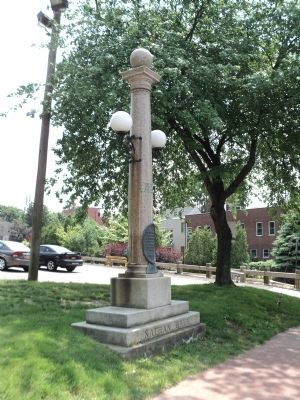
When Frederick MacMonnies 13′ tall statue of Nathan Hale was dedicated in New York’s City Hall Park in 1893, it was suggested that a suitable memorial should also be placed on the shores of Huntington Bay where Nathan Hale began and perhaps ended his spying mission in September 1776.  A committee of local citizens was formed.  Originally, the committee planned to place a granite boulder from Connecticut, Hale’s home state, on the shore of Huntington Bay.  It was thought that a bronze statue on Main Street in Huntington village would also be appropriate. [Huntington does have a copy of the New York City statue–but much smaller.  It is in safekeeping in the Town Clerk’s archives.]

Nathan Hale 1

The 1894 Memorial on Main Street

As it turns out, the Main Street memorial—a marble shaft, rather than a statue—was ready first.  The shaft was erected in front of the library, which at that time was located in the Soldiers & Sailors Memorial Building, and was dedicated on July 4, 1894.  The committee did not realize its goal of placing a Connecticut boulder on the shores of Huntington Bay.  But the same year the Main Street memorial was dedicated, George Taylor, the president of a prominent Manhattan dry goods store, purchased a large tract of land in Huntington Bay.  Taylor soon became enthralled with the Nathan Hale story—no doubt because he now owned the land where Hale landed.  Taylor named his estate “Hale-Site,” a name that was soon applied to the entire section on the east side of Huntington Harbor.  Taylor, at his own expense, also completed the second part of the memorial committee’s plan.  He arranged for local contractor Oscar “Dynamite” Kissam to move a large boulder from near Taylor’s house to the beach.  Perhaps unwittingly realizing the committee’s original intent, the boulder did, in fact, come from Connecticut, courtesy of the last glacier.  Taylor also had three bronze plaques affixed to the boulder, telling Hale’s story.

For three quarters of a century the boulder stood on the beach at the end of Vineyard Road, where, unfortunately, it was subject to the effects of erosion and vandalism.  Ownership remained in the Taylor family.  At one point Taylor’s grandson, Balmor Taylor, removed the bronze plaques for safekeeping.  As early as 1962, he also explored transferring ownership to the Town of Huntington.  It appeared that an agreement had been reached and in 1974, town workers removed the 45-ton boulder from the beach and transported it to a new home at the intersection of New York Avenue and Mill Dam Road.  Mr. Taylor, however, did not think he and the Town had reached an agreement.  Over the next two years, differences were resolved and an agreement was reached.  The boulder was rededicated at its new location on September 19, 1976, two hundred years after Hale’s mission.

Nathan Hale Rock

The Nathan Hale Rock before its latest move

But that was not the last stop for Huntington peripatetic monument.  As part of the current road improvement project along New York Avenue, the New York Department of Transportation constructed a roundabout at the intersection where the boulder stood.  The rock would be in one of the travel lanes around the new traffic circle.  So last September (2012), the monument was moved once again.  This time the move was only about 50 feet to the southwest corner of the intersection.  When the roadwork is done, the area around the rock will be landscaped.

The Town of Huntington continues to celebrate its most famous visitor.  Just be careful when you read an earlier description that says the rock marks the spot where Nathan Hale landed.  He did not land at Mill Dam Road.

Read Full Post »

Until it was developed in the 1920s, the area between Depot Road and Lenox Road from Ninth Street south to a point south of Vondran Street was home to a one-mile horse racing track featuring a 1500 seat grandstand, a club house, large barns and open fields.

Horses had been raced at this site since as early as the 1840s.  The Suffolk Racing or Driving Course was a half-mile track that reportedly was the scene of some the first races run by the legendary horse “Lady Suffolk.”  These early races featured trotters pulling a driver in a sulky.  The track sat on a 47-acre parcel and endured an uneven history with different owners and operators.  Races were held sporadically.  For example, in 1874, the summer meeting lasted just three days with only two or three races each day.  Nonetheless, the meet was popular enough to attract visitors from Brooklyn by way the Long Island Rail Road.

After the Civil War, concerns were raised about the future of the track.  In 1878, it was suggested that a fair be held at the course—so long as it didn’t detract from the county fair in Riverhead.  But it took another decade for the idea to be realized.  In 1886, Henry C. Brown, proprietor of the Long Island Brewery in Brooklyn and a recent resident of Northport (his home is now the Indian Hills County Club), organized the Huntington Live Stock Fair Association.  Despite the Association’s best efforts, the grounds were not ready for the hoped for opening in 1887.  The Association had purchased additional land around the track and had made extensive alterations to the grounds and the track itself.

The track and fair grounds were formally opened on the Fourth of July the following year.  The track was hard and pebbly; the grand stand was missing some final details and needed a coat of paint.  Nonetheless, attendance was excellent.  The wealthy summer residents of East Neck and from miles around came.  So did local farmers and their families dressed in their Sunday best.  Several races were run—but there was no betting.  Between heats, a brass band played.  Visitors enjoyed the scene from the wide balconies of the club house; and enjoyed meals in the lunch rooms.  The grounds were surrounded by open meadows and fields of grain with forests on the distant horizon.  It was a “picture so full of beauty and variety” that it “calms the mind when agitated by conflicting thoughts.”  Further improvements were made in time for the September races, erasing all memory of the “unsavory Mecca of the horsemen of olden times.”

Fair Grounds

By September–when the Association’s first annual fair was held—every pebble had been removed from the track, but racing was not part of the program.  The event featured livestock shows, displays of local produce and flowers, samples of bread, cakes, pies and jellies, as well as quilts and paintings.  Wagons and carriages, and farm equipment were displayed.  Visitors could ride the merry-go-round, have their photograph taken, or watch a baseball game between the Suffolks and the Norwalks.

It was a welcome diversion for a town that had experienced a terrible blizzard the previous March and a devastating fire that had destroyed the block of stores known as the Brush Block, a carriage factory, blacksmith shop and the Central Presbyterian Church just a week before the fair opened.  But the first day of the fair also featured rain, which turned out to be an omen of things to come.  In succeeding years, rain would be a constant problem for the fair’s organizers.   Even though the Long Island Rail Road ran extra trains to get visitors to the fair, which was only a few minutes walk from the train depot, rain kept them away.

By 1893, the Live Stock Association had defaulted on its debts.  A new company, known as the Long Island Fair Grounds Association, was formed to take over.  The group intended to resume the fairs, but it seems the only activity was horse racing.  In 1905, an effort was made to incorporate a new organization—The Huntington Fair and Exhibition Company—to purchase the property and resume the fairs.    The grounds were instead purchased by Singleton Van Schaick, son of one of the founders of the Huntington Live Stock Fair Association.  In 1921, the old fair grounds were purchased by Addison Sammis, who turned the land over to the Huntington Station developers, Koster & Cornehlsen, who subdivided the land into 20 foot wide lots and began building houses where the horses had once raced.

Perhaps the only tangible reminder of the old race track, other than horse shoes found buried in the area, are the cement pillars that flank the south entrance to East Park Drive.  According to neighborhood lore, the pillars were a part of the stable area and were where the jockeys dismounted from their horses.

Although the annual fairs did not last, they did give rise to a new name for the surrounding community—Fair Grounds.  But that too turned out to be a temporary appellation.  In 1911, the name was changed to Huntington Station.

Read Full Post »

Paved with Good Intentions

Roads in Huntington today are mostly paved in asphalt.  There are a few concrete roads—especially in Northport—and maybe even a dirt road or two.  But a hundred years ago, Huntington’s Main Street was a wood road.

In 1911, the Town Board decided to pave Main Street with wood blocks.  At the time the road was basically a dirt road with a covering of Peekskill gravel.  It tended to get muddy in wet weather and dusty in dry weather.  For many years around the turn of the twentieth century, Samuel Shadbolt would ride up and down Main Street in a wagon equipped with a water tank in an effort to keep the dust down during the summer months.  In 1907, George Taylor circulated a petition asking that oil be used instead of water because it would last longer.  Those who favored water circulated their own petition.  They say oil and water don’t mix, but that didn’t keep several storeowners from signing both petitions.

The decision was made to use oil.  But oiling the dirt road was not good enough.  For one thing, it did nothing about the mud after a rainstorm.  For another thing, the advent of automobiles took their toll.  In 1907, The Long-Islander predicted that with the arrival of William K. Vanderbilt’s Long Island Motor Parkway, Huntington would became “an Arcadia for Autoists.”  One Sunday afternoon that summer, Mrs. Thomas Aitken counted 250 automobiles pass along Main Street in just three hours.

Four years after the oil was introduced to Huntington’s streets, the Town Board decided it was time for a more permanent solution.  This time salvation from mud and dust came in the form of wood

Image

blocks measuring 8” x 3” and 3” deep (the block pictured here measures 7¾” x 2¾’”and 2½“ deep).  The work began in September 1911.  The blocks were laid on a concrete foundation from New York Avenue to Green Street (the wood paving was extended to Prospect Street two years later).   Private companies wishing to lay water, electric, telephone, or gas lines were warned to do their work before the wood blocks were laid because they would not be allowed to dig up the blocks once they had been installed.

There was some discussion as to the effect the new surface would have on the annual bobsled races down Cold Spring Hill into the village.  Would sleds go faster and further; or slower and less far?  The blocks also inspired a weekly newspaper column, “Along the Wood Blocks.”  The column was inaugurated soon after the blocks were laid and ran for five years.  The witty observations exposing the foibles, idiosyncrasies, and charm of the local population and extolling the beauty of their town were signed, appropriately enough, with the name  “Creosote.”  The writer was, in fact, Harry R. Fleet, a Huntingtonian who had enjoyed a long career in newspapers.

The wood blocks lasted until 1927.  Despite the warning to the utility companies, over the course of a decade and a half, so many holes were dug into the blocks—and improperly filled—that it was almost impossible to keep the street in decent shape.  Out with the wood blocks, in with concrete.

Blocks were salvaged by local residents.  Some were burned to heat houses.  The one pictured here—along with a few thousand others—was used to pave the new cow barn at the Park Avenue Dairy.

Read Full Post »

Over the last half-century, the Town of Huntington and the County of Suffolk have assembled an impressive collection of open space totaling some 520 acres in the Crab Meadow section of Huntington.  But a small portion of that land was acquired by the Town more than 350 years ago.

Under the Town’s colonial patents issued by various royal governors, the Trustees of the Town were granted all lands that constitute the town.  Over the years, the Trustees sold almost all of the land.  The few remaining trustee lands include the beach at Crab Meadow.  As early as 1901, several residents had erected shacks on this beach.[1]  In 1907, residents of the area sent a petition to the Town Board requesting the Town to remove the houses; “thereby giving all citizens of the Town the use of said property in common.”[2]  The Huntington Board of Trustees retained attorney Willard Baylis to render an opinion on the legal status of these shacks.  After examining records at the County Clerks’ Office as well as the Town Clerk’s Office, Baylis concluded that the Board of Trustees had never conveyed the lands at Crab Meadow beach.  As a result, none of the persons who erected the structures on the beach “has any right in or title to such beach, and certainly their possession has not been long enough in time or of such character as to give any of them adverse rights against the Town, or its Trustees.”[3]

The beach in question extended from the highway leading south from the Sound (what we know as Waterside Avenue) east to the Gut or creek that flows out of the meadows south of the beach.  Prior to 1890, the road jogged to the east and separated the Trustees’ land, which was on the east side of the road, from private land on the west side of the road.  In about 1890, the road had been straightened, and as a result 196.7 feet of the private property along the Sound was now on the east side of the road.

That parcel was part of the land acquired by Willis B. Burt from William Chesebrough in 1900.  Burt developed the land on the west side of the road as Waterside Park.  On the beach on the east side of the road, Burt operated a private beach pavilion.

After Baylis confirmed the Town’s ownership of the beach property east of Burt’s pavilion, residents petitioned the Town Board to maintain the beach as a public park and to appropriate $5,000 to equip and maintain the park.  Proponents pointed out that most of the town’s waterfront was owned by private parties and was, therefore, inaccessible to the public.  In fact, the Town’s only waterfront park at the time was Halesite Park, which had opened a dozen years earlier and had only 200 feet of shoreline along Huntington Harbor.  The proposal was the subject of a special town wide referendum held in October 1919 at the Centerport firehouse.  The two resolutions passed by a 4 to 1 ratio.[4]  Once the park was established, Burt served as the manager of the park on behalf of the Town, in addition to operating his concession stand.

Unfortunately, swimming at Crab meadow was not without risk.  Northeast storms had built up a peninsula from the east side of the Crab Meadow Creek across the outlet of the creek, which diverted the flow of the creek westward directly in front of the town beach.  The swift current created hazardous swimming conditions, especially for children.  The dangers presented by this situation were brought to the Town’s attention as early as 1920,[5] but it would take decades before the problem was resolved.

An attempt in 1920 to cut a channel through the peninsula so that the creek would flow north into the Sound rather than along the beach was met with a letter from one of the owners of the adjoining land on the east side of the creek.  Edwin H. Brown asserted that he and his partner Frank Lambert owned the peninsula.   Lambert and Brown had purchased land on the east side of the creek in 1903.[6]  They claimed ownership of the peninsula as an accretion of their property.[7]  Brown warned the Town, “I hereby forbid the work above mentioned and give notice that if, as I believe, we can establish title to said land I shall claim and endeavor to collect damages if the work is continued.”[8]

Despite Brown’s warning, the Town hired Burt to proceed with the work in 1923.  Brown made good on his threat and sued. The case dragged on for the next twenty years during which time attorneys became ill, interested parties died, and settlement talks fell apart.  All the while, the current caused by the peninsula continued to pose a threat to swimmers.

In the meantime, thousands of residents visited the beach each summer.  Five years after voters approved a resolution to create a park at Crab Meadow, they approved another resolution to spend $20,000 to acquire Burt’s property on which he operated his pavilion.[9]

But the park’s popularity was not without its downside.  Residents of Waterside Park complained about late night partying at the beach.  Members of the Waterside Park Association, many of whom were Brooklynites with summer homes at Waterside Park, reported that young people would arrive at the beach late in the evening after the town’s beach pavilion had closed and they would stay until as late as 3:00 in the morning and sometimes until dawn.  They asserted that “the hilarity and boisterousness that occasionally ensue not only cause serious discomfort, annoyance and disturbance, but are a distinct menace to the good name of the place.”[10]  The problems of late night use of the beach continued—especially when there was a high tide after midnight.  In 1926, the Town Board placed a police officer at the beach to help avoid the problems presented to nearby residents.[11]

There was also another private pavilion nearby.  As early as 1929, Walter Post had opened Post’s Pavilion on Waterside Avenue just south of the town beach.  Having a somewhat unsavory reputation in later years, Post’s Pavilion remained open until the late 1950s.  It then was known as the Soundview Inn and burned to the ground in the early morning hours of June 7, 1963.[12]

Burt’s old wooden pavilion was showing its age and as early as 1927 voters were asked to approve expenditures to replace it.  The measure was defeated each time it was presented.  But the need to create jobs during the Great Depression fit nicely with the need to improve the facilities at Crab Meadow beach.  In 1937, the old pavilion was finally replaced with a Mediterranean style brick and concrete building designed by Huntington architect David Dusenberry that featured men’s and women’s locker rooms, showers and lavatories.  The locker rooms would be in the two wings of the building that were joined by an open-air court.  On the roof of the center portion was a sun deck.  The cost of the building, which was a WPA project, was split between the State and the Town.[13]  The new building also included food concessions.  In front of the building, the Town built an 18 foot wide boardwalk extending 700 feet east and west of the pavilion.[14]  The new building was ready for the opening of the 1938 season.  As part of the dedication ceremony on May 28, 1938, a time capsule was placed in the cornerstone of the building.[15]

The building was a hit, a perfect compliment to the always-popular beach.  However, the dangerous current created by the outflow from the creek continued to be a concern.  Moreover, the erosion occasioned by the current threatened the new pavilion.  In light of the failure of earlier efforts to reach a settlement in the matter, the Town Board voted to seize the offending sand bar by eminent domain.  The action was, of course, challenged by the Brown and Lambert interests.  By this time Edwin Brown and Frank Lambert had both died, but their estates continued to fight the Town.  In 1942, the Town finally prevailed and paid Brown & Lambert $9,258.64 for the disputed sandbar.

After a hurricane in 1944, the Town constructed a breakwater along the creek, which resulted in the accumulation of so much additional land that the Town was able to add parking for 120 to 150 additional cars.[16]  The continued popularity of the beach—one neighbor compared it to Coney Island on a hot summer weekend—led the Town to acquire an additional eight acres south of the parking area for additional parking.[17]  At the time private homes continued to stand on the south side of Waterview Street West, which now runs just past the entrance gate to the beach, but at one time extended as far as the creek.

But Brown & Lambert (or more accurately their estates) continued to own hundreds of acres of the meadow and uplands.  On the higher ground to the south of the meadows, a golf course, known as the Northport Country Club, was laid out in 1923.[18]  The club lasted only about twenty years and the abandoned clubhouse burned to the ground in 1949.[19]

In 1956, a private company with a public sounding name—Empire State Development Company, Inc.—acquired Brown’s interest.  Justine Lambert, Frank Lambert’s widow and heir to the bulk of his estate continued as the co-owner.   In all the years this tract was privately owned, it was never developed.  Of course, the meadows were too wet to be easily developed, but the uplands where the Northport Country Club had been located could have been developed.

By the early 1960s, the Brown & Lambert holdings in Crab Meadow were one of the largest undeveloped lands in a fast growing town.  In June 1961 the Town held a special election to vote on a proposed $2,500,000 park and recreation plan that would involve the acquisition of nine sites for parkland, including the Brown & Lambert holdings.[20]  Town Supervisor Robert J. Flynn explained. “We are trying to solve our desperate need for space while the area is still available.  If we wait much longer, we will have to take what the speculators leave us at costs that would be frightful.”  The referendum failed by 548 votes out of 7,224 votes cast.[21]

At the same time, the Empire State Development Company instituted legal proceedings to clarify title to the property so that it could proceed with development plans.[22]  In 1962, Justine Lambert and Empire State Development engaged in a bidding war at Town Hall.  Bids were made for individual parcels and then the referee asked for bids for the entire tract.  Lambert started at $705,000; Empire responded, only to be outbid by Lambert.  The parties raised their bids by a thousand dollars a bid, sometimes four or five thousand dollars at a time.  Until, finally, Lambert bid one million dollars. There was no response from Empire. [23]

Lambert said she intended to develop the property with luxury homes on lots of two to three acres—and no “split levels”—even though the Town had already announced plans for a re-vote on the parks referendum.

In September of that year, the parks referendum was put before the voters again and passed by an overwhelming majority, 5,272 to 1,815.  The referendum covered only the cost of acquisition; it was estimated that it would cost another $3.8 million to develop the parks.  The proposal for the Crab Meadow parcel included plans to dredge the meadow to create fresh water fishing lakes, restoration of the golf course, bridle paths, a salt-water marina and a wildlife refuge.[24]

Of course, Lambert’s plans to develop the property were rendered moot by the passage of the referendum.  Subsequent condemnation proceedings to establish the fair market value of the land did not commence until 1966.  The case also involved title issues arising from the Town’s Colonial grants.  The Town’s Board of Trustees claimed ownership of the waterways through the meadow under these patents arguing that their ownership had never been transferred.  The Town prevailed and began making payments for the land in 1967.[25]  The Town had hoped to acquire all the land between the Sound and a right of way established by the Long Island Lighting Company for its transmission lines, but there were not enough funds.  However, in 1970, Suffolk County was persuaded to purchase the 140 acres along Makamah Road from the LILCO right of way to the meadows that the Town had not purchased earlier.[26]

The old Northport Country Club golf course was renovated and a new clubhouse was built overlooking the meadow.

In the 1980s, the town undertook an extensive renovation of the Crab Meadow beach pavilion.  What had been a snack bar was expanded to a full service restaurant with the addition of greenhouse enclosures on the west side of the building.  The boardwalk and gazebos were rebuilt, shuffleboard courts were added and lights were installed.  When the work was done, the Town Supervisor and Town Board sent invitation to a 50-year “Golden Anniversary Celebration and Rededication of Crabmeadow Beach.”  Cocktails and hors d’oeuvers were served.  It is doubtful that anyone pointed out that the building was in fact only 48 years old.

By 2009, the WPA pavilion was showing its age.  An engineering report indicated that the breezeway between the two wings was structurally unsound, perhaps because salt water was used to mix the cement when it was built.  The Town replaced the breezeway with an exact replica.  The bricks have not been painted so the building appears as it did when it was originally built.  Another benefit is that the rooftop sundeck is once again open to the public.

In recent years, the Town has added additional parcels to its open space. The Ingraham Nature Preserve, which includes the Crab Meadow Burying Ground and which lies across Waterside Avenue, was added in 1998 with partial funding coming from the Iroquois Pipeline Operating Company.  The Fuchs property was purchased with Suffolk County in 2003.

But a question remains.  Who were Brown and Lambert?

Francois Lambert was born in Lyons, France on June 13, 1851.  He arrived in the United States in 1876.  He was an inventor, eventually holding 60 patents.  His first patent, secured in 1878, was for a striking mechanism for clocks.  He also invented an early recording device, which appears to have been intended to be used for a talking clock.  A recording of his voice announcing the hours of the day made in 1879 is the oldest surviving recording in the world.

Lambert’s most financially successful invention was of a water meter.  He shared that 1887 patent with John Thomson.  The Thomson Water Meter Company was based in Brooklyn.  The company was sold to Neptune Water Meter Co. in 1925, netting Lambert $800,000 (the equivalent of about $10 million dollars in 2012).  Later that year Lambert’s wife died.

The following June, the 74 year old Lambert married 30 year old Jennette Justine Lawson Ebbets, who had sold sheet music in Lambert’s son-in-law’s office.  After a yearlong honeymoon in Europe, the couple moved from Brooklyn to the 22nd floor of the Savoy Plaza Hotel in Manhattan and later moved to the Waldorf-Astoria Hotel.  A profile of Lambert notes that in his retirement “he owned several rental properties in Brooklyn, and some undeveloped land on Long Island.”[27]

Lambert died in 1937 and left the bulk of his estate to his young widow.  Justine Lambert was apparently a successful investor and when she died in 1975, the fortune had grown to an estimated $15 million (or about $64 million in 2012 dollars).  That explains why the widow of a man who had first purchased land in 1903 was still around in the 1960s and was able to coolly bid one million dollars to gain complete control over the hundreds of acres her husband had purchased so long ago.

Edwin H. Brown was Lambert’s patent attorney.  Born in Brooklyn to English parents the same year as Lambert was born in France, Brown graduated from Columbia University Law School in 1874.  He became one of the most well regarded patent attorneys of his day.  He retired in 1902 and traveled extensively, living in London for two years.  When he returned in 1912 he focused his attention on his extensive real estate holdings, which he had acquired previously.  He developed Addisleigh Park in St. Albans, Queens in 1892.  Based on English garden suburb designs, the neighborhood features homes built in the Colonial Revival, English Tudor Revival and Arts and Crafts styles popular in the period from 1910 to 1930.  Starting in the 1940s, the neighborhood became a popular place for jazz musicians.  The Addisleigh Park Historic District was created by the New York City Landmarks Preservation Commission in 2011.[28]

Brown died in 1930.


[1] The Brooklyn Eagle, June 9, 1901, page 36

[2] Petition dated December 21, 1907 in the files of the Huntington Town Historian

[3] Report of Willard N. Baylis to the Huntington Board of Trustees as reported in The Long-Islander, May 30, 1919

[4] The Long-Islander, October 31, 1919

[5] The Long-Islander, September 17, 1920

[6] The Long-Islander, July 31, 1903

[7] The Long-Islander, December 7, 1923

[8] The Long-Islander, October 29, 1920

[9] The Long-Islander, May 9, 1924

[10] The Long-Islander, August 21, 1925

[11] The Long-Islander, April 29, 1927

[12] The Long-Islander, June 13, 1962

[13] The Long-Islander, February 5, 1937

[14] The Long-Islander, May 27, 1938

[15] The Long-Islander, June 3, 1938

[16] The Long-Islander, February 13, 1958

[17] The Long-Islander, December 18, 1958

[18] The Long-Islander, June 8, 1923

[19] The Long-Islander, March 24, 1949

[20] New York Times, June 4, 1961

[21] New York Times, September 9, 1962

[22] The Long-Islander, August 2, 1962

[23] The Long-Islander, August 9, 1962

[24] New York Times, September 30, 1962

[25] The Long-Islander, May 4, 1967

[26] The Long-Islander, April 16 & May 7, 1970

[27] Information on Frank Lambert can be found at http://www.nipperhead.com/old/aaron/lambert_article.htm

[28] Information on Edwin H. Brown can be found at http://www.konvalinka.com

Read Full Post »

Crab Meadow, West

Today the name Crab Meadow is generally considered to encompass the town beach, marshes and golf course by that name and the residential area to the immediate west of those public lands.  But historically, the area extended as far south as Route 25A.  In fact, the post office that was established in 1820 at the Scudder store located on the corner of Waterside Avenue and Route 25A was known as Crabmeadow until the name was changed to Northport in 1840.

This larger area is bisected by Waterside Avenue, which runs from the Long Island Sound to the historic settlement of Red Hook at the five corners intersection of Waterside, Route 25A, and Main Street.

About a mile south of the Sound, Eaton’s Neck Road runs from Waterside Avenue up the hill to Eaton’s Neck.  This road was dug out before 1723 and for centuries was known as the Dug Way.   The Crab Meadow Burying Ground lies just south of Dug Way and had been used as a burial place for local residents for two centuries.[1]

To the west of Waterside Avenue north of the Dug Way is a fresh water lake.  This essay concerns the properties surrounding the lake.

Before Europeans arrived here in the middle of the seventeenth century, the Crab Meadow area was home to a Native American settlement.  Extensive archeological records of the native presence, including burials, were unearthed over the years mostly by amateur archeologists.   The area was—and is—an ideal place to live.  The area was a plateau with an elevation of 80 to 100 feet above the Sound with steep slopes down to the fresh water lake.  The forests were home to a variety of animals as well as berries.  The lake provided fresh water.  The Long Island Sound provided shell and fin fish as well as transportation.  Before the land was extensively disturbed, amateur archeologists discovered numerous shell heaps or middens, some measuring as much as six feet deep and up to 75 feet in diameter.  Potsherds, and stone tool fragments were also found throughout the area.  Eight native graves were also discovered.[2]   The Native American presence is now noted by a historical marker on Eaton’s Neck Road.

The lake may have originally been open to the Sound and was for years known as the Cove.  According to a book published in connection with the celebration of the Town’s 250th anniversary in 1903, Captain Kidd, the pirate, may have sailed into the Cove seeking a safe anchorage.  He also supposedly used the occasion to hide some treasure on the shores of the Cove—if so, it has never been found.  Over time the tides closed the outlet to the Sound.  Spring fed fresh water replaced the salt water and the Cove became a fresh water lake.  In the nineteenth century it was known as Sweetwater Lake.  The current name, Blanchard Lake, derives from the name of a bordering property owner.  A glowing description of the beauty of the area in 1893 includes a reference to the estate of Mr. Blanchard.[3]  Interestingly, the name Blanchard does not appear on any of the historic maps of the Crab Meadow area, but, unlike other prominent property owners, Blanchard’s name lives on in connection with the lake.

In the seventeenth century, Huntington and Smithtown were involved in a legal dispute over the boundary line between the towns because the deeds each secured from the native inhabitants covered overlapping territories.  In order to strengthen its claim, the Town of Huntington in 1672 laid out ten farms along the disputed territory.  Farms 7 through 10 were located in Crabmeadow Neck.  One of the men to whom farm 7 was assigned was a Mr. Bryan—some family members spelled the name with a “T” at the end.

The Bryant family remained in Crabmeadow into the nineteenth century.  Melancthon Bryant, 1810-1884, had a large farm on the west side of Waterside Avenue.  His home, which stood about a half mile from the beach, was destroyed by fire in 1919.  Melancthon Bryant was an agent for the Lodi Manufacturing Co., which had exclusive control of “all the night soil from the great city of New York.”  In the days before sewers, night soil was dried then mixed with charcoal, gypsum or some other material and then sold as “the cheapest and very best fertilizer on the market.”[4]

The Bryants’ neighbor on the west side of the lake starting in about 1820 was Eliphalet Arthur whose two hundred acre farm stretched from the cliffs on Long Island Sound to the Dug Way.  The farm was eventually inherited by his grandson Elbert, who was born in 1829.  In 1855 Elbert married Margaret Skidmore, who had grown up on an adjoining farm to the east of the Arthur property.  Five years later, Elbert Arthur went into the sand mining business with David Carll, Jesse Carll and William Gardiner.  The four men had secured a lease from the Town of Huntington to mine sand on town-owned land known as East Beach—today known as Asharoken Beach—and located just west of the Arthur property.  In 1866, Arthur began mining the 60-foot cliffs on his own property.  Arthur, who built what was described as “one of the finest homes in Suffolk County” overlooking the Sound and Northport Bay, was elected Town Supervisor in the 1880s.  He retired in 1900 and died six years later.  His son, John W. Arthur, inherited the estate but apparently did not continue in the sand mining business—although he did follow in his father’s political footsteps by serving a two-year term as Town Supervisor in 1903.[5]

John W. Arthur sold the 177 acre estate in 1910 to William Henry Hall, president of Hall & Ruckel a wholesale Manhattan druggist.[6]  The estate of Hall’s widow sold the property in 1927 to the Goodwin-Gallagher Company, which resumed sand and gravel mining through its subsidiary Metropolitan Sand and Gravel.

The reintroduction of mining to the area was met with much opposition.  Lawsuits were filed, and zoning restrictions suggested.  Eventually a three way agreement among the Town of Huntington, the Village of Asharoken and the sand mining company was reached pursuant to which the company agreed to maintain a buffer along Eaton’s Neck Road.  The company demolished the Arthur home in the 1940s and eventually excavated the entire property except for the buffer.[7]

In 1956 the mining operation was acquired by Colonial Sand and Stone Corporation, which also acquired the old Skidmore farm which was located between the Arthur property and Waterside Avenue, south of Blanchard Lake and which Metropolitan had acquired earlier that year.[8]

The Skidmore family was among the earliest settlers of Huntington. The Skidmore’s extensive holdings straddled both sides of the Dug Way.  Thirty-one acres of the Skidmore land north of the Dug Way was sold to Waterside Holding Corp. in 1928, which in turn sold the land to W.N. Beach.[9]  As noted above, Colonial Corp. acquired the Skidmore lands in 1956.[10]  The Revolutionary War era homestead is gone, but the Skidmore burying ground, on Eaton’s Neck Road just west of the intersection with Ocean Avenue, is still maintained by the family.

H.C.S. Blanchard owned about 120 acres on the east side of the lake that bears his name.  In 1889, he had the property subdivided into 18 lots of 4 to 6 acres each plus the Home Farm of 27 acres (identified as Cedarholm on the 1909 Atlas of Suffolk County, Sound Shore).[11]   The subdivision created West Avenue and North Avenue.

To the northeast of Blanchard’s holdings (on the northwest corner of what is now Soundview Terrace and Waterside Avenue) was the property of William Chesebrough, which was acquired by Willis Burt in 1900.  Over the next three years, Burt acquired the land on the south side of Soundview Terrace (lots 8 through 13 of Blanchard’s subdivision).  Burt, who had a wheelwright and blacksmith shop in Northport village, and his son Henry, subdivided the land in 1908 as Waterside Park.  In 1925, they developed the property south of West Street as Waterview Terrace.

Building in Waterside Park was controlled by several restrictions imposed privately in the days before Huntington adopted its zoning code.   Only one building per lot was allowed; no building could be erected within 30’ of the street; no ale house, brewery, distillery, saloon, liquor store, hotel or inn, or manufacturing plant was allowed; dwellings north of Soundview Terrace had to cost at least $1,500; those south of Soundview Terrace for a distance of 700’ had to cost at least $1,200, those south of that as far as West Street had to cost at least $1,000.  Initially, homes in the area were used as summer homes by Brooklynites, but soon became year round residences.

The land to the west of Burt’s new development and north of the lake had been owned by Bartley T. Horner, a retired representative for the Lorrillard Tobacco Company throughout the South.[12]  Horner, who had “a fine residence near the sound shore,”[13] sold His 17½ acres with 720 feet of shoreline to Messrs. Frank of New York City in 1905.[14]  Later that year, Horner was fatally shot by his son-in-law at his house in Northport village.  That story can be found in Vernon Valley Violence, posted on February 25, 2012.

Isaiah Frank intended to manufacture bricks on the property.  He spent a great deal of money building a plant and unsuccessfully sought permission to construct a dock into the Sound.  The brick-making venture did not work out because the clay was not of the right sort.  Frank sold the property to Rudolph Oelsner in 1908. [15]  Oelsner also acquired lots 5, 6 and 7 of the Blanchard subdivision.[16]  Oelsner had previously acquired land in the area in 1906.[17]  By 1909, Oelsner owned all the land on the shorefront between North Avenue and the Arthur property.  He acquired the Cedarholm parcel (i.e. Blanchard’s “Home Farm”) in May 1909.[18]

Oelsner, who had emigrated from Prussia in 1863 when he was 11 years old, was a beer importer with offices on West Broadway in Manhattan.  He had owned a 300-acre estate in Roslyn, but was forced to allow a right of way for a trolley across his estate in 1907.[19]  Perhaps that episode is what led him to Crab Meadow.  His main residence was in Yonkers.  After he died in 1925, his daughter Martha inherited the Crab Meadow property.

In 1935, Oelsenr’s superintendent John R. Leslie advertised camping sites available for rent on the “beautiful shore of Long Island Sound, or woods bordering on fresh water lake.”[20]

Oelsner’s daughter Martha sold the 20-acre Cedarholm tract to Jean Arabo in 1946.[21]  This was the old “Home Farm” parcel identified on the Blanchard map of 1889.  The mid-nineteenth century home on the property remains.  The property is identified as belonging to E.G. Lewis on the 1858 map of the area and G. W. Kelsey in 1873.  Blanchard purchased it sometime between 1873 and 1889.

Arabo was the proprietor of Colony Wine and Spirits Co., a Madison Avenue liquor shop that was often featured in The New York Times dining section.  Arabo was originally from Italy but lived in Nice.  His son, also named Jean, was born in the United States in 1927 and graduated from Lycee Francais de New York in 1946.  The son eventually inherited the property.

Martha Oelsner sold the rest of the property in 1949.  Paul Kirchbaum purchased 14.5 acres for $40,000 and Walter C. Hewitt and Stephen Cavagnaro purchased almost 82 acres for $60,883.  Both purchasers filed subdivision maps with lots of less than an acre, which generated some controversy.  The Sound Shore Bluffs subdivision, located west of North Avenue, was filed in 1949 by Walter C. Hewitt and Stephen Cavagnaro.

The land that Kirchbaum purchased had been used as a summer colony since the 1930s.  Visitors would rent tents or trailers.  There were also ten cottages on the bluff overlooking the Sound.  Despite neighbors’ complaints, the property passed sanitary inspections (The Long-Islander, June 16, 1955, page 1).   Kirchbaum filed a subdivision, known as Hillsboro Beach, but the property was never developed.  The Town of Huntington acquired the property from Kirchbaum in 1974.

The most significant feature of this area is, of course, the Northport power plant, whose smoke stacks can be seen from miles away.  In 1956, Metropolitan Sand and Gravel Corporation agreed to sell 175 acres of the former Arthur property and 77 acres of the former Skidmore property—which it had been mining for three decades—to the Long Island Lighting Company.[22]  The company’s application to re-zone the property was not favorably received by the resident’s of Crab Meadow, Asharoken or Northport.

A proposal to fill in a large portion of Blanchard Lake sent opponents back to the Town’s colonial deeds to assert that the lake was owned by the Town’s Board of Trustees and not Metropolitan or LILCO.  The argument rested on the claim that in the colonial period the lake was open to the Sound and thus fell within the colonial patent’s grant to the Trustees of all “havens and harbors.”  LILCO offered to exchange whatever rights the Trustees may have had in the western half of the lake for 600 feet of beach front in the northwest corner of its property.  The Trustees, arguing they were getting valuable beachfront in exchange for property in which they had no interest, accepted the offer.[23]

The Town Board granted the re-zoning and a subsequent lawsuit by residents of Sound Shore Bluffs—part of the former Oelsner property—was denied.[24]  LILCO began construction of the power plant in 1964.


[1] For the early history of Crab Meadow, see Huntington Babylon History, Romanah Sammis, 1937, pages180-185.

[2] “The Crabmeadow Site: Going, Going, G—“ by Richard S. Spooner published in the Bulletin of the Nassau Archeological Society, Volume 1, Number 1, Summer 1955.

[3] The Long-Islander, June 24, 1893

[4] Advertisement for poudrette, The Long-Islander, April 11, 1862, page 3.

[5] For information on the Arthur family and sand mining, see Edward A.T. Carr’s excellent book, Faded Laurels, The History of Eaton’s Neck and Asharoken (Heart of Lakes Publishing 1994)

[6] The Long-Islander, February 11, 1910 and The New York Times, February 8, 1910

[7] Faded Laurels, page 154.

[8] The Long-Islander, July 12, 1956, page 1

[9] The Long-Islander, May 11, 1928

[10] The Long-Islander, July 12, 1956

[11] Map of property located in the Town of Huntington belonging to the Estate of H.C.S. Blanchard, surveyed June 1889,  filed with the Suffolk County Clerk, September 6, 1892, File No. 79.

[12] The Long-Islander, December 29, 1905.

[13] The Long-Islander, September 14, 1900

[14] The Long-Islander, February 17, 1905

[15] The Long-Islander, December 25, 1908 and May 26, 1905

[16] The Long-Islander, December 25, 1908.

[17] The Long-Islander, March 2, 1906

[18] The Long-Islander, May 7, 1909

[19] The New York Times,  December 21, 1907

[20] The Long-Islander, June 7, 1935

[21] The Long-Islander, August 29, 1946

[22] The Long-Islander, January 19, 1956

[23] The Long-Islander, January 2, 1958

[24] The Long-Islander, November 8, 1956.

Read Full Post »

It is unknown who was the first Irish immigrant to settle in Huntington. To start, what do we mean by “Irish?” Does the term include the Scotch Irish who settled in this country starting in the eighteenth century; or do we mean the Irish who are often defined by their Catholic religion? This paper will use the latter definition.

While Irish Catholics had been immigrating to America for years, the numbers greatly increased during the Irish Potato Famine of the 1840s. An analysis of the 1850 U.S. census—the first census that included place of birth—reveals that there were 325 residents of Huntington who had been born in Ireland, about 4.34% of the Town’s population of 7,481. These figures are for the entire town, which at the time included what is now the Town of Babylon. Seventy-two percent of these Irish immigrants were under the age of 30. Most were young adults, age 18 to 29. Eleven children lived with families other than their own, perhaps because their parents had died during the famine.

Occupations in 1850 were only listed for men. It can be assumed that the young women living with other families were domestic servants. Of the 144 men whose occupation is indicated, most were listed as laborers. It is not unusual to find that a farmer’s household included a young Irish woman, who was probably a domestic servant, and a young Irish man listed as a laborer, or in five cases as an ostler or horse handler. Three of the more prominent Huntingtonians of the time had multiple Irish servants: Churchill Chamberling had four, as did Hiram Paulding, while John Rhinelander had six.

But forty per cent of the Irish born men worked in the brickyards. In fact 81% of all brick makers in 1850 Huntington were Irish born. Ten years later the number of Irish-born brickyard workers had doubled to 124. The overall Irish born population of Huntington had increased by 238 to 563, which was 6.32% of the town’s population of 8,908, up from 4.34% ten years earlier. In other terms the Irish born population in Huntington had increased by 75%; while the overall population increased 19%.

The Irish population was aging. In 1860, just under half the Irish born were under the age of thirty down from 72% ten years earlier. Of course, this figure doesn’t include the children born here to immigrant parents. The number of Irish born children under 18 remained somewhat constant (50 children in 1850 and 43 children in 1860), despite the increase in immigrant population.

Again, many of the occupations listed (which now included women as well as men) were as servants or farm laborers. But brick making retained its Irish flavor.

Bricks had been made in Huntington since the seventeenth century, but did not become a big business until Gilbert Crossman entered the business in the early nineteenth century. His yards at West Neck—now Lloyd Harbor Village Park—eventually produced as many as eleven million bricks in one year. Many of the Irish immigrants worked at Crossman’s yard or at the adjoining Jones yard. Most lived in company housing and shopped in the company store. In fact, the West Neck brickyards were a separate enclave to themselves.

Irish immigrants, who made up half of all immigrants coming to the United States at the time, were met at Castle Garden, the immigrants’ point of entry in lower Manhattan, by representatives of the brickyards. They would head over to the East River and board a steam ship to Lloyd’s Dock, located just north of the brickyards.

The company provided housing for the workers that included a small plot of land for a garden and sometimes for a pig or cow, but almost always for chickens. Rent was $8-15 a year. In 1854 a common laborer could earn from a dollar to $1.25 a day. Work at the brickyards could be dangerous. In 1839 “an Irishman (whose name we could not learn) was killed by the caving in of a bank from which he was digging clay.” A similar accident in 1853 resulted in a broken leg for Dennis Coleman.

Of course, the Irish immigrants were overwhelmingly Catholic. The closest church was in Brooklyn. However, a priest came to Huntington in 1838 to say mass in the home of Matthew Hoban, who lived on the north side of Main Street east of Sabbath Day Path. For ten years, missionary priests would tend to the spiritual needs of Huntington’s small Irish Catholic community with masses in the Hoban home.

In August 1849, a small church was built in West Neck on the grounds of what is now St. Patrick’s Cemetery. It was certainly the first Catholic church in Huntington and perhaps also the first in Suffolk County. The first resident pastor of the church, the Reverend Jeremiah J. Crowley, was assigned to Huntington in 1860. Crowley, like those he ministered to was a young Irish immigrant. He had completed his seminary studies and had been ordained in Dublin in 1860. He immediately came to Long Island, settling first in Bay Shore and then moving to Huntington.

Father Crowley’s arrival coincided with the beginning of the Civil War. The war was fought in the south until 1863, when Confederate forces entered Pennsylvania. The three day battle at the beginning of July in the town of Gettysburg marked a high water point in the war.

Just one week after the Battle of Gettysburg, New York City began to draw names of those to be drafted into the service under the National Conscription Act, which had been enacted the previous March. At the outset of the war, the federal government had relied on volunteers—who were given a bounty to enlist—to fill the ranks. But heavy losses, dwindling recruitment and soaring desertion rates led to the enactment of a draft. The draft was unpopular in New York, not least because a draftee could avoid service by either finding a substitute or paying $300, a sum beyond the means of the working class.

The first 1,236 names were drawn at the draft office at Third Avenue and 47th Street on Saturday, July 11, 1863. Before the lottery could resume the following Monday, protesters had marched through the city and then burned the draft office down. Over the next three days, the city was engulfed in riots. What originally started as a protest against the draft, became an attack on the wealthy and then an attack on poor blacks. In addition to extensive property damage, it was estimated at the time that a thousand people had been killed (only 119 deaths could be confirmed).

Many of the rioters were recent Irish immigrants.

News of the riot reached Huntington on the day it started. Amos P. Conklin noted in his diary: “Quite an excitement has been made by a report of a riot in New York. Caused by the enforcement of the Draft.” Conklin was a 27-year-old father of a daughter who was about to celebrate her third birthday the next day. His wife was expecting their second child within the next month. Conklin worked in the Sammis bakery on the south side Main Street, just east of Green Street. Although the Sammis bakery was known for flying a large American flag each time the Union won a battle, Conklin dreaded the thought of being drafted. In fact, he and ten other young Huntingtonians set up an “Insurance Company.” Conklin collected $100 from each member of the insurance company. If any of the men were drafted, he could draw the $300 needed to avoid the draft from the pool. As it turned out, three of the members—including Conklin—w ere drafted. Each drew $300 from the pool. The balance of $200 was split among the 11 members—each received $12 back. The eight who were not drafted lost $82. The three who were drafted had to pay only $82 instead of $300 to avoid the draft.

Huntington’s Irish immigrants could not have afforded such a scheme.

On Tuesday, Conklin wrote in his diary: “The Riot still continues in the City and much damage is likely to be done to property And many lives will be lost.” The alarming news from New York caused a panic in Huntington. Conklin went on: “Some of the citizens of our Village are getting very much alarmed about an Irish invasion. A meeting was held this evening in the store of Baylis & Mills and a Kind of Organization for defense was formed. . . . Watchman will be on duty during the night.”

Conklin confessed that he did not think there was any danger. Nonetheless, he and Daniel Pearsall served as night watchmen the following night from 10:30 Wednesday night until 3:00 Thursday morning.

On Wednesday, Conklin noted: “The public is very much excited about the riot in the city and strange rumors are afloat concerning the Irish attacking this Village. … Groups are standing on the corners of the Streets discussing the events in the city, etc. . . . Men and boys are very much engaged at looking up guns and Pistils [sic] They even will take up with old Flint Locks.”

The riots in the New York were suppressed—with troops fresh from Gettysburg—by Thursday evening. That night Conklin reported, “David Brush & 2 or three men came in to watch the brick building.” Brush’s wife Amelia noted in her diary that her husband “& Elias & Jim went to Huntington tonight and staid [sic] until 10:00 to assist in putting down the expected riot but the rioters did not make their appearance.” It is curious why they were guarding “the brick building,” which must be a reference to the building erected on the southwest corner of Main Street and New Street by Richard Leaycraft in 1859—probably the first brick commercial building in Huntington. They may have suspected that that building in particular would be a target based on prejudiced views of the Irish—there was a liquor store located there.

The New York City Draft Riots did not incite Huntington’s Irish to riot. But four years later tragedy struck the small community when a fire destroyed the small wooden church, which had been incorporated in 1865 as “The Roman Catholic Church in West Neck.”

The Long-Islander newspaper reported on March 1, 1867 that the fire started in a stove pipe and somehow reached the wall, completely destroying the church.  Fr. Crowley objected to this explanation for the fire because “the stove pipes were as well and as safely secured in the Church as in any other building, and every precaution was taken to guard against the sad accident that has left us without a place of worship.”  Crowley may also have been thinking of an incident a year earlier.  In July 1866, Fr. Crowley offered a $500 reward “for the arrest and conviction of the person or persons who attempted to set on fire my premises on July 4.”  The notice of the reward appeared on the same page of the newspaper as a comment in which the editor commended Fr. Crowley for the Fourth of July celebration he had organized for the Town’s Irish residents.

Fortunately, the church was insured and was able to recover $1,482.50 from the insurance policy. Perhaps as a statement that the Irish were here to stay and to be a part of the larger community, Father Crowley decided to rebuild on Main Street instead of out in the woods of West Neck. He acquired a one-acre lot at the corner of Main Street and Anderson Place. The cornerstone for the new church was laid on Thanksgiving Day 1867. The new church was built appropriately of brick and was dedicated with an imposing ceremony led by Bishop Loughlin of Brooklyn on June 27, 1869. The 114′ x 45′ building was erected at a cost of $26,710.03. Looking back ten years later, the church finance committee noted that the ability to build such a handsome and commodious church was remarkable especially since none of its members was wealthy.

The 500-seat church was renovated in 1896. That same year additional land was acquired adjacent to the old church property to provide additional cemetery space.

The small, brick church served the parish for almost a century. But by the early 1960s, Huntington’s rapidly growing population created the need for a larger church. The present church building was completed in 1963.

The old church was razed in July 1969-almost exactly 100 years after it had been dedicated.

Huntington’s Irish organized the Irish American Social Club in 1933 to advance “their educational, economic, commercial and social advancement in American life.” Two years later the club organized Huntington’s first St. Patrick’s Day parade. The parade was held on St. Patrick’s Day, which fell on a Sunday that year, and featured, as it does today, bands, local fire departments, veterans groups and politicians. At 2:00, the marchers started at the intersection of New York Avenue and Depot Road and headed north. At High Street they turned left to Woodbury Road and then down to Main Street. They marched through the village to Town Hall where the Town Supervisor, a retired judge and a Justice from Queens made brief addresses from the steps of the Soldiers & Sailors Memorial Building, which was at that time home to the Huntington Public Library.

By the second parade, there were 1,000 marchers and several thousand spectators. The night before the parade a dinner dance was held. In the early years, the dance was held at Odd Fellows Hall on Wall Street and later at the Hotel Huntington on New York Avenue.

With the outbreak of war in December 1941, the Irish American Club voted unanimously not to hold a parade in 1942. The annual dinner dance was held and the usual journal was published. The first $100 of proceeds from both was given to the Buy-a-Bomber Fund and the rest was divided equally between the Red Cross and the U.S.O.

The parade resumed in 1946. The following year the county-wide Ancient Order of Hibernians created a division covering the Huntington area. The new division was expected to work in cooperation with the Social Club.

In 1949, the Irish American Club held its first Irish Field Day at Rice Farms, the former home of the Squadron C Cavalry Club. The fair featured Gaelic football, hurling and other traditional Irish sports in addition to Irish dancing and music. Administration of the fair was assumed by the Ancient Order of Hibernians the following year and, in a probably unintended nod to multiculturalism, the venue was changed to Lindbergh Park Lodge on Jericho Turnpike in Elwood.

In 1954, the parade was changed. Marchers would now proceed north on New York Avenue and then turn left to the reviewing stand on the west end Main Street. The parade disbanded at the St. Patrick’s school playground.

On occasion, the parade has been postponed a week due to inclement weather. But other than the war years of the 1940s, it has been every March. The numbering sometimes gets confusing—somehow the 1958 edition was inexplicably celebrated as the 25th anniversary parade—but, if you’re keeping track, Huntington has hosted the parade 72 times since 1935.

Today the Ancient Order of Hibernians, Division 4 hosts Long Island’s oldest and largest St. Patrick’s Day Parade on the second Sunday in March.

Read Full Post »

Vernon Valley Violence

In the late nineteenth century many successful businessmen summered in Huntington and some retired here as well.  One was Bartley T. Horner.  Mr. Horner was working as a clerk in a New York tobacco shop by the time he was 18 years old in 1870.  Four years later, he married Ella Selvage in Brooklyn.  Mr. Horner eventually became the representative for the Lorrillard Tobacco Company throughout the South.  He lived in Galveston, Texas.  A loss of hearing forced him to retire early.

By the 1880s he had acquired a ten-acre tract (later enlarged to 17½ acres) overlooking Long Island Sound in the Crab Meadow section of Huntington for use as a summer residence.

The Horners’ daughter Julia—their only child—had married James Simpson in 1895.  Well over six feet tall, Simpson was a dentist from Virginia.  In September of 1900, Mr. & Mrs. Horner were at their “fine residence near the sound shore” in Crab Meadow.   While the Horners home sat atop a sixty-foot bluff, the Simpson home in Galveston was on low ground.  The Horners anxiously awaited word from their daughter when a category 4 hurricane hit Galveston on September 8 and claimed up to 8,000 lives.  The storm hit the city on a Saturday.  The Horners received no word from their daughter until a telegram arrived on Wednesday morning assuring her parents that the couple had escaped harm but had lost everything.  Horner sent a reply telegram advising them to come north right away.

It appears that the young couple moved to New York City where Dr. Simpson set up a dental practice at 434 Fifth Avenue, near the Waldorf-Astoria Hotel.   In 1902, Mr. Horner rented the house of C.W. Call, perhaps for his daughter and son-in-law to use that summer.

In February 1905, Mr. Horner sold his Crab Meadow property and moved to Vernon Valley.  His house on Vernon Valley Road, just south of Fort Salonga Road, still stands.  Dr. and Mrs. Simpson moved in with the Horners, and Dr. Simpson commuted to his dental office in Manhattan.

On Christmas day that year, Dr. Simpson went rabbit hunting with a friend.  Two days later, he retrieved the shotgun from the attic to clean it.  First he marched around the house performing the manual of arms.  Then he went into the kitchen to clean the gun.  He thought the gun was empty, but it wasn’t.  When Simpson pressed the gun against the table to open it, it discharged.  The bullet tore through his father-in-law’s abdomen.  Dr. Simpson hurried to the village to summon Dr. Heyen.  Dr. Donohue soon followed.  The two doctors tried everything to stop the bleeding, but were unsuccessful.  Mr. Horner died within two hours of being shot.

It was a horrible tragedy.  But was it an accident?

During the inquest held the following day, it was revealed by the dead man’s widow that Mr. Horner feared his son-in-law and had an appointment with his attorney scheduled for the day after the shooting to redraw his will so that Dr. Simpson would not receive a penny of his money.  The widow testified that she, her daughter, and her son-in-law discussed the will that night during supper before Mr. Horner came home.  At the inquest, Dr. Simpson denied that he knew Mr. Horner planned to re-write his will.  But he did admit that he had asked an attorney in New York about whether Mr. Horner could set up a trust that would include Mrs. Horner’s separately owned property.  When asked why he would make such an inquiry, he said he was concerned about his mother-in-law’s welfare.[1]

Mr. Horner’s funeral was held at his home on New Year’s Eve.  A large crowd heard the local Episcopal minister base the service on John 8:7, “What I do thou knowest not, but thou shalt know hereafter.”  This was perhaps a reminder to Dr. Simpson that even if the truth of the shooting was not revealed at trial, it would be revealed in the hereafter.  But Dr. Simpson was not at the funeral.  He was in the Riverhead jail, charged with murder.

Mr. Horner’s body was taken to Huntington Rural Cemetery and placed in the receiving vault there until a mausoleum could be built.

The following week, a preliminary hearing was held in Northport’s Union Opera Hall.  The county’s new district attorney, George H. Furman, and new sheriff, John F. Wells, began their terms in office with one of the most sensational cases in the County’s history.  Reporters and photographers from the New York papers descended on Northport and it was reported that “very little business was done that day in the village.”  Mr. Horner’s attorney testified that he left a paper with Mr. Horner the day of the shooting.  The paper was the outline of a new will.  Dr. Donohue, who came to the house after the shooting, testified that Mr. Horner had two wounds, showing that Dr. Simpson’s gun had been fired twice.

The victim’s widow testified that her husband and son-in-law frequently argued.  Mr. Horner was concerned about Dr. Simpson’s gambling on horse races and staying out all night.  Dr. Simpson had financial difficulties and had fallen three months behind on his share of the household expenses.  She thought that Dr. Simpson may even have been drinking on the night of the shooting—although the two doctors who came to the house after the shooting disputed that claim.    Julia Simpson also testified for the prosecution much to the surprise of her husband.  Both women testified that Dr. Simpson handled the gun roughly when he first retrieved it, marching around the house as if in a military drill.  He then went upstairs where the ammunition was kept.  When he came back down he was careful with the gun and then went into the kitchen where Mr. Horner had gone to get a drink of water.  A short time later they heard the gun fire.

At the conclusion of the preliminary hearing, Justice Partridge determined there was enough evidence to refer the case to the grand jury.  In March, the grand jury issued an indictment for murder in the first degree.  Dr. Simpson was confident that he would be exonerated.

Fortunately, there was an eyewitness to the shooting.[2]  Mr. Horner’s 26-year-old Polish stable hand Frank Wisnewski could surely help determine if the shooting was accidental.  But the young man was distraught, concerned that his poor English would be misunderstood and perhaps fearing that if he testified against Dr. Simpson, he also would be killed.  He was put to bed to calm down, but only grew agitated and violent.  Eventually, Mr. Wisnewski was admitted to the Kings Park Psychiatric Hospital.  In September he escaped from King Park, but was found two weeks later in the woods of Central Islip.  A month before the trial a habeas corpus hearing was held in Brooklyn.  Mr. Wisnewski was found incompetent to testify at the murder trial.  When he was called to testify during the trial, he could not even take the oath to swear to tell the truth.  He was dismissed without having testified.

A May trial was expected, but the judge assigned to the case died.  An October date was then expected.  Dr. Simpson spent his months in jail meticulously preparing for trial, reading over similar cases and providing his lawyers with hundreds of well thought out questions.

Dr. Simpson sat in jail for all of 1906.  In January 1907, his lawyer commenced a habeas corpus proceeding in Brooklyn seeking his release.  The Suffolk County District Attorney tried to argue that he could not get a justice to try the case.  The Brooklyn judge cut him off and ordered that the trial be held by the end of the month or Dr. Simpson would have to be released on $1,000 bail.

The trial began with jury selection on January 28, 1907 and was not without drama.  During jury selection, one of the potential jurors suddenly died.  Another juror was about to be accepted onto the jury when he told the judge he could not serve due to a death of a relative.  The judge asked how close a relative it was.  He replied that it was his brother-in-law.  A court attendant explained to the judge that the potential juror’s brother-in-law was the man who had died just minutes earlier.  One juror fell ill during the trial and the others complained of the unsatisfactory living conditions in the house where they were staying.[3]

Hundreds of spectators attended the sensational trial, including many women and girls, who apparently were enamored of the tall, good-looking dentist with jet black hair, dark eyes, and a soft Southern drawl.  They firmly believed in his innocence.

The trial repeated much of the testimony from the preliminary hearing.  A question arose as to whether the shotgun shells admitted to evidence were the same as those in the gun at the time of the shooting.  The gun and empty shells had been taken from the house on the night of the shooting by Dr. Isaiah Frank (who coincidentally was the man who had purchased Horner’s property in Crab Meadow).  Dr. Frank testified that the shells were maroon like the ones entered into evidence.  Meanwhile his brother and mother, who both lived with him, testified that the shells Dr. Frank brought home were yellow.  Expert testimony differed on whether it was physically possible for a shotgun to discharge when it had been “broken” or opened. Through it all, sentiment in favor of Dr. Simpson grew.  Wagers were taken on his acquittal.

At the conclusion of the week-long trial, it took the jury less than two hours to reach a verdict of not guilty.  Dr. Simpson was congratulated by the courtroom spectators.  He made his way to the hotel where his sister had been staying to retrieve her things before they took the train into New York.  At the hotel, the doctor ran into the judge who had presided over the trial.  He thanked the judge for a fair trial.  The judge replied, “Let this be a lesson to you to keep away from guns.”

Mrs. Horner, Mrs. Simpson, and their servant Marion Walsh boarded the same train, but rode in the rear car.  Mrs. Simpson made it clear that she and her mother had no interest in the prosecution, but had testified because they had been subpoenaed.  Dr. Simpson said he hoped he and his wife would reconcile.

Mrs. Horner and Mrs. Simpson continued to live in the house on Vernon Valley Road.   They had enough money from the estate to live comfortably, but they lived in fear of Dr. Simpson.  They kept the doors locked even though they lived in one of the most peaceful spots on Long Island.  And they always kept a loaded revolver in the house.

Dr. Simpson took up residence at 24 West 59th Street and resumed his dental practice with an office at 1181 Broadway.  He had initiated a lawsuit against his wife and mother-in-law claiming he was entitled to $5,000 from his victim’s estate.  But the suit was soon dropped.  Eventually he sought a divorce, but his wife refused.  He traveled to Northport on occasion to see his wife and once accosted her on the street in the village.

Then on Monday, July 13, 1908—18 months after his acquittal—Dr. Simpson took the 12:40 p.m. train to Northport, transferred to the trolley and went to his former home.  He rang the bell.  Mrs. Horner asked who it was.  Dr. Simpson replied, “It is I.”

“What do you want?” Mrs. Horner asked.

“I want to see Julia.”

Then two shots were fired through the glass door.  One hit the doctor in his lower lung and continued into his liver.  The other missed him.  Dr. Simpson went to a neighbor’s house and asked for a carriage.  He drove to Dr. Heyen’s office on Main Street.  He asked Dr. Heyen if the shot would be fatal.  Dr. Heyen said he wouldn’t know until he operated.  Dr. Simpson said he wanted to go to Roosevelt Hospital in New York for the surgery.

Before he left, Dr. Simpson explained to the magistrate what had happened, signed a deposition and then calmly boarded the trolley and took the one and half hour train ride back to Long Island City and from there boarded the 34th Street Ferry.  He took a taxi to Roosevelt Hospital, where the doctors decided to wait until morning to operate.   It was feared that the wound would prove fatal, but eventually it was determined that no operation was needed.

Meanwhile back in Northport, word of the shooting spread quickly.  It was some time before the authorities came to the house to arrest Mrs. Horner.  Her daughter accompanied her to the Magistrate’s office and posted the $5,000 bail.   Mrs. Horner claimed she had told Dr. Simpson he couldn’t come in and then went upstairs to get her gun.  When she came down he was shaking the door and beating on it trying to gain entry.  Mrs. Horner said that it appeared through the glass door that Dr. Simpson was reaching for a gun.  It was then that she shot him.

It was thought that the charge against Mrs. Horner might need to be raised to murder, but Dr. Simpson recovered.  In October, the grand jury refused to indict Mrs. Horner.

While still waiting for the grand jury to act, Dr. Simpson sued Mrs. Horner for $10,000.  He won a verdict of $1,500 in June 1910.

With the lawsuit behind them, mother and daughter left New York for a cruise to the Orient the following February.  They made an around–the-world cruise in 1923.  By and large it seems they lived a quiet live in their home on Vernon Valley Road.

In the 1930 census, Julia Simpson is listed as a widow.  But a Virginia born dentist by the name of James W. Simpson matching in age Julia’s husband is listed as living in Larchmont with his wife Pauline who was 16 years his junior.

Mrs. Horner died in 1944.  She left her entire estate to her daughter.  She also left instructions that if her daughter had pre-deceased her, she was to be buried in the family mausoleum, which would then be permanently sealed and the key destroyed.  She also directed that her horse, dog and cat be destroyed.  She left $2,000 to the cemetery to care for the mausoleum.

Julia Simpson died ten years later.  The obituaries for all three family members indicate that the family mausoleum is at Pinelawn Cemetery.  But the cemetery has no record of a Horner family mausoleum.


[1] When Mr. Horner’s estate was settled, it was valued at $40,898 (the equivalent of almost one million dollars in 2012).  Because he had cancelled his will, his widow received one third of the estate or  $13,496 under the laws of intestate distribution and his daughter received the balance.  Mr. Horner apparently transferred $100,000 of securities to his wife shortly before his death.

[2] The Horner’s cook Marion Walsh was also in the kitchen at the time of the shooting, but her back was to the men so she did not see what had happened.

[3] The 12 men on the jury were quartered at a cottage near the courthouse.  Some slept two to a bed.  Three of the men slept on cots in unheated rooms.  None were permitted to bathe because the bath was for the women of the house.  On the Saturday that fell in the middle of the trial, some of the jurors accompanied by deputy sheriffs were permitted to go to their homes, where they could bathe.  Others walked five miles to the Long Island Sound, but a north wind, twenty degree temperature, and lack of bathing suits compelled them to return to Riverhead unwashed.

Read Full Post »

He was described by The New York Times as “one of Huntington’s most famous characters and dearly beloved friends.”[1]  He was “known to every man, woman and child living within a radius of several miles.”[2]  His death in 1906 was mourned by many and plans were soon underway to memorialize him.  His name was Tom.  He was a swan.

The story of Tom the Swan is one of those interesting tidbits of local history that are often forgotten after the last person with a memory of it passes away.  But Tom was so well loved that post cards bearing his image were printed; and these photographic memorials can still be found.  The descendant of one of Tom’s “owners” also remembers being told about Tom and was curious about his current whereabouts, but more on that later.

Tom was originally owned by P.T. Barnum, who had imported a pair of swans presumably for his Happy Family circus exhibit.  The exhibit of various animals living in harmony in the same cage was supposed to inspire humans to live in peace with their fellow man.  Apparently, the animals’ complacency was drug induced.[3]   This Civil War-era exhibit may have been the inspiration for Animal Crackers, which are still sold at circuses.

According to one account, Tom did not follow the script for the Happy Family exhibit.  He became agitated and attacked and killed other animals in the cage. [4] According to another account, one of the pair of swans imported by Barnum soon died and the survivor was given to Dr. John Rhinelander, who had retired to Huntington in the 1830s (his house still stands on Kane Lane in Huntington Bay).[5]  In the second account, there were in fact two pairs of swans.  One of each pair dying shortly after being imported and each of the survivors given to Dr. Rhinelander.

Dr. Rhinelander died before 1864.[6]  If Tom were indeed one of the swans given to Dr. Rhinelander by P.T. Barnum, he would have been at least 43 years old when he died (the story announcing his death conceded that his age was a mystery, but reports that “good authorities state that he was probably between 75 and 100 years of age”).  Swans typically live no more than 20 years, so it is more likely that Tom was the offspring of the pair given to Dr. Rhinelander.

In any event, Tom was well known around Huntington.  He—or his parents—decided that the waters of Huntington Harbor were more inviting than the fresh water ponds on Dr. Rhinelander’s estate.  He and a mate soon built a nest in Thurston’s Cove, the area we now know as Wincoma.  In light of the swans’ preference for that location, Dr. Rhinelander gave the swans to Lewis M. Thurston.  It should be noted that a third account credits Thurston with introducing the swans to Huntington’s waters.[7]

The swans reportedly hatched four to six cygnets each spring, which were sold by Thurston’s sons for as much as $60.  But once the nest was discovered local boys would steal the eggs and the flock dwindled to just the pair.  Tom may have had as many as three mates.  One was reportedly killed on her nest by a dog; another was shot by a group on a steamboat and the third abandoned poor Tom.

By the time Thurston died in 1895, just shy of his 91st birthday, the swans had not been seen since the year before.  It was assumed they had been shot.  But on that day in October 1895, the pair returned to the harbor and resumed their residency in Thurston’s Cove.  Tom’s mate—presumably his third—disappeared soon thereafter.

When Thurston’s property was auctioned off, Tom was purchased by Gustav deKay Townsend.  Although Tom was allowed to remain free, it was thought if he had an owner, his life would not be in danger.  In his old age, Tom did not appreciate the advent of motor boats.  He would fly straight at them flapping his large wings in an attempt to scare them off.

Tom wandered the waters of Long Island alone.  He spent the winter of 1899-1900 in Northport and had been seen as far east as Port Jefferson.  By November 1900, he was back in Huntington Harbor where Warren S. Sammis and Silas Ott made sure to feed him during the cold winter months.

Tom was found dead on the shore of the millpond in February 1906.  The original report did not indicate the cause of death.  Writing nine years later, The New York Times reported that he had been hit by a car.  Whatever the cause of his death, it was immediately suggested that he should be stuffed and placed on display in the library at the Soldiers & Sailors Memorial Building.  Mrs. John Caire was retained to do the work at a cost of $25.  Contributions to defray the expense were accepted at local drug stores.  Within a month $20 had been raised.[8]  Over the summer, the children of the village held a fair on the lawn of Charles N. White’s house on Carver Street.  They raised $5.76.

Two weeks before Christmas, Tom had been stuffed and was on display in a glass case in the library.  Since he stood fully four feet high when out of the water,[9] the library soon found that he took up too much room.  In July 1914, the library gave Tom to the Huntington Historical Society to display in the newly acquired Conklin House Museum.[10]

Even in death Tom remained a popular attraction.  A lengthy New York Times article about visiting Huntington to see sites associated with Nathan Hale thought the trip to Huntington would not complete without a stop to see Tom.[11]

In 2012, a descendant of Lewis Thurston wrote to find out whatever happened to Tom.  He remembered his mother telling him about Tom and how he had been stuffed and put on display in the library, but that he had eventually found his way to the basement of either the library or the Conklin House.  He is in neither place today.  The Huntington Historical Society’s accession records do not include a listing for a stuffed swan.  As popular and well loved as he was, over the years his story was forgotten and some time in the last several decades, it was decided that there was no room for a stuffed swan in the Historical Society’s collection.

But where did he go? His whereabouts were a mystery until November 2022 when a Greenlawn resident asked Deanne Rathke, the executive director of the Greenlawn-Centerport Historical Association, if she knew about Old Tom.  She did.  The gentleman returned the next day with Tom himself.  He explained that he purchased the taxidermy swan some time between 1969 and 1971 at an auction held by the Huntington Historical Society.

Karen Martin, archivist at the Huntington Historical Society then found the minutes of the Society’s April 22, 1969 Board meeting.  The last item of business at that meeting was approving a list of items to be removed from the collection to be sold at an auction on May 24.  The first item on the list was “Swan.”  Unless the historical society had more than one stuffed swan in its collection, this was undoubtedly Tom. Earlier accounts report that out of the water, Tom stood four feet tall. Perhaps he was stretching his neck–the stuffed Tom stands three feet tall.

On May 15, 1969, The Long-Islander printed an announcement about a Country Auction to be held at the Kissam House on May 24.  “Among the items to be auctioned off are ruby glass, Empire lamps and sofa, old and new china, a picnic table set, and antiques.”  No mention of a swan!

Tom at the offices of the Greenlawn-Centerport Historical Association


[1] The New York Times, August 22, 1915.

[2] The Long-Islander, February 9, 1906

[3] The New York Times, September 21, 1924

[4] The Long-Islander, February 16, 1906

[5] The Long-Islander, February 9, 1906

[6] The New York Times obituary for his wife in the March 16, 1864 refers to the late Dr. Rhinelander.

[7] The Long-Islander, November 16, 1900

[8] The Long-Islander, March 9, 1906

[9] The Long-Islander, November 17, 1938

[10] The Long-Islander, April 9, 1964

[11] The New York Times, August 22, 1915.

Read Full Post »

« Newer Posts - Older Posts »