Feeds:
Posts
Comments

When Frederick MacMonnies 13′ tall statue of Nathan Hale was dedicated in New York’s City Hall Park in 1893, it was suggested that a suitable memorial should also be placed on the shores of Huntington Bay where Nathan Hale began and perhaps ended his spying mission in September 1776.  A committee of local citizens was formed.  Originally, the committee planned to place a granite boulder from Connecticut, Hale’s home state, on the shore of Huntington Bay.  It was thought that a bronze statue on Main Street in Huntington village would also be appropriate. [Huntington does have a copy of the New York City statue–but much smaller.  It is in safekeeping in the Town Clerk’s archives.]

Nathan Hale 1

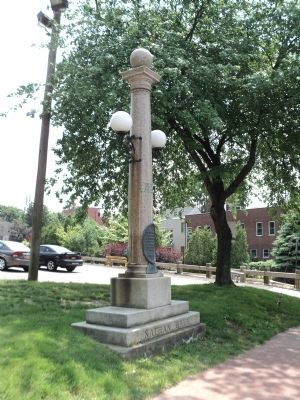
The 1894 Memorial on Main Street

As it turns out, the Main Street memorial—a marble shaft, rather than a statue—was ready first.  The shaft was erected in front of the library, which at that time was located in the Soldiers & Sailors Memorial Building, and was dedicated on July 4, 1894.  The committee did not realize its goal of placing a Connecticut boulder on the shores of Huntington Bay.  But the same year the Main Street memorial was dedicated, George Taylor, the president of a prominent Manhattan dry goods store, purchased a large tract of land in Huntington Bay.  Taylor soon became enthralled with the Nathan Hale story—no doubt because he now owned the land where Hale landed.  Taylor named his estate “Hale-Site,” a name that was soon applied to the entire section on the east side of Huntington Harbor.  Taylor, at his own expense, also completed the second part of the memorial committee’s plan.  He arranged for local contractor Oscar “Dynamite” Kissam to move a large boulder from near Taylor’s house to the beach.  Perhaps unwittingly realizing the committee’s original intent, the boulder did, in fact, come from Connecticut, courtesy of the last glacier.  Taylor also had three bronze plaques affixed to the boulder, telling Hale’s story.

For three quarters of a century the boulder stood on the beach at the end of Vineyard Road, where, unfortunately, it was subject to the effects of erosion and vandalism.  Ownership remained in the Taylor family.  At one point Taylor’s grandson, Balmor Taylor, removed the bronze plaques for safekeeping.  As early as 1962, he also explored transferring ownership to the Town of Huntington.  It appeared that an agreement had been reached and in 1974, town workers removed the 45-ton boulder from the beach and transported it to a new home at the intersection of New York Avenue and Mill Dam Road.  Mr. Taylor, however, did not think he and the Town had reached an agreement.  Over the next two years, differences were resolved and an agreement was reached.  The boulder was rededicated at its new location on September 19, 1976, two hundred years after Hale’s mission.

Nathan Hale Rock

The Nathan Hale Rock before its latest move

But that was not the last stop for Huntington peripatetic monument.  As part of the current road improvement project along New York Avenue, the New York Department of Transportation constructed a roundabout at the intersection where the boulder stood.  The rock would be in one of the travel lanes around the new traffic circle.  So last September (2012), the monument was moved once again.  This time the move was only about 50 feet to the southwest corner of the intersection.  When the roadwork is done, the area around the rock will be landscaped.

The Town of Huntington continues to celebrate its most famous visitor.  Just be careful when you read an earlier description that says the rock marks the spot where Nathan Hale landed.  He did not land at Mill Dam Road.

 The Town of Huntington recently acquired twelve acres of open space in Greenlawn.  While valued as a natural habitat, the property also has a long history dating back to the early eighteenth century when it was owned by Charles Saxton, who sold a portion of his land to Jeremiah Smith in or about 1719.  An easement to allow Saxton access to Smith’s property to clear a drainage ditch refers to the earlier land transfer.[i]

But the property is known for its connection to the Brush family.  Thomas Brush was a farmer in West Neck who, in addition to his farm at West Neck, owned land in Old Fields (now Greenlawn).  When he died in 1862, he bequeathed to his son Samuel the large farm in Old Fields “where he now resides.”[ii] The 1858 atlas lists “S. Brush” in that location.  Samuel’s brother James owned the farm to the east across Old Field Road.

Samuel Brush was born in 1807 in Huntington.  He married Elizabeth Sammis in 1835.  Two years later, he acquired six acres from Moses Rogers on the west side of the road leading from “Centre port to the Old Fields” bounded on the east and south by the road, on the west by land owned by someone whose name is illegible and on the north by land of Henry Lewis.[iii]  Six years later he acquired from William Smith 20 acres of partly enclosed arable land and partly timber land near Centerport bordered on the south and west by an old road, on the north by the timber land of Henry Lewis and on the east partly by other land Brush already owned and partly by the highway leading from Centerport to Old Fields.[iv]  From the descriptions given in the deeds, these two tracts would appear to include at least part of the current 12-acre subject property.

Brush

The Brush Homestead

An inspection of the original part of the house indicated a construction date in the 1830s, which is consistent with the date of Brush’s marriage and his acquisition of the property described above.

Samuel’s son Samuel Brush, Jr., who was born in 1845, and his wife Anna lived with him on the farm when he was widower (his wife died in 1864).[v]  Father and son were both farmers.[vi]  Samuel Brush Jr. inherited the farm when his father died in 1881.

In 1905, Samuel Brush, Jr. sold the 116-acre farm to Frederick A. Phelps of Brooklyn.[vii]  Phelps was a land speculator who acquired hundreds of acres of land in the Centerport-Greenlawn area as an agent for Dean Alvord, the developer of Prospect Park South in Brooklyn and Belle Terre in Port Jefferson.  Locally, he subdivided land overlooking Northport Harbor, known as Cedarcroft.  Part of that subdivision became the Grace Estate, and a part of that property including a log cabin, is now Town of Huntington parkland.

Phelps did not intend to live in the house and his acquisition of the property saw its transformation from a working farm to a wealthy gentlemen’s farm, where horses, sheep and show dogs would be raised.  Two years after he acquired the property, Phelps sold it to Harrison Gilmore of Utica.  Gilmore was a successful coal dealer in western New York[viii] and did not intend to live in the house year round—it would be a summer retreat.  Gilmore hired William A. Davis to work as foreman on the farm.[ix]  In 1912, Gilmore sold 12½ acres at the southern end of the farm to Claire A. Knapp of Bellport;[x] and the northern parcel of about 80 acres to Francis C. Hicks of Philadelphia.[xi]

Claire Knapp, who was only 23 years old at the time, was from an old Fairfield, Connecticut family.  Her grandfather made a fortune in the printing business in Brooklyn and was one of the founders of the Metropolitan Life Insurance Company.  Her father Joseph Palmer Knapp followed his father in the printing business, merging the family company with others to form American Lithograph Company, later known as ALCO.  Joseph P. Knapp also acquired and started several newspapers and magazines, including Everyweek magazine and Collier’s Weekly.

According to one account, Joseph P. Knapp purchased the Greenlawn property for his ex-wife, who divorced him in 1903, and his two children; and spent $75,000 fixing it up. [xii]  The work included adding a large wing to the west side of the old Brush farmhouse.  An article in December 30, 1914 editions of The American Architect shows the historic house with the new west wing forming an L shaped house.  The new wing contained a spacious living room and dining room on the first floor and a large master bedroom on the second floor.  The original deed was to Claire Knapp; but within a year, she transferred the property to her father.

Knapp1914

The Brush Homestead with West Wing added by Joseph Knapp

Miss Knapp, operating under the name Clairedale Farm, raised show dogs—and cats.[xiii] She apparently moved the operation to Mastic in 1916, where she later eloped with her chauffer (but that’s another story).   The same year, Joseph Knapp leased the farm to Baron de Stackelberg of Russia for the summer.[xiv]  A year later, the Knapps sold the 12½-acre property to Annie Brinley, the widow of Captain Edward Brinley of Greenlawn subject to a $15,000 mortgage held by Joseph Knapp.[xv]  Edward Brinley, a member of the Annapolis class of 1880, had died just six months earlier.

The property then changed hands several times over the next thirty years.  Brinley sold the property to James G. Hall of Garden City in 1924.[xvi]   Just three years later Ida Bell Hall of Coronado, California (presumably the heir of James G. Hall) conveyed the land to Waldron and Rey Belknap of Manhattan.[xvii]  The Belknaps also acquired a 76½-acre parcel to the north reuniting the property to close to its original size.  Waldron Belknap was a vice president of the Bankers Trust Company.  As a young man, he had been a member of Manhattan’s Squadron A Cavalry unit, whose Brooklyn rival, Squadron C, had a summer farm in Huntington.  He re-enlisted in 1916, at the age of 43, to serve in World War I.

Knapp Barns

Stables, Water Tower and Kennel Building

In 1946, Rey Belknap, now residing at the St. Regis Hotel in Manhattan, sold the 12½-acre southern portion of the property to Henry Sanford of Smithtown Branch for $50,000.[xviii]  Two years later Henry Sanford conveyed the property to Anne N. Sanford.[xix]

Anne Sanford married Dr. Walter T. Carpenter and transferred ownership of the property to him in 1977.[xx] Dr. Carpenter was the first board-certified pediatrician in Suffolk County.  He was born in Brooklyn in 1911.  After graduating from Cornell Medical School, he volunteered as a ship’s surgeon during World War II and later joined the Office of Strategic Services.  After the war, he set up his pediatric practice in Greenlawn.  He enlarged the east wing to the house in the 1950s for his medical practice.

Dr. Carpenter died in October 2008.  His estate had the house and outbuildings demolished in 2010 in order to save the expense of insurance and taxes.


[i] Suffolk County Clerk’s Office Deed Liber X, page 85

[ii] The Descendants of Thomas and Richard Brush of Huntington, Long Island, compiled by Stuart C. Brush, Gateway Press, Inc., 1982, page 115

[iii] Suffolk County Clerk’s Office Deed Liber 28, page 121

[iv] Suffolk County Clerk’s Office Deed Liber 39, page 205

[v] Brush, page 244

[vi] Brush, pages 244 and 429

[vii] Suffolk County Clerk’s Office Deed Liber 567, page 314

[viii] History of Oneida County, New York
From 1700 to the present time
of some of its prominent men and pioneers.
By: Henry J. Cookinham
The S. J. Clarke Publishing Company
Chicago 1912

[ix] The Long-Islander, March 15, 1907, page 6

[x] Suffolk County Clerk’s Office Deed Liber 798, page 220

[xi] The Long-Islander, October 4, 1912, page 4

[xii] See http://www.spoonercentral.com/2011/Talk.html for an account of the Knapp family in Mastic.

[xiii] The Long-Islander, September 29, 1922

[xiv] New York Times, June 2, 1916

[xv] Suffolk County Clerk’s Office Deed Liber 959, page 353

[xvi] Suffolk County Clerk’s Office Deed Liber 1116, page 135

[xvii] Suffolk County Clerk’s Office Deed Liber 1270, page 149

[xviii] Suffolk County Clerk’s Office Deed Liber 523, page 68

[xix] Suffolk County Clerk’s Office Deed Liber 2835, page 106

[xx] Suffolk County Clerk’s Office Deed Liber 8261, page 123

Until it was developed in the 1920s, the area between Depot Road and Lenox Road from Ninth Street south to a point south of Vondran Street was home to a one-mile horse racing track featuring a 1500 seat grandstand, a club house, large barns and open fields.

Horses had been raced at this site since as early as the 1840s.  The Suffolk Racing or Driving Course was a half-mile track that reportedly was the scene of some the first races run by the legendary horse “Lady Suffolk.”  These early races featured trotters pulling a driver in a sulky.  The track sat on a 47-acre parcel and endured an uneven history with different owners and operators.  Races were held sporadically.  For example, in 1874, the summer meeting lasted just three days with only two or three races each day.  Nonetheless, the meet was popular enough to attract visitors from Brooklyn by way the Long Island Rail Road.

After the Civil War, concerns were raised about the future of the track.  In 1878, it was suggested that a fair be held at the course—so long as it didn’t detract from the county fair in Riverhead.  But it took another decade for the idea to be realized.  In 1886, Henry C. Brown, proprietor of the Long Island Brewery in Brooklyn and a recent resident of Northport (his home is now the Indian Hills County Club), organized the Huntington Live Stock Fair Association.  Despite the Association’s best efforts, the grounds were not ready for the hoped for opening in 1887.  The Association had purchased additional land around the track and had made extensive alterations to the grounds and the track itself.

The track and fair grounds were formally opened on the Fourth of July the following year.  The track was hard and pebbly; the grand stand was missing some final details and needed a coat of paint.  Nonetheless, attendance was excellent.  The wealthy summer residents of East Neck and from miles around came.  So did local farmers and their families dressed in their Sunday best.  Several races were run—but there was no betting.  Between heats, a brass band played.  Visitors enjoyed the scene from the wide balconies of the club house; and enjoyed meals in the lunch rooms.  The grounds were surrounded by open meadows and fields of grain with forests on the distant horizon.  It was a “picture so full of beauty and variety” that it “calms the mind when agitated by conflicting thoughts.”  Further improvements were made in time for the September races, erasing all memory of the “unsavory Mecca of the horsemen of olden times.”

Fair Grounds

By September–when the Association’s first annual fair was held—every pebble had been removed from the track, but racing was not part of the program.  The event featured livestock shows, displays of local produce and flowers, samples of bread, cakes, pies and jellies, as well as quilts and paintings.  Wagons and carriages, and farm equipment were displayed.  Visitors could ride the merry-go-round, have their photograph taken, or watch a baseball game between the Suffolks and the Norwalks.

It was a welcome diversion for a town that had experienced a terrible blizzard the previous March and a devastating fire that had destroyed the block of stores known as the Brush Block, a carriage factory, blacksmith shop and the Central Presbyterian Church just a week before the fair opened.  But the first day of the fair also featured rain, which turned out to be an omen of things to come.  In succeeding years, rain would be a constant problem for the fair’s organizers.   Even though the Long Island Rail Road ran extra trains to get visitors to the fair, which was only a few minutes walk from the train depot, rain kept them away.

By 1893, the Live Stock Association had defaulted on its debts.  A new company, known as the Long Island Fair Grounds Association, was formed to take over.  The group intended to resume the fairs, but it seems the only activity was horse racing.  In 1905, an effort was made to incorporate a new organization—The Huntington Fair and Exhibition Company—to purchase the property and resume the fairs.    The grounds were instead purchased by Singleton Van Schaick, son of one of the founders of the Huntington Live Stock Fair Association.  In 1921, the old fair grounds were purchased by Addison Sammis, who turned the land over to the Huntington Station developers, Koster & Cornehlsen, who subdivided the land into 20 foot wide lots and began building houses where the horses had once raced.

Perhaps the only tangible reminder of the old race track, other than horse shoes found buried in the area, are the cement pillars that flank the south entrance to East Park Drive.  According to neighborhood lore, the pillars were a part of the stable area and were where the jockeys dismounted from their horses.

Although the annual fairs did not last, they did give rise to a new name for the surrounding community—Fair Grounds.  But that too turned out to be a temporary appellation.  In 1911, the name was changed to Huntington Station.

Roads in Huntington today are mostly paved in asphalt.  There are a few concrete roads—especially in Northport—and maybe even a dirt road or two.  But a hundred years ago, Huntington’s Main Street was a wood road.

In 1911, the Town Board decided to pave Main Street with wood blocks.  At the time the road was basically a dirt road with a covering of Peekskill gravel.  It tended to get muddy in wet weather and dusty in dry weather.  For many years around the turn of the twentieth century, Samuel Shadbolt would ride up and down Main Street in a wagon equipped with a water tank in an effort to keep the dust down during the summer months.  In 1907, George Taylor circulated a petition asking that oil be used instead of water because it would last longer.  Those who favored water circulated their own petition.  They say oil and water don’t mix, but that didn’t keep several storeowners from signing both petitions.

The decision was made to use oil.  But oiling the dirt road was not good enough.  For one thing, it did nothing about the mud after a rainstorm.  For another thing, the advent of automobiles took their toll.  In 1907, The Long-Islander predicted that with the arrival of William K. Vanderbilt’s Long Island Motor Parkway, Huntington would became “an Arcadia for Autoists.”  One Sunday afternoon that summer, Mrs. Thomas Aitken counted 250 automobiles pass along Main Street in just three hours.

Four years after the oil was introduced to Huntington’s streets, the Town Board decided it was time for a more permanent solution.  This time salvation from mud and dust came in the form of wood

Image

blocks measuring 8” x 3” and 3” deep (the block pictured here measures 7¾” x 2¾’”and 2½“ deep).  The work began in September 1911.  The blocks were laid on a concrete foundation from New York Avenue to Green Street (the wood paving was extended to Prospect Street two years later).   Private companies wishing to lay water, electric, telephone, or gas lines were warned to do their work before the wood blocks were laid because they would not be allowed to dig up the blocks once they had been installed.

There was some discussion as to the effect the new surface would have on the annual bobsled races down Cold Spring Hill into the village.  Would sleds go faster and further; or slower and less far?  The blocks also inspired a weekly newspaper column, “Along the Wood Blocks.”  The column was inaugurated soon after the blocks were laid and ran for five years.  The witty observations exposing the foibles, idiosyncrasies, and charm of the local population and extolling the beauty of their town were signed, appropriately enough, with the name  “Creosote.”  The writer was, in fact, Harry R. Fleet, a Huntingtonian who had enjoyed a long career in newspapers.

The wood blocks lasted until 1927.  Despite the warning to the utility companies, over the course of a decade and a half, so many holes were dug into the blocks—and improperly filled—that it was almost impossible to keep the street in decent shape.  Out with the wood blocks, in with concrete.

Blocks were salvaged by local residents.  Some were burned to heat houses.  The one pictured here—along with a few thousand others—was used to pave the new cow barn at the Park Avenue Dairy.

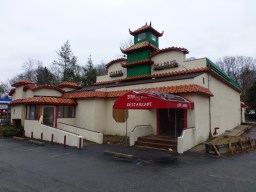
The sign in the window says:  “Closed for Renovations.”  The work will be more extensive than originally planned—the former Sun Ming restaurant building is slated to be demolished.

Image

As an example of Roadside Architecture, the building has served as a landmark along Jericho Turnpike, but it did not achieve enough significance to arise to the level of a “ historic landmark.”  Nonetheless, like any building that’s been around for over 80 years, it does have a history.

In 1923, Pat and Lena Maggi, a young couple from Brooklyn, moved to West Hills and opened a restaurant on Jericho Turnpike called Ye Old Homestead Chop House.  The exact location of Ye Old Homestead, which appears to have been in a converted house, has not been determined.  A 1924 newspaper article in the “Plainview” column refers to it as being “on the Jericho Turnpike near Huntington.”  So it may have been in Nassau County.

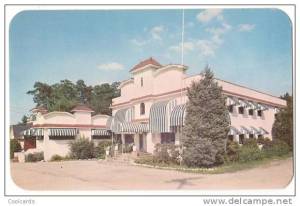
After seven and a half years, the Maggis built a new restaurant at the corner of Jericho Turnpike and Round Swamp Road.  The Chateau Maggi featured American and Italian food and promised “A real, bang-up good time.”  Maggi sold the restaurant in 1940.

By 1947, it was known as Pavillon Henri IV and featured a live orchestra.  A year later the owner and the orchestra were the same, but there was a new chef and a new name:  The Patio.  It can be assumed from the name Cliff Fearn originally gave to his version of the restaurant that he served French cuisine.  While the quality of the food is unknown to us, perhaps the bigger attraction was Mr. Fearn’s novel idea of a “television theatre.”  Mr. Fearn claimed to have the world’s largest television screen—eight feet by ten feet.   Weekly bulletins were mailed to patrons to advise them of the nightly schedule.  For example, in July of 1948, the schedule included the Democratic Convention on Thursday night, the CBS feature film on Friday, the Brooklyn handicap on Saturday, “Author Meets the Critics” on Sunday, baseball on Monday, the Texaco Start Theatre on Tuesday,  and the Kraft Television theatre on Wednesday.

196_001

Apparently the novelty of the world’s largest television and the French cuisine were not popular enough to sustain The Patio.  Within just a few years, new ownership invited Huntingtonians to “Dine delightfully in a beautiful Spanish Inn;”  a Spanish inn that served southern fried chicken, sirloin steaks and sugar cured ham steaks.  The new incarnation was known as Raay-Nor’s Inn, the north shore companion to Baldwin’s Raay-Nor’s Cabin, which opened in 1946.  In Baldwin the country cuisine was matched by the building’s log cabin architecture, which was similar to Link’s Log Cabin in Centerport.

Soon the rotation of international cuisine turned to the east.  In February 1955, Peter Chinn, who served as a Marine Intelligence Officer in World War II, added pagoda details to the French chateau cum Spanish inn and converted the menu to Chinese fare.   Chinn had come to the United States with his family in 1930 as a teenager.   During the war he was stationed in China and remained there until the Communists gained control of the country in 1948.   Each of the two dozen employees of King Wah Restaurant had an ownership stake in the venture.

In 1966, the restaurant changed hands, but the menu remained Chinese.   The new owner Albert Chin renamed the place Sun Ming.  This last incarnation would prove to be the most long-lived—over 40 years—but it too closed a few years ago.  And soon Pat Maggi’s building like each of its incarnations will just be a memory.

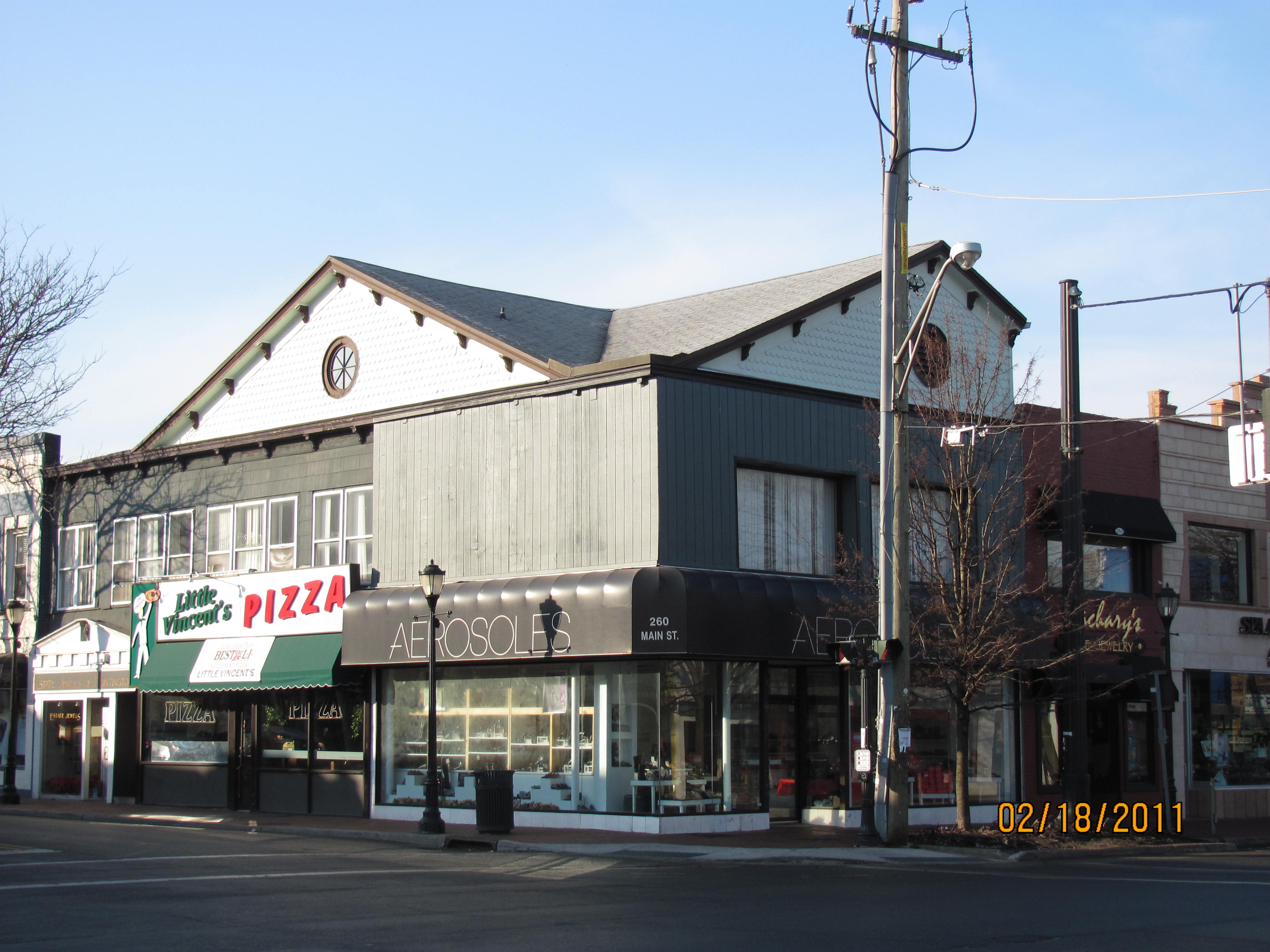
The building at the southwest corner of Main Street and New York Avenue in Huntington village has an unusual shape.  It’s as if someone chopped off the western third of the building.  And, in fact, that is what happened.

The first building at that location was erected by Stephen C. Rogers in 1860.[1] Rogers and David C. Brush had opened the Suffolk Hotel just to the west of the corner lot in 1840.[2]  In the summer of 1860, Rogers built what was initially called a “Village Hall.”  It was not built for governmental purposes, rather as a venue for lectures, concerts and meetings.  It was estimated that the 27’ x 56’ building would seat 600 persons, which seems an overly optimistic number.[3]  In September 1860, the new hall opened with an address by the Reverend Hiram Crozier on the science of music, which was appropriate because the new venue was known as Euterpean Hall, named for the Greek muse of music.  The address, of course, was followed by a concert.[4]

Euterpean Hall was used not only for concerts, but also for lectures, religious services and town meetings.  Both the Central Presbyterian Church and the Methodist Church used the hall for religious services when their church buildings were being constructed.  The Hall was used as a drill room when men were training to defend the village from a supposed Draft Riot at the West Neck brickyards (see The Irish in Huntington, posted on this site on March 17, 2012).

Town meetings and annual elections were also held here.  In the nineteenth century, town matters were decided by the citizens of the town in an annual meeting held in April.  The Hall was not big enough to accommodate all the town’s residents, so the Town Supervisor would announce the propositions to the crowd from the rear staircase.   Matters were decided by voice vote unless there was some doubt on which position received the loudest response; in which case a show of hands was requested.  Residents, who came to the village for the annual meeting, took advantage of the large crowds to do some business.  They would swap horses and cows and conduct many lines of business.  The trading wasn’t limited to livestock; votes were openly bought as well. The bars did a good business that day and impromptu horse races were held on Main Street. [5]

The ground floor of the building housed the grocery business of Stephen Morris and the feed store of Russell Hurd.  The grocery business was later assumed by Sammis & Baylis and the feed store became the meat market of Burling & Higbie.[6]   Rogers retired from the hotel business in May 1864, but continued to own the land until 1875 when he sold it to Samuel Hubbs.[7]

The 1899 Building

The 1899 Building

In 1899, the executors of Hubbs’ estate sold the property, which included the Euterpean Hall building, to Edward Carll, the son of Northport’s famous shipbuilder Jesse Carll.  At the time of the sale, it was announced that the Euterpean Hall building would be taken down and replaced with a wider two-story building that would cover the alley between Euterpean Hall and the hotel and contain three stores.[8]  Within just a couple of weeks, the two businesses in the Euterpean Hall building were relocated to a new building on New York Avenue and the old building was torn down.[9]  A month later the new building was completed and Sammis & Baylis as well as Burling & Higbie moved back to Main Street.  The second floor was used as sleeping accommodations for the Suffolk Hotel.[10]  After the hotel was torn down in 1927, the second floor rooms were converted to office use.

Edward Carll died in 1913 and left the Main Street property in trust for his family.[11]  The heirs sold the property in 1921.[12] The following year, the portion of the building containing corner grocery business of Sammis & Baylis and the middle store occupied by the Barr & Willis jewelry store was purchased by Henry M. Woessner.[13]  Woessner and his brother-in-law John F. Semon owned a pharmacy on Main Street opposite the Bank of Huntington.[14]  Woessner made several improvements to the store including installing large show windows and a soda fountain.[15]  The new store opened on July 29, 1923.  Within two years, Woessner had transferred the pharmacy business to Harris A. Tomashoff.[16]

In the westernmost storefront,  David W. Trainer conducted his stationery and newspaper business.  In 1928, the drug store was re-divided and the middle storefront was used for a shoe store.[17]

The Building Today

The Building Today

In 1934, just as the drugstore (now the Max Rosen Pharmacy) and the shoe store were about to be taken over by Walgreen’s, fire swept through the building.  Believed to have started from an oil burner in the drugstore, the early Saturday morning fire gutted the stores and second floor offices.  Above the drugstore and shoe store were two dental offices.  Above Trainer’s stationery store was the law office of Theron Sammis.  Although it was one building, there were two owners.  The two storefronts to the east were owned by H.T. and S.E. Corporation (H.T. was Harris Tomashoff and S.E. was Sol Elkins).  The western most storefront and office above was owned by Trainer.  It was thought the entire building would have to be razed.[18]

Tomashoff and Elkins decided to restore their portion of the building.  Trainer decided to start over again with a new brick building.[19]  The result is Huntington’s lopsided building.


[1] A later account (The Long-Islander, March 25, 1899) indicates that Rogers raised the second floor of an existing building.  Contemporaneous accounts confirming this assertion have not been located.

[2] The Long-Islander, August 3, 1860

[3] The Long-Islander, July 27, 1860

[4] The Long-Islander, September 28, 1860.  It should be noted that there had previously been a Euterpian Hall in Huntington. In 1852, the Odd Fellows Hall was re-dedicated as Euterpean Hall (The Long-Islander, November 12, 1852).  The location of this hall has not been determined yet.  Euterpean Hall later relocated to a third building at the northeast corner of Main and Wall Streets.

[5] The Long-Islander, March 25, 1899, March 20, 1925, and April 1, 1927

[6] The Long-Islander, March 25, 1899.

[7] The Long-Islander, September 11, 1885

[8] The Long-Islander, March 25, 1899

[9] The Long-Islander, April 8, 1899

[10] The Long-Islander, May 6, 1899

[11] The Long-Islander, September 5, 1913

[12] The Long-Islander, November 4, 1921

[13] The Long-Islander, December 15, 1922

[14] The Long-Islander, October 29, 1942.  Semon later entered the real estate business and built Columbia Hall on New York Avenue in Huntington Station, the first three story office and business building in that section of town.

[15] The Long-Islander, April 6, 1923

[16] The Long-Islander, March 20, 1925

[17] The Long-Islander, September 21, 1928

[18] The Long-Islander, March 30, 1934

[19] The Long-Islander, April 20, 1934.

147 Woodbury RoadOn Woodbury Road, about a half mile south of Main Street, Huntington sits a brick commercial building in the middle of a residential neighborhood. For decades, half of the first floor has been home to a delicatessen, while the other half has been dedicated to personal grooming businesses—previously a beauty parlor, currently a nail salon. The upper level has seen a variety of businesses. How did this commercial building end up in a residential neighborhood?
Ben Tasman, one of the first glaziers in the Town of Huntington, acquired the almost half acre property in 1928. By the following year, he apparently started to construct a building on the site—a notice in The Long-Islander that year advises that Tasman had topsoil available for removal from a site across the street from the Woodbury Avenue School.  The building is built into the side of a hill across from the site of the old schoolhouse.  This early construction date explains why a commercial building sits in an area zoned residential—Huntington didn’t enact a zoning ordinance until 1934. However, it seems the building was not finished before the onset of the Great Depression.
The not-yet-completed building drew the attention of one of Huntington’s wealthy summer residents.  In 1935, during the depths of the Great Depression, Marshall Field, whose estate on Lloyd Neck is now Caumsett State Historic Park, wanted to help alleviate unemployment in town and show that a small town like Huntington could support manufacturing enterprises. He established the United States Leather Goods Company, Inc. with John Clark, the superintendent of Caumsett, as the company’s president. The manufacture of leather luggage was chosen because it was a labor-intensive business and would not compete with any existing businesses in Huntington. The company expected to employ 50 or 60 hands initially. The company leased Tasman’s building and would begin operations “as soon as it is completed.” Perhaps Tasman started construction in 1929 and stopped with the onset of the Depression, but was able to complete the building with the promise of a new tenant.
The company manufactured high-grade luggage for department stores across the country and was soon known as Suffolk Leather Goods Company and later as Suffolk Craftsman, Inc. Field hired Samuel Balterman, who was later described as “one of the best leather manufacturing men of the East,” to serve as general manager of the venture. Six years later, Balterman purchased the company from its organizers. Despite the earlier predictions of increased employment, by 1941 the company had only 20 employees.
The building was almost entirely destroyed by fire in December 1950 with damage estimated at $40,000 to $60,000. It took firefighters five and a half hours to extinguish the blaze, which they attacked from all sides as well as from an aerial ladder truck. All that was left were the four walls and the roof. Mr. Tasman said he would rebuild. But the fire appears to have been the end of the leather goods factory. At the time of the fire, the building was also home to a printing concern known as Pheasant Press, and was used for storage by the owner of Peggy’s Outlet store on Elm Street in Huntington village.
Three years after that devastating fire, M&D Coat Company moved into the building because there had been a fire at its previous location on Railroad Avenue in Huntington Station. M&D made coats on the premises and sold at factory prices, or as they advertised in 1958 “A little out of the way; less to pay.”
According to Building Department records, in 1958, the roof on the building was re-shingled, the rotted cornices replaced and the building was painted. Around the same time, a deli was opened on the north side of the first floor; while the south side was home to a hairdresser.
The executors of Tasman’s estate sold the property in 1984 to Henry Birli, Paul Birli and Michael Macchiarella, who sold appliances from the second floor of the building under the name Three D T.V. & Appliance Co., Inc. The current owner acquired the property in 2000 and the upper floor is now the production studio of a shop that sells monogrammed gifts.

Early in the last century there were two businesses on Wall Street operated by Huntingtonians named Thomas Gorman.  One was born in 1884; the other was born in 1887.  At one time they each conducted business from the store directly behind the First National Bank building, which was at the northeast corner of Wall and Main Streets.  Each man’s paternal grandfather was named Daniel Gorman.  One was a tinsmith; the other sold fish.

Thomas Henry Gorman, the tinsmith, was the son of William and Anna Mullen.  His father had been in the fruit and vegetable business.  He had four sons and three daughters.  His son Thomas found employment in William H. Stoyle’s tinsmith store on Main Street.  In 1918, after 20 years with Stoyle, Thomas started his own business at 6 Wall Street (an addition to the back of the First National Bank building).  His business eventually occupied the upper two floors of the building comprising nearly 2000 square feet in addition to the 13’ x 18’ storefront.  Ten years later, the business grew to such an extent that Thomas needed a bigger building.  He purchased land across the street at 13 Wall Street and built a brick structure.  The new facility was considered the largest sheet metal works east of New York City.

In addition to repairing and cleaning stoves, ranges and heaters, Thomas installed metal work, such as gutters, tin ceilings and ventilating ducts at construction projects throughout the Island.  Local projects included Huntington High School, the Lowndes Avenue School, Central High School and the Hotel Huntington.  Thomas’ two brothers, Walter and Joseph, joined him and  in 1929 incorporated as Thomas H. Gorman Brothers, Inc.

In 1935, the business moved to Thomas’ home at 102 Woodbury Road, where he died in 1959.

The other Thomas Gorman was the son of Peter J. Gorman.  During the 1890s, Peter worked at the Cold Spring Harbor Fish hatchery.  In 1899, he purchased the saloon of James Garity on Wall Street.  James Garity’s wife was the sister of Peter Gorman’s wife.  The 1900 census identifies Peter as a saloon keeper.  In 1910, he was listed as working at a saw mill—in 1915 there was a notice that he had retired as an engineer at the Brookside Mill, which was a steam mill on the west side of New York Avenue, north of Main Street.  In 1920, Peter’s occupation was given as day labor; and in 1930 as a fish market dealer.  His sons, Daniel and Thomas meanwhile were identified as masons and later as plasterers. (In the 1915 New York State census, Daniel was identified as a trolley car conductor).

But in 1919, Thomas and Daniel Gorman purchased the Wall Street Fish Market.  A photograph of Gorman’s Lobster Grill shows an address of 6 & 8 Wall Street, meaning that the fish store was in the same building as the tinsmith shop.   It should be noted that the picture probably dates to after 1934 because italso advertised that there was “Beer on Draught.”  The 1922 Sanborn insurance map shows three stores in that location:  closest to Main Street is “Fish,” next is “Rest’rt,” and the northernmost store is “tin shop.”

Thomas F. Gorman of the fish market was a World War I veteran.  He, his brother, two sisters, his brother’s daughter and his mother lived in the brick house at the top of Carver Street.  Thomas continued to live there until the late 1960s when he moved to Walnut Creek, California, where his niece lived.  Thomas died in 1970.

The First National Bank building, which included the fish market and tin shop was torn down in the early 1950s.

Because their paternal grandfathers had the same name and they operated their businesses in the same building, it may be thought that the two Thoamses were related.  Perhaps their fathers—Peter and William—were brothers, making the two Thomases first cousins.  But the 1870 census, when William was 13 years old, does not list Peter, who was 5 years old that year.  Moreover, Peter’s mother’s name was Ellen; William’s mother’s name was Ann.   It seems just a coincidence that Thomas H. Gorman and Thomas F. Gorman shared a name, a grandfather’s name, and a business address.

Visitors to Cold Spring Harbor’s Community Beach may be hard pressed to imagine the industrial bustle that once characterized the area.  For 175 years, the spit of land now known as Eagle Dock Community Beach was a center of commercial activity.  With the removal of the oil storage facility to the north of the beach, the area is returning to its bucolic past.

The east side of Cold Spring Harbor was known in the nineteenth century as Clamtown because of the abundance of clams found in the local waters.  Oysters were also harvested here.  But it was commercial activity that defined the area.

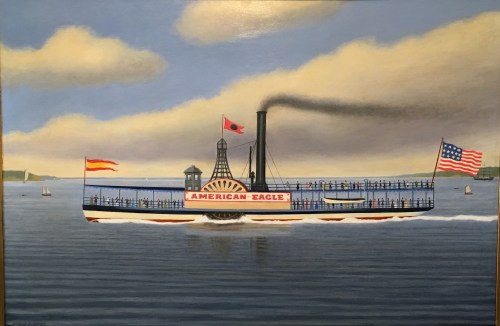
As early as the 1830s, a steamboat dock was built near the north end of the spit of land known as Middle Beach—now the site of the community beach.  Walter R. Jones and John H. Jones acquired this parcel and the adjoining land to the north from the Huntington Board of Trustees in 1837.    The outline of the dock can be seen on the 1837 Coastal Survey of Long Island.  From this dock, the steamboat American Eagle made three trips a week into New York.  The side-wheel steamboat carried passengers and freight on its regular run and also was used to tow whale ships in and out of the harbor when tides and wind conditions required.  One passenger in 1843 wrote of his trip aboard the American Eagle.  The ship left Cold Spring Harbor at 5:00 on a Monday morning.  There were stops in Oyster Bay, Glen Cove and New Rochelle before reaching Fulton Market pier at 9:30.  During the four and a half hour ride, the passengers enjoyed a hearty breakfast and a very good cup of coffee—“the best cup of coffee that is made in the ‘nine counties’,” according to the correspondent.

The American eagle depicted in a recent painting by artist Bill Jonas.

The American eagle depicted in a recent painting by artist Bill Jonas.

The American Eagle was retired in 1845 and replaced by the Croton.  Seven years later a new dock was built at the southwest corner of Lloyd’s Neck and the Croton used that dock saving passengers 45 minutes.  By 1873, the dock used by the American Eagle was identified on a survey as “Old S.B. Dock.”

But Middle Beach had not been abandoned.  Around 1860, John P. Dole established a ship salvage yard south of the old steamboat dock.  Over the next 25 years, Dole would purchase old wooden boats, some from the U.S. Navy, and salvage what useable material he could.  The most valuable commodity was the metal hardware.  Larger timbers were used to build houses.   After all that could be salvaged was removed, the ship’s carcass was burned.  The spectacular fires drew large crowds along Shore Road.  Reportedly, Cornelius Vanderbilt’s famous yacht, The North Star met its demise at Dole’s Beach.

By the 1870s, Cold Spring Harbor had become a resort community.  Grand hotels—Laurelton, Glenada and Forest Lawn—and smaller boarding houses attracted New Yorker seeking to escape the heat of the city.  What better way to start a vacation than with a steamboat ride?  With that in mind Dr. Oliver Jones decided to rebuild the old steam dock, this time with a causeway across the cove to reach shore road.  At the time, the cove extended as far north as the present day Beach Club property.  Dr. Jones, whose obituary noted he had a hobby of building new roads, planned to extend the road through a ravine and on to Huntington village two miles away.  The road was never completed east of Shore Road.

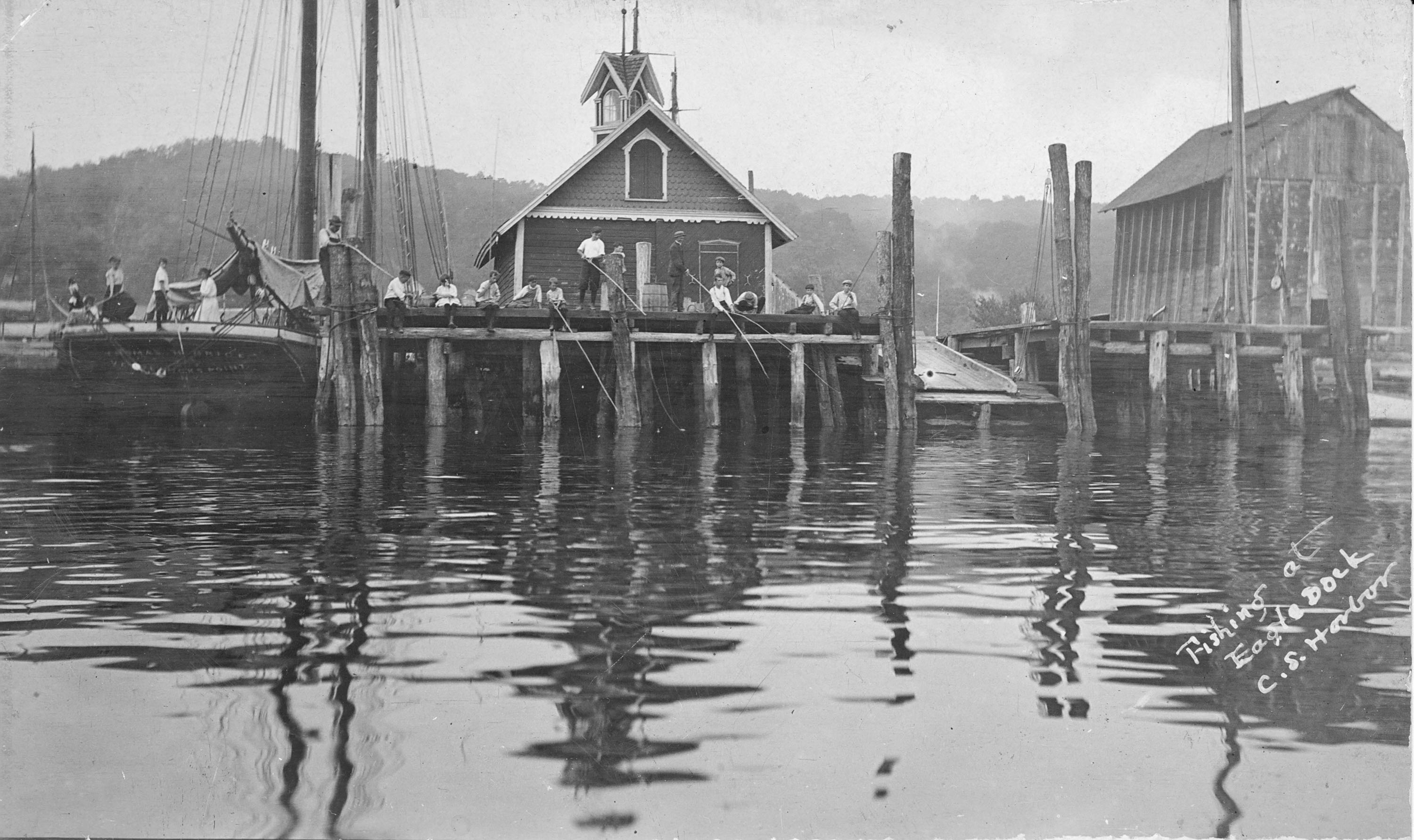
Dr. Jones used bricks from his yard at West Neck for fill, which explains the plethora of bricks in the area where the dock had been.  The new dock was completed in 1885 and was named “Eagle Dock,” undoubtedly in honor of the first steamboat to ply Cold Spring Harbor’s waters.  On the dock—which was really more of a bulkhead pier—was a freight house.  The steamboat Sylvan Dell made the trip from Eagle Dock to Pier 23 in New York in two hours and fifteen minutes—half the time it took the American Eagle­ forty years earlier.

Image

A few years earlier (1881), Elwood Abrams leased from Charles H. Jones the land north of the dock for use as his shipyard.  He had arrived in Cold Spring Harbor in 1868 and operated a shipyard further south on the harbor.  Abrams eventually added a saw mill.  He lived across Shore Road and there he operated an ice cream, soda, candy and tobacco store as well as a boarding house.

In the 1890s, there seemed to be no end to the activities at Eagle Dock:

William Bingham and Benjamin Brush opened a grocery store near the present site of the crew team’s boathouse in 1890.  Bingham also had an ice house and imported ice from Maine when the local ice crop failed.

A gentleman named Mason converted the old sail loft and ice cream saloon at Eagle Dock into a dance hall in 1891.  Mason’s Eagle Dock Pavilion became a popular social gathering place.

In the late 1890s, T. Wilson Gildersleeve had a bowling alley at Eagle Dock.  But it wasn’t until 1957, when he was 74 years old, that Gildersleeve bowled a perfect game and that was at the Commack bowling alley.

In 1896, the State fish hatchery started a lobster hatchery at Eagle Dock.

When the grand old hotel, the Glenada was dismantled in 1906, the used lumber was shipped from Eagle Dock.

In 1908 when William K. Vanderbilt II invited motorist from Europe and across the country to come to Long Island to race their automobiles on Long Island’s rural highways, steamboats from Connecticut and Westchester brought passengers to Eagle Dock where they were met by stage coaches to take them to see the race from Woodbury turn—the corner of Jericho Turnpike and Woodbury Road.  The next year, Eagle Dock welcomed the steamer Victor, which had been outfitted to take cars across the Sound from Stamford, CT.

During Prohibition, Eagle Dock was reportedly the drop off point for hundreds of cases of illicit liquor from Canada.

Meanwhile, the Abrams shipyard continued to be busy.  Instead of building ships, the yard was now mostly involved with repairing yachts and storing them for the winter.  Abram’s saw mill was considered one of the best and largest on Long Island.

The land on which Eagle Dock and Abrams shipyard were located continued to be owned by the Jones family.  The rest of Middle Beach to the south as well as the land under the cove had been acquired by Henry DeForest in 1879.  DeForest acquired hundreds of acres of uplands reaching from Shore Road to Goose Hill Road.  The last 31 acres of that estate is now being offered for sale.

The DeForest land on Middle Beach had, according the 1952 estate appraisal of the property, “a summer beach house and shacks with no market value.”   DeForest also had a small engine, known as a donkey engine, that would pull his yacht, the 8 meter sailboat Priscilla III, along rails to the beach for winter storage.  Remains of the engine and rails can still be seen.  The house at the north end of the DeForest property on Middle Beach (about where the “pirate” ship is today) was the home of George Shellack, who was the captain on the DeForest boats during the summer and their chauffer during the winter.   There were three other buildings, all on stilts.  The largest, near the donkey engine, was where all the yachting paraphernalia was kept.  A second was home to two young bachelors who helped with the DeForest boats.  The third is where the maids from Johnston DeForest’s house (the white house behind the pond) changed their clothes when they went to swim every afternoon during the summer.   The Dole family had a boathouse on the beach between the three shacks and the Shellack’s cottage.

The Deforests also had a small floating building moored along Shore Road opposite the driveway to their mansion, Wawapeck.  They kept rowboats and canoes in the house, which they used to get out to the spit.

The DeForest family allowed Cold Spring Harbor residents to use their beach for swimming.  The Cold Spring Harbor Civic Association raised money to fund the operation of the beach.  Access was across the road built by Dr. Jones to the old Eagle Dock.

In July 1922, Rosalie Jones, acting as executor for her mothers’ estate, offered several pieces of land, including the Eagle Dock property, for sale.  The parcel was described as being “five acres in all” so it included the shipyard property as well.  Walter Abrams, who had taken over the shipyard from his father, purchased the shipyard property from the Jones family for $50,000 in October 1922.  Just two years later, Abrams sold the land to the Standard Oil Company of New York for $175,000.  Abrams moved his shipyard to Halesite and it is now operated by the Knutson family.  Interestingly, Abrams’ father was appointed an agent of Standard Oil in 1900 for the sale of naptha, a petroleum product used as a solvent and sometimes for fuel.

Local legend has it that the oil tanks were the result of the failure of the newly formed Beach Club to invite members of the Jones family to join.  According to this story, Rosalie Jones convinced Walter Abrams, whose shipyard was supposedly struggling, to sell his land to her.  She in turn sold the land to Standard Oil of New York, the rival of Standard Oil of New Jersey, whose president Walter Jennings was the founder of the Beach Club.  But since the Jones family owned the land in 1921 when the Beach Club was formed and since the deed to Standard Oil was signed by Walter Abrams not Rosalie Jones, the accuracy of the legend has to be questioned.

In any event, until they were torn down in 2005, Standard Oil’s tank farm would be the last remnant of Clamtown’s industrial past.

The Jones family didn’t sell the old Eagle Dock property until 25 years after it sold the shipyard property.   Dolores Brock purchased and just three months later sold the land to Harry Knight and August Carbone.  Four months after they acquired the land, Knight and Carbone requested that the zoning on the property be changed from residential to business.  The request was not met favorably by the neighbors.

Knight and Carbone intended to use the property to rent boats, sell refreshments and operate a bathing beach for profit.  They promised to tear down the existing old buildings and build a new dock and a refreshment stand and some bath houses.  Almost 200 people showed up for a hearing before the Huntington Planning Board in June 1948—only two spoke in favor of the re-zoning.   One of the supporters of re-zoning was none other than Rosalie Jones, who had argued unsuccessfully to have the property classified as business rather than residential when Huntington first adopted zoning laws in the early 1930s.  Jones noted that many in the room were not natives of Cold Spring Harbor, yet they seemed wary of any development that would attract outsiders.

Opponents were led by Johnston DeForest, who was one of the members of the commission that first proposed that Huntington should adopt a zoning ordinance.  Where Knight and Carbone saw a refreshment stand, opponents saw a bar.  Some saw the opposition as an attempt by wealthy residents to keep regular folks away from the town’s beaches.

After a summer of controversy, the application for re-zoning was denied.

On September 23, 1948, 42 concerned residents gathered at the home of B. Tappen Fairchild on Shore Road.  They resolved to form a charitable organization to purchase the Eagle Dock property and make it available to Cold Spring Harbor residents who did not have access to private beach facilities.  At the time 80 residents had made pledges totaling $24,000.  The beach would be available to residents of Cold Spring Harbor school district 8 at no charge.  The corporation formed to purchase and maintain the beach would be “charitable and educational and exist for the general welfare of the people” of Cold Spring Harbor.

On October 21, 1948, seven residents formed Eagle Dock Foundation, Inc., the purpose of which was

 To establish, equip, maintain and operate a public beach, playground and bathing facilities for the children and other residents of Cold Spring Harbor School District No. 8, to create and promote better under-standing and sympathy between the people of the community and to further the general welfare and health of all the people in the said School District.

The next month they purchased the 1.1-acre Eagle Dock property from Knight and Carbone for $22,293.11.  It was reported that Knight and Carbone managed to turn a nice profit on the sale.  In addition to the Eagle Dock property, which only included the roadway and the area between the current split rail fence and the Standard Oil property, the Foundation entered into a lease with Johnston DeForest for part of his property on the spit—the area up to the line of boulders near the current floating dock.  The rent was one dollar a year.

An early concern of the donors was the tax-deductibility of their gifts.  They were advised that no assurances could be made concerning deductibility, but that they should nonetheless claim the deduction on their tax returns.  The IRS initially refused to allow the deduction.  But one of the original supporters, Isabel Peters, pursued the case in Tax Court and in a landmark case finally prevailed in 1953.  The IRS was reluctant to accept the outcome, but acquiesced six years later.

From the beginning, the management of the beach was turned over to a committee of Cold Spring Harbor residents for the benefit of the children and families of Cold Spring Harbor.  A management committee of seven local residents was appointed in time for the 1949 bathing season.  The committee had the two old buildings near Shore Road torn down and a large amount of fill was brought in to level off the property and provide more space for playground and parking facilities.  Leslie Peckham, who was the first chairman of the committee, writes in Clamtown, which was published in 1962, that the old bulkheads “were demolished during the recent landscaping at Community Beach.  However, some of the piling was left standing—upon which rests a portion of the float ramp.”  Peckham also writes about adding earth and “other fill” to the cove to widen the road built by Dr. Jones in 1885. (Standard Oil had filled in the Cove north of the road when it built its storage tanks in the 1920s.)

The committee relied on volunteer labor and volunteer contributions.  In 1951 a new bathhouse, about the size of a garage, was built.  Water was provided by Standard Oil from its property at no charge to the beach.  On a year-to-year basis, beach privileges were extended to residents of school district 11 in Suffolk County.  School district 8 was the old East Side district, while district 11 was the West Side district and also included Laurel Hollow.  Over the years, the Foundation was concerned that Cold Spring Harbor’s growing population might preclude extending these privileges to district 11 residents.  The border between the two districts was just north of Lawrence Hill Road.  But eventually the privilege was made permanent.

In 1953, 195 families provided support for the beach, a second life guard was hired and the beach was opened seven days a week instead of just six.

Beach finances relied on voluntary contributions from residents, all of whom were issued admission cards.  Boy Scouts distributed pledge cards, but donations were slow to arrive.  It was not until 1961, that stickers were issued for the privilege of parking at the beach.

From the earliest days, vandalism, noise and unauthorized use were problems.  In 1954, it was decided to lock the gate at night.  In 1966, a high chain link fence was installed.  (The driveway entrance was moved to the north end of the property in 1956 as an accommodation to the Fairchilds, who lived across the street.)

Just a dozen years after its first season, Eagle Dock faced an existential crisis.  New York State had just acquired the Marshall Field Estate in Lloyd Neck.  The Parks Commission proposed building an extension of the Bethpage Parkway that would run up along Harbor Road and then along the east shore of Cold Spring Harbor—right over the beach.  The Foundation was very concerned.  The State made promises of either giving the Foundation money to buy other beach property—but where was there a beach to buy? —or to create a manmade beach along side the new parkway.  The Foundation surprisingly did not take a position to either support or oppose the Parks Commission’s plans, in part because the plans were not yet final.  But the Foundation did submit a memorandum to the Parks Commission outlining its concerns:

  1. The shore route should not be chosen because it will destroy or impair the natural harbor which is the principal physical asset of the area.
  2. The choice of the shore route does not take into account developments in transportation, such as monorails, helicopter, or hydrofoils, which may well be better methods of transportation to the new park before any route can be completed, and which would better serve the new park without spoiling the adjoining area.
  3. The choice of the shore route, and the substitution of other property for the property presently owned by the Foundation, may impose annual charges for maintenance on the Foundation which it will not be able to meet.
  4. The shore route raises practical problems regarding water and electric lines, the solution of which is unclear.

The issue was discussed every year at the Foundation’s annual meeting into the early 1970s, but no further information was provided by the Parks Commission.  Perhaps bearing in mind that Sunken Meadow Park opened in 1929, but the parkway leading up to it was not completed until 1957, the Foundation’s ongoing concern was justified.  The threat was not removed until 2004 when the Cold Spring Harbor Library secured a long-term lease from the Parks Commission for five acres on the proposed parkway right of way.  With the community’s library standing in the way, the parkway would not be built.

Even with the uncertainty presented by the proposed parkway, the beach thrived.  But by the 1980s, the beach was at a crossroads.   The dock built on the old pilings was destroyed by winter storms in 1981.  A floating dock was built to replace it.  In 1984, a reorganized and re-energized Management Committee announced plans for a major upgrade of the beach, including “dock restoration, landscaping, security enhancement, bathing beach improvement, and building restoration and improvement.”   The community responded to appeals for donations to realize these plans.

In 1986, the beach made several strides.  The sail locker was built and the floating dock was completed.  But the most important development was Priscilla DeForest Williams’ decision to donate the rest of the spit as well as the land under the Cove and land on the water side of Shore Road to the Foundation on the condition that the land be kept forever wild.

Throughout its history, Eagle Dock has been a place for Cold Spring Harbor residents to socialize with their neighbors.  A long-standing tradition is the annual clambake in August.  Over the years other events have been added to the calendar: Field Day, the Sunday Brunch, Dancing Under the Stars, S’Mores to mark the end of the school year, Wine & Cheese night, and even potluck parties.

In keeping with the terms of its charter that the beach was for the children of the community, in 2001, the Foundation entered into an agreement with the Cold Spring Harbor Rowing Club, the sponsor of the high school’s crew team.  Pursuant to the agreement, the Rowing Association constructed a boathouse and uses Eagle Dock for its practices.  The arrangement allows for greater use of the beach by the children of the community, without interfering with the swimming and boating that have always been the focus of beach activities.

In recognition of the importance of the fragile marine environment, in 2009, the Foundation—harking back to the educational aspect discussed at the Foundation’s 1948 organizational meeting—restated the beach’s mission statement:

The mission of Eagle Dock Community Beach is to establish, equip, maintain and operate a public beach, playground and bathing facilities for the children and other residents of Cold Spring Harbor and to promote a better understanding of the marine ecosystem of Cold Spring Harbor, including our beach and its surrounding coastal environs.

Eagle Dock Community Beach is dedicated to the protection of the marine ecosystem of Cold Spring Harbor in order to facilitate our continued access to a healthy waterfront.  Through the conduct of environmental education programs, our community is engaged in the stewardship of this important natural resource.

Environmental education programs have proven very popular and will help to ensure that the community remains sensitive to the need to protect its harbor.  Although the removal of the oil tanks was a welcomed development, the removal of the oil dock has accelerated erosion of the beach property presenting new challenges.  But with the community support Eagle Dock has enjoyed for the past sixty plus years, it is certain that the people of Cold Spring Harbor will continue to have a beach to call their own.

Over the last half-century, the Town of Huntington and the County of Suffolk have assembled an impressive collection of open space totaling some 520 acres in the Crab Meadow section of Huntington.  But a small portion of that land was acquired by the Town more than 350 years ago.

Under the Town’s colonial patents issued by various royal governors, the Trustees of the Town were granted all lands that constitute the town.  Over the years, the Trustees sold almost all of the land.  The few remaining trustee lands include the beach at Crab Meadow.  As early as 1901, several residents had erected shacks on this beach.[1]  In 1907, residents of the area sent a petition to the Town Board requesting the Town to remove the houses; “thereby giving all citizens of the Town the use of said property in common.”[2]  The Huntington Board of Trustees retained attorney Willard Baylis to render an opinion on the legal status of these shacks.  After examining records at the County Clerks’ Office as well as the Town Clerk’s Office, Baylis concluded that the Board of Trustees had never conveyed the lands at Crab Meadow beach.  As a result, none of the persons who erected the structures on the beach “has any right in or title to such beach, and certainly their possession has not been long enough in time or of such character as to give any of them adverse rights against the Town, or its Trustees.”[3]

The beach in question extended from the highway leading south from the Sound (what we know as Waterside Avenue) east to the Gut or creek that flows out of the meadows south of the beach.  Prior to 1890, the road jogged to the east and separated the Trustees’ land, which was on the east side of the road, from private land on the west side of the road.  In about 1890, the road had been straightened, and as a result 196.7 feet of the private property along the Sound was now on the east side of the road.

That parcel was part of the land acquired by Willis B. Burt from William Chesebrough in 1900.  Burt developed the land on the west side of the road as Waterside Park.  On the beach on the east side of the road, Burt operated a private beach pavilion.

After Baylis confirmed the Town’s ownership of the beach property east of Burt’s pavilion, residents petitioned the Town Board to maintain the beach as a public park and to appropriate $5,000 to equip and maintain the park.  Proponents pointed out that most of the town’s waterfront was owned by private parties and was, therefore, inaccessible to the public.  In fact, the Town’s only waterfront park at the time was Halesite Park, which had opened a dozen years earlier and had only 200 feet of shoreline along Huntington Harbor.  The proposal was the subject of a special town wide referendum held in October 1919 at the Centerport firehouse.  The two resolutions passed by a 4 to 1 ratio.[4]  Once the park was established, Burt served as the manager of the park on behalf of the Town, in addition to operating his concession stand.

Unfortunately, swimming at Crab meadow was not without risk.  Northeast storms had built up a peninsula from the east side of the Crab Meadow Creek across the outlet of the creek, which diverted the flow of the creek westward directly in front of the town beach.  The swift current created hazardous swimming conditions, especially for children.  The dangers presented by this situation were brought to the Town’s attention as early as 1920,[5] but it would take decades before the problem was resolved.

An attempt in 1920 to cut a channel through the peninsula so that the creek would flow north into the Sound rather than along the beach was met with a letter from one of the owners of the adjoining land on the east side of the creek.  Edwin H. Brown asserted that he and his partner Frank Lambert owned the peninsula.   Lambert and Brown had purchased land on the east side of the creek in 1903.[6]  They claimed ownership of the peninsula as an accretion of their property.[7]  Brown warned the Town, “I hereby forbid the work above mentioned and give notice that if, as I believe, we can establish title to said land I shall claim and endeavor to collect damages if the work is continued.”[8]

Despite Brown’s warning, the Town hired Burt to proceed with the work in 1923.  Brown made good on his threat and sued. The case dragged on for the next twenty years during which time attorneys became ill, interested parties died, and settlement talks fell apart.  All the while, the current caused by the peninsula continued to pose a threat to swimmers.

In the meantime, thousands of residents visited the beach each summer.  Five years after voters approved a resolution to create a park at Crab Meadow, they approved another resolution to spend $20,000 to acquire Burt’s property on which he operated his pavilion.[9]

But the park’s popularity was not without its downside.  Residents of Waterside Park complained about late night partying at the beach.  Members of the Waterside Park Association, many of whom were Brooklynites with summer homes at Waterside Park, reported that young people would arrive at the beach late in the evening after the town’s beach pavilion had closed and they would stay until as late as 3:00 in the morning and sometimes until dawn.  They asserted that “the hilarity and boisterousness that occasionally ensue not only cause serious discomfort, annoyance and disturbance, but are a distinct menace to the good name of the place.”[10]  The problems of late night use of the beach continued—especially when there was a high tide after midnight.  In 1926, the Town Board placed a police officer at the beach to help avoid the problems presented to nearby residents.[11]

There was also another private pavilion nearby.  As early as 1929, Walter Post had opened Post’s Pavilion on Waterside Avenue just south of the town beach.  Having a somewhat unsavory reputation in later years, Post’s Pavilion remained open until the late 1950s.  It then was known as the Soundview Inn and burned to the ground in the early morning hours of June 7, 1963.[12]

Burt’s old wooden pavilion was showing its age and as early as 1927 voters were asked to approve expenditures to replace it.  The measure was defeated each time it was presented.  But the need to create jobs during the Great Depression fit nicely with the need to improve the facilities at Crab Meadow beach.  In 1937, the old pavilion was finally replaced with a Mediterranean style brick and concrete building designed by Huntington architect David Dusenberry that featured men’s and women’s locker rooms, showers and lavatories.  The locker rooms would be in the two wings of the building that were joined by an open-air court.  On the roof of the center portion was a sun deck.  The cost of the building, which was a WPA project, was split between the State and the Town.[13]  The new building also included food concessions.  In front of the building, the Town built an 18 foot wide boardwalk extending 700 feet east and west of the pavilion.[14]  The new building was ready for the opening of the 1938 season.  As part of the dedication ceremony on May 28, 1938, a time capsule was placed in the cornerstone of the building.[15]

The building was a hit, a perfect compliment to the always-popular beach.  However, the dangerous current created by the outflow from the creek continued to be a concern.  Moreover, the erosion occasioned by the current threatened the new pavilion.  In light of the failure of earlier efforts to reach a settlement in the matter, the Town Board voted to seize the offending sand bar by eminent domain.  The action was, of course, challenged by the Brown and Lambert interests.  By this time Edwin Brown and Frank Lambert had both died, but their estates continued to fight the Town.  In 1942, the Town finally prevailed and paid Brown & Lambert $9,258.64 for the disputed sandbar.

After a hurricane in 1944, the Town constructed a breakwater along the creek, which resulted in the accumulation of so much additional land that the Town was able to add parking for 120 to 150 additional cars.[16]  The continued popularity of the beach—one neighbor compared it to Coney Island on a hot summer weekend—led the Town to acquire an additional eight acres south of the parking area for additional parking.[17]  At the time private homes continued to stand on the south side of Waterview Street West, which now runs just past the entrance gate to the beach, but at one time extended as far as the creek.

But Brown & Lambert (or more accurately their estates) continued to own hundreds of acres of the meadow and uplands.  On the higher ground to the south of the meadows, a golf course, known as the Northport Country Club, was laid out in 1923.[18]  The club lasted only about twenty years and the abandoned clubhouse burned to the ground in 1949.[19]

In 1956, a private company with a public sounding name—Empire State Development Company, Inc.—acquired Brown’s interest.  Justine Lambert, Frank Lambert’s widow and heir to the bulk of his estate continued as the co-owner.   In all the years this tract was privately owned, it was never developed.  Of course, the meadows were too wet to be easily developed, but the uplands where the Northport Country Club had been located could have been developed.

By the early 1960s, the Brown & Lambert holdings in Crab Meadow were one of the largest undeveloped lands in a fast growing town.  In June 1961 the Town held a special election to vote on a proposed $2,500,000 park and recreation plan that would involve the acquisition of nine sites for parkland, including the Brown & Lambert holdings.[20]  Town Supervisor Robert J. Flynn explained. “We are trying to solve our desperate need for space while the area is still available.  If we wait much longer, we will have to take what the speculators leave us at costs that would be frightful.”  The referendum failed by 548 votes out of 7,224 votes cast.[21]

At the same time, the Empire State Development Company instituted legal proceedings to clarify title to the property so that it could proceed with development plans.[22]  In 1962, Justine Lambert and Empire State Development engaged in a bidding war at Town Hall.  Bids were made for individual parcels and then the referee asked for bids for the entire tract.  Lambert started at $705,000; Empire responded, only to be outbid by Lambert.  The parties raised their bids by a thousand dollars a bid, sometimes four or five thousand dollars at a time.  Until, finally, Lambert bid one million dollars. There was no response from Empire. [23]

Lambert said she intended to develop the property with luxury homes on lots of two to three acres—and no “split levels”—even though the Town had already announced plans for a re-vote on the parks referendum.

In September of that year, the parks referendum was put before the voters again and passed by an overwhelming majority, 5,272 to 1,815.  The referendum covered only the cost of acquisition; it was estimated that it would cost another $3.8 million to develop the parks.  The proposal for the Crab Meadow parcel included plans to dredge the meadow to create fresh water fishing lakes, restoration of the golf course, bridle paths, a salt-water marina and a wildlife refuge.[24]

Of course, Lambert’s plans to develop the property were rendered moot by the passage of the referendum.  Subsequent condemnation proceedings to establish the fair market value of the land did not commence until 1966.  The case also involved title issues arising from the Town’s Colonial grants.  The Town’s Board of Trustees claimed ownership of the waterways through the meadow under these patents arguing that their ownership had never been transferred.  The Town prevailed and began making payments for the land in 1967.[25]  The Town had hoped to acquire all the land between the Sound and a right of way established by the Long Island Lighting Company for its transmission lines, but there were not enough funds.  However, in 1970, Suffolk County was persuaded to purchase the 140 acres along Makamah Road from the LILCO right of way to the meadows that the Town had not purchased earlier.[26]

The old Northport Country Club golf course was renovated and a new clubhouse was built overlooking the meadow.

In the 1980s, the town undertook an extensive renovation of the Crab Meadow beach pavilion.  What had been a snack bar was expanded to a full service restaurant with the addition of greenhouse enclosures on the west side of the building.  The boardwalk and gazebos were rebuilt, shuffleboard courts were added and lights were installed.  When the work was done, the Town Supervisor and Town Board sent invitation to a 50-year “Golden Anniversary Celebration and Rededication of Crabmeadow Beach.”  Cocktails and hors d’oeuvers were served.  It is doubtful that anyone pointed out that the building was in fact only 48 years old.

By 2009, the WPA pavilion was showing its age.  An engineering report indicated that the breezeway between the two wings was structurally unsound, perhaps because salt water was used to mix the cement when it was built.  The Town replaced the breezeway with an exact replica.  The bricks have not been painted so the building appears as it did when it was originally built.  Another benefit is that the rooftop sundeck is once again open to the public.

In recent years, the Town has added additional parcels to its open space. The Ingraham Nature Preserve, which includes the Crab Meadow Burying Ground and which lies across Waterside Avenue, was added in 1998 with partial funding coming from the Iroquois Pipeline Operating Company.  The Fuchs property was purchased with Suffolk County in 2003.

But a question remains.  Who were Brown and Lambert?

Francois Lambert was born in Lyons, France on June 13, 1851.  He arrived in the United States in 1876.  He was an inventor, eventually holding 60 patents.  His first patent, secured in 1878, was for a striking mechanism for clocks.  He also invented an early recording device, which appears to have been intended to be used for a talking clock.  A recording of his voice announcing the hours of the day made in 1879 is the oldest surviving recording in the world.

Lambert’s most financially successful invention was of a water meter.  He shared that 1887 patent with John Thomson.  The Thomson Water Meter Company was based in Brooklyn.  The company was sold to Neptune Water Meter Co. in 1925, netting Lambert $800,000 (the equivalent of about $10 million dollars in 2012).  Later that year Lambert’s wife died.

The following June, the 74 year old Lambert married 30 year old Jennette Justine Lawson Ebbets, who had sold sheet music in Lambert’s son-in-law’s office.  After a yearlong honeymoon in Europe, the couple moved from Brooklyn to the 22nd floor of the Savoy Plaza Hotel in Manhattan and later moved to the Waldorf-Astoria Hotel.  A profile of Lambert notes that in his retirement “he owned several rental properties in Brooklyn, and some undeveloped land on Long Island.”[27]

Lambert died in 1937 and left the bulk of his estate to his young widow.  Justine Lambert was apparently a successful investor and when she died in 1975, the fortune had grown to an estimated $15 million (or about $64 million in 2012 dollars).  That explains why the widow of a man who had first purchased land in 1903 was still around in the 1960s and was able to coolly bid one million dollars to gain complete control over the hundreds of acres her husband had purchased so long ago.

Edwin H. Brown was Lambert’s patent attorney.  Born in Brooklyn to English parents the same year as Lambert was born in France, Brown graduated from Columbia University Law School in 1874.  He became one of the most well regarded patent attorneys of his day.  He retired in 1902 and traveled extensively, living in London for two years.  When he returned in 1912 he focused his attention on his extensive real estate holdings, which he had acquired previously.  He developed Addisleigh Park in St. Albans, Queens in 1892.  Based on English garden suburb designs, the neighborhood features homes built in the Colonial Revival, English Tudor Revival and Arts and Crafts styles popular in the period from 1910 to 1930.  Starting in the 1940s, the neighborhood became a popular place for jazz musicians.  The Addisleigh Park Historic District was created by the New York City Landmarks Preservation Commission in 2011.[28]

Brown died in 1930.


[1] The Brooklyn Eagle, June 9, 1901, page 36

[2] Petition dated December 21, 1907 in the files of the Huntington Town Historian

[3] Report of Willard N. Baylis to the Huntington Board of Trustees as reported in The Long-Islander, May 30, 1919

[4] The Long-Islander, October 31, 1919

[5] The Long-Islander, September 17, 1920

[6] The Long-Islander, July 31, 1903

[7] The Long-Islander, December 7, 1923

[8] The Long-Islander, October 29, 1920

[9] The Long-Islander, May 9, 1924

[10] The Long-Islander, August 21, 1925

[11] The Long-Islander, April 29, 1927

[12] The Long-Islander, June 13, 1962

[13] The Long-Islander, February 5, 1937

[14] The Long-Islander, May 27, 1938

[15] The Long-Islander, June 3, 1938

[16] The Long-Islander, February 13, 1958

[17] The Long-Islander, December 18, 1958

[18] The Long-Islander, June 8, 1923

[19] The Long-Islander, March 24, 1949

[20] New York Times, June 4, 1961

[21] New York Times, September 9, 1962

[22] The Long-Islander, August 2, 1962

[23] The Long-Islander, August 9, 1962

[24] New York Times, September 30, 1962

[25] The Long-Islander, May 4, 1967

[26] The Long-Islander, April 16 & May 7, 1970

[27] Information on Frank Lambert can be found at http://www.nipperhead.com/old/aaron/lambert_article.htm

[28] Information on Edwin H. Brown can be found at http://www.konvalinka.com