Feeds:
Posts
Comments

Squadron Hill is a 1960 subdivision located about a half mile west of Huntington village.  Most of its inhabitants have been led to believe that the property was used by Theodore Roosevelt to train his Rough Riders prior to fighting in Cuba during the Spanish American war in 1898.  One of the streets in the development is even named Rough Rider Court.  There was once a sign on Main Street welcoming visitors to Huntington, “Home of the Rough Riders.”  In fact, some residents talked about Rough Riders coming back after the houses had been built to view their old training grounds.  But if anyone had stopped to do the math, they would have realized that a veteran of the Spanish American War would have been quite old by the time the houses were built.

The story isn’t true.

In 1898, Theodore Roosevelt was living in Washington, D.C.  After receiving permission to form an all-volunteer cavalry force to fight in the Spanish American War, he went to San Antonio, Texas where the First Volunteer Cavalry trained and was given the nickname the Rough Riders.  The closest Roosevelt’s Rough Riders actually came to Squadron Hill was Camp Wikoff in Montauk, where the unit camped after their tour of duty in Cuba.  Prior to the publicity surrounding Roosevelt’s unit, the term “rough rider” appears to have been a generic reference to cavalry men.

In later years, Theodore Roosevelt did visit Squadron Hill, but in 1898 the land that now comprises Squadron Hill was being farmed by Alfred Rogers, a member of a large and prominent family in the Cold Spring Harbor area (in fact, Turkey Lane was once known as Rogers Avenue).  One hundred years ago Squadron Hill comprised the bulk of the Rogers’ 100 acre homestead, which was made up of two parcels—twenty acres north of Lawrence Hill Road and 82.5 acres south of Lawrence Hill Road, bounded on the west by Peabody Road, on the south by Saw Mill Road and Woodbury Road, and on the east by the land of various neighbors.  The Rogers’ house, a five bay 2.5-story gable roofed house, still stands at 97 Lawrence Hill Road.  The north wing of the house is estimated to have been built in about 1820 and the main house in about 1860.  The house has recently been renovated and enlarged by its present owner.

Alfred Rogers had inherited the farm from his father, Moses Rogers. Moses Rogers’ father, Zebulon Rogers, was a Revolutionary War veteran.  Although the early records are unclear, it appears that Zebulon Rogers owned the homestead when he died intestate in 1820.  An inventory of Zebulon Rogers’ personal property includes among other things, a house (valued at $60), four cows and six sheep.  Moses Rogers appears to have acquired the homestead from his siblings following their father’s death.

Known around town as “Uncle Moses,” he was born on April 25, 1784 in the old homestead.  Moses Rogers, a wealthy but unpretentious man, was a farmer his whole life, working the farm up to within a few months of his death in 1878, just eleven days shy of his 94th birthday.  The Rogers farm was diversified.  According to the 1860 agricultural census, Rogers grew a variety of crops:  wheat, rye, oats, Indian corn, Irish potatoes, barley buckwheat and hay.  They also had 5 milch cows (producing 500 pounds of butter), 12 pigs and 50 sheep (producing 150 pounds of wool).   In addition to farming, Moses Rogers owned several ships, including at the time of his death “an interest in almost every coal schooner that went out of Cold Spring and many of the Northport vessels.”  He also served as the town’s Overseer of the Poor for several years.  On Moses’ death, the homestead passed to his son Alfred, who was born in 1820.

At his death 81 years later, Alfred was eulogized as one of Huntington’s “oldest and most respected residents.”   Two months before his death, Alfred conveyed the farm to his son Franklin P. Rogers for one dollar, reserving a life estate for Alfred and his wife, Phebe Ann.

Frank Rogers was the last of his family to farm the homestead.  In 1905 Frank, his wife Esther, and Frank’s mother Phebe Ann sold the 82.5-acre parcel south of Lawrence Hill Road to a Brooklyn-based National Guard cavalry unit for $15,000 (including two mortgage notes, each in the amount of $5,500; one payable to Frank, the other to Esther).

Frank apparently continued to farm the twenty acres of the homestead north of Lawrence Hill Road until about 1914 when he sold the remaining parcel to Jerome A. Suydam and moved to a house on Woolsey Avenue in Huntington.      Frank and Esther had no children.

TROOP C

The cavalry unit that purchased the farm was formed in 1895 after several unsuccessful efforts to organize a cavalry troop in Brooklyn.  But the 1895 trolley strike in Brooklyn, during which Troop A of neighboring New York City was called in to help control, “demonstrated the value of cavalry for State service, and the need of an organization in Brooklyn.”

In the spring of 1895, authorization was given by the Adjutant-General of the New York National Guard to organize a troop.  On August 27, 1895, the North Portland Avenue Armory in Brooklyn was converted from infantry use to cavalry use.  On December 16, 1895, Troop C was mustered into the service of the National Guard (the letter B was claimed by a troop forming in upstate Geneseo at about the same time).

The troop was composed of well-to-do gentlemen of Brooklyn—businessmen, lawyers, doctors and college students.  By 1898 the troop achieved full membership and when war was declared against Spain, the troop volunteered as a body to join the fight.

In May 1898, the troop trained for three weeks at Camp Black on the Hempstead plains, after which the troop was mustered into federal service as Troop C of the N.Y. Volunteer Cavalry and eventually saw combat duty in Puerto Rico.

By 1909, Troop C had a membership of 150 and a waiting list twice as long.  The troop was expanded into a squadron with the same letter designation under the command of Major Charles I. DeBevoise.  Following reorganizations and re-namings understandable only to the military mind, the Fourth Platoon of Troop C became Troop 6 of Squadron C and eventually Troop K of the First New York Cavalry.

SQUADRON C FARM

Membership in this National Guard unit was not strictly a military matter; There were social and recreational aspects as well.  In 1905, a few of the wealthier members of the unit formed Troop C Armory Auxiliary, Inc. and purchased the 82.5 acres of the Rogers homestead south of Lawrence Hill Road.  The farm was to be used as a riding club for members of the troop.  The troop members also opened a clubhouse across the street from the armory in Brooklyn.  The clubhouse was operated by Squadron C Cavalry Club of Brooklyn, Inc., which was formed in 1915 and was open to members of Troop C of the N.Y. Volunteers, Troop C and Squadron C of the N.Y. National Guard, and the First Cavalry of the N.Y. National Guard who were quartered in Brooklyn.

Squadron C's Sleeping Cabins:  One survives today

Squadron C’s Sleeping Cabins: One survives today

The purpose of the club was “to provide a Club House [in Brooklyn] for their meetings and social intercourse; and to promote their interest in the Cavalry service of the National Guard of the State of New York and preserve the traditions of their own past service.”

In 1929, the club’s charter was amended to include among its purposes the encouragement of recruits to join the cavalry service.  In 1921, members of the squadron formed Squadron C Farm Inc. to manage the squadron’s stock farm in Huntington.  The specific purposes of the corporation were “to breed and raise horses for military purposes and otherwise, and to keep, rent and deal in same, to sell its produce, to own the farm buildings and equipment thereon … and to have the farm used as a place of recreation, athletic exercise and military drills.”

The unit had always raised its own horses because, while the State of New York supplied saddles, bridles and other equipment, it did not provided horses.  The unit would buy and breed horses and sell those they didn’t want on the open market.  They started with only a handful of horses and by 1912 had 300 of the finest quality military horses in the country.  Representatives from the War Department came out to the Farm to inspect the horses and were impressed with their quality.


THE GREAT WAR

The Brooklyn men were mobilized in July 1916 for federal service on the Mexican border chasing Mexican revolutionary Poncho Villa after his attack on Columbus, New Mexico.  In March 1917, the unit was mustered out of federal service but remained as a National Guard unit.  Just four months later, the New York National Guard was called into service to fight in World War I.  By military alchemy, Troop K was transformed into Company A of the 106th Machine Gun Battalion and the cavalrymen were accordingly relieved of their horses.

While the Brooklyn men were preparing to fight in France, where they would be credited with helping to break the Hindenburg Line, the men of the Huntington Rifle Club met to consider forming a Home Defense Reserve, which would train at Squadron C Farm.

At the initial meeting on July 13, 1917 at the Masonic Hall, 24 men enlisted in a Home Defense League.  Sixty more joined at a meeting the next night.  Two volunteers had to be rejected from membership—Eugene Johnson, a veteran of the Civil War, was ten years over the age limit; and Thomas Miranda, an Italian immigrant, was not yet fully naturalized.

The League started drilling eleven days after its inception and made its first public appearance in the Town’s Labor Day parade that year.  A similar unit in Cold Spring Harbor mustered in as a Home Defense Corps under regulations promulgated by the Adjutant General of the National Guard.  The Huntington group intended to do the same, but Major C.S. DeBevoise of Squadron C recommended that they join the National Guard whose ranks had been depleted when its members were federalized.

The National Guard was now unable to perform its traditional duties, such as riot control or suppression of an uprising by the alien population (considered a real threat at the time).  Moreover, a trained force was needed as a back-up to federal forces engaged in Europe.  On September 26, 1917, 52 members of the Huntington group agreed to take the State’s oath of enlistment and became members of Troop K of Squadron C.  Troop K trained through the winter in Huntington village and along its highways.  The following June, horses arrived from the Armory in Brooklyn and cavalry training commenced at the squadron’s farm.  Huntington residents drove out to Squadron C Farm to observe the military preparations.

The local troop reached its greatest number in January 1918 when it had 64 members. The number dwindled as some joined the federal army and others dropped out as their enlistments expired and the Armistice obviated the need for the Guard.  After the war, the National Guard was reorganized and small, isolated units were transferred to armories throughout the state.  On October 30, 1919, Troop K was transferred to Brooklyn. The remaining 18 Huntington members were given Honorable Discharges on February 9, 1920.

A PART OF THE HUNTINGTON COMMUNITY

Despite being based in Brooklyn, the troop became a part of the Huntington community.  Huntington was becoming a popular summer resort for New York’s wealthy.  In 1909, The New York Times noted, ”with the arrival of Squadron C of Brooklyn at its summer camp here there will be a whirl of activity.  This crack military organization makes things hum when it comes here for its summer maneuvers.  Its presence also adds an element of activity to the general air of the resort.”

Squadron C donated a trophy awarded to the winner of the annual bobsled race held on Main Street (from the top of Cold Spring Hill to as far as New York Avenue) between 1907 and 1920.  In 1909, the Troop escorted the first car on the inaugural run of the Huntington-Amityville trolley line and participated in Fourth of July parades.  The troop also entertained local residents with monthly exhibitions and polo matches.  According to legend, the cavalry was once called to quell a riot caused by an armed robbery.  However, they also annoyed local merchants by galloping down Main Street.

It was during the early years of the Farm that Theodore Roosevelt was a visitor.  In August 1908 when he was President, Roosevelt rode an automobile over from his home in Oyster Bay to inspect the troops.  Later visits were unofficial.  According to William Stefurak, who joined the Squadron in 1936, older members mentioned Roosevelt’s visits.  The President would “sit on the porch with the guys and swap lies.”  The memories, records and photographs of some of the members, such as Bill Stefurak, provide a fuller description of the Farm and its activities from the late 1930s onward.

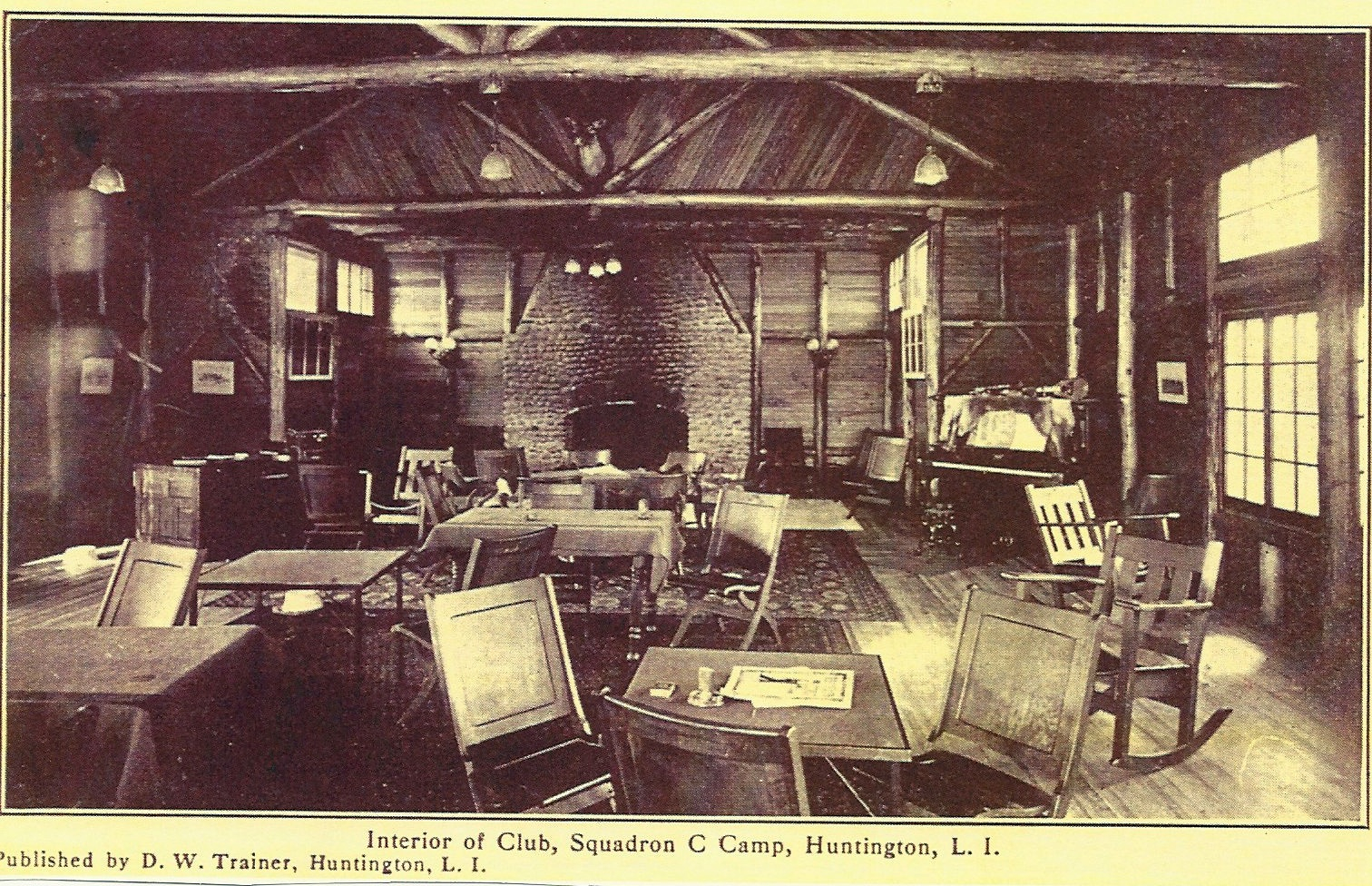
The entrance to the Farm was on Lawrence Hill Road, more or less where Donovan Drive now begins. A sign near the main gate read, “Ladies will please not pass this point.”  Ladies were thus deprived of visiting the race track to the right of the entrance road.  To the left was a practice polo field, followed by two clay tennis courts behind which stood two cement handball courts (which stood until recently in the yard of one of the houses on Donovan Drive).  South of the tennis courts were twenty bungalows, each equipped with six spring beds and with shutters on all sides that could be opened in the warmer weather.
The Club House is gone, but the fireplace still stands

The Club House is gone, but the fireplace still stands

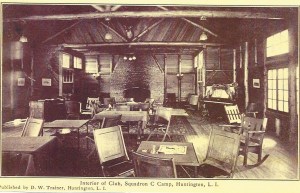
To the east of the bungalows stood the mess hall (which could accommodate 125 to 150 at a sitting) and the clubhouse. The stone fireplace for the clubhouse still stands in the yard of a house on Squadron Court.  The mess hall, which was at a right angle to the club house, stood more or less where Squadron Court is now.  Further south was the wash house or locker room and a water tower.

The road ended in a T intersection.  To the left (east) it led behind the wash house to a parking area.  To the right the road led to the stable complex which stood approximately where Donovan Drive and Rough Riders Court now intersect and consisted of a shed, four stables, a barn, a water tower and pump house.

To the south and west of the stables was the polo field.  The Farm was open from early July to early September.  From September to June the men trained once a week in the armory in Brooklyn.  During the summer months, the horses were stabled at the Farm.  Although the Farm was established for the benefit of the men, the horses seemed to be rejuvenated after two months in the fields eating fresh grass.

Some members lived at the Farm all summer commuting to their jobs in the city.  Most, however, came out just for the weekend.  Although there was no charge to stay in the bungalows, the men were charged for breakfast (50¢) and dinner ($1) whether they ate on the Farm or not.  Lunch was 75¢.  Active members of the squadron, who paid $4.25 a month in dues, were charged 50¢ to ride a horse at the farm.  Veteran members, who paid annual dues of $9, paid $1 to ride a horse.  The dues paid for the upkeep of both the Brooklyn clubhouse and the Farm.
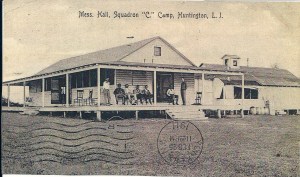
The Mess Hall

The Mess Hall

In the summer, the cooks from the clubhouse and the staff from the armory would come out to tend the horses and maintain the farm.  Members would arrive by car or take the train to Cold Spring Harbor, where they would be met by the farm bus.  Although the farm had tennis courts, handball courts and baseball diamonds, most men spent their time on horseback.  They could ride a trail with jumps through the hilly wooded section of the property along Peabody Road.  This area was known as the “Russian ride.”  The origins of that name are lost, explained Stefurak:  “There was an Italian jump on it.  Figure that out.”

There was also a sabre course in the southwest corner of the Farm where Peabody and Saw Mill Roads intersect.  Some members would organize races on the racetrack near the entrance to the Farm.  The track, which was in a hilly area, “was all up and down, the damnest thing you’d ever want to ride on,” remembers Stefurak.

The men would wear racing silks and odds would be placed, but it was all done for fun.  “You make a couple of bucks here, lose a couple of bucks.  And if you made it, you’d buy beer anyway,” explains William Hurley, who joined the squadron in 1938.

Members would also ride out through the surrounding countryside.  A brochure for the 1937 season boasts of “the diversity of scene found in this charming wooded, rolling country. . . .   The region abounds in bridle paths, so that little or no riding need be done on main highways.”  Destinations included the Otto Kahn estate, Eagle Dock Beach in Cold Spring Harbor, and a German beer garden in Melville.  “We always went up to Melville,” recalls Bill Hurley.  “At that time, the property around the Farm was farms; potato farms and so forth.  You could ride right from the Farm itself right to Melville.”

Polo matches between the squadron’s team and teams from the U S. Army and local polo clubs were held every Sunday.  Spectators would enter through the white gate, which still stands, on Woodbury Road just east of Saw Mill Road.  The members, most of whom were single, rode hard during the day and raised hell at night.

Some went into town on dates with the nurses from Huntington Hospital, but most spent their evenings on the Farm.  While the Farm was run like an exclusive country club, Hurley says, “the men themselves came from all walks of life.  You had attorneys and you had draftsmen and you had bus drivers.  You name it.

“We lived like millionaires.  We were the working class of Brooklyn and we lived very well,” adds Stefurak.

But on the eve of World War II, the Farm was once again used for military training.  Members enlisted in the federal service for one year from January 1941 to January 1942. That one year enlistment was soon extended for the duration of the war.

The Farm fell into disuse and was leased to a local farmer to graze his cows.  Reportedly the turf at the Farm was so good that during the war some of the sod was transplanted to Ebbets Field in Brooklyn, which was three blocks from the Squadron’s armory.  To help commercial farmers work their fields in the face of labor shortages during the war federal and state agricultural agencies proposed using the Farm to house 250 Bahamans, who would work on local farms.  The Huntington Town Board denied the request because it would violate local zoning laws.

World War II also saw the demise of the cavalry.  Horse fighting was deemed incompatible with modern warfare and both the U.S. Army and the New York National Guard abolished their cavalry units.  During the war, there were no active members paying their $50 a year in dues, so “the Board of Governors had to make a choice between the Farm and the clubhouse. Most felt under the circumstances it was better to hold on to the Farm and to sell the clubhouse, which they did,” explains Hurley.

While the men were training at Fort Devens in April 1942, club officials came up and told them to sign their rights to the Farm over to Squadron C Cavalry Club.  In May 1942, Troop C Armory Auxiliary conveyed the farm to the Squadron C Cavalry Club of Brooklyn, Inc. for a nominal sum.  In August 1942, the club’s charter was again amended,

this time to allow the club to hold real property and thus legitimize the purchase of the Farm.  To be sure of good title, the club also received a quitclaim deed from Squadron C Farm, Inc., which had been managing the property for over twenty years.

AFTER WORLD WAR II

In the summer of 1946, after returning from service in the Pacific theatre, Stefurak took his wife Ruth out to see the Farm.  They found the buildings intact but surrounded by four-foot high grass.  Some of the grass was trampled down in a path leading to one of the bungalows.  Inside, Stefurak found three other members of the cavalry club, John Delapina, Arty Campbell and Bill Sloan.  Stefurak asked, “Why don’t we get some of the guys together and get the farm going again?”

And that’s what they did.

They cut the grass, painted the buildings, rebuilt the tennis courts, planted flowers around the clubhouse and maintained the pump house, which according to Stefurak, produced “the sweetest water you ever tasted.”

Still missing were horses.  Since the cavalry unit was disbanded, there were no horses to bring out from Brooklyn.  Squadron A, in Manhattan, did manage to hold onto its horses.  Squadron A loaned the horses for the summer in 1947, but someone let them loose and the privilege was not extended the following year.   Instead, the club entered into a month-to-month lease with John and Francis Rice to operate a horse farm on the site.   In addition to receiving rent from the Rice brothers to pay the property taxes, club members could ride the horses for $2.  Weekends at the Farm were now more do-it-yourself.  There was no staff to cook meals and no set schedule of fees.  Instead those who came out put up five dollars and shopping details were organized.  The shoppers would drive into Huntington village, buy some steaks at Berger’s Butcher Shop on New Street and then stop at Finnegan’s for a drink before driving back up to the Farm.  The steaks, or sometimes lobsters, were barbequed on Saturday night.  “At night we got dolled up and we went out,” remembers Stefurak.

Enjoying the Club House after the war

Enjoying the Club House after the war

In addition to tennis, the men, and now their wives as well, would continue to ride horses out into the countryside.  The Melville beer garden was still a popular destination.  They would also visit the Marshall Field estate to swim in the Long Island Sound (the club members were admitted to the still private estate by the stable hands who knew them from the pre-war period).

Sunday dinner was at Ma Glynn’s on East Main Street or Rothman’s in East Norwich.

Bill and Ruth Stefurak were post-war regulars at the Farm.  “It was a great weekend.  I’d come out here. I’d ride, play tennis, swim, have a good drink, good eatin’.  What more could you ask for?  We had everything for nothing.”  Immediately after the war, 50 to 60 members would regularly gather at the Farm for picnics.  But as time went on and families grew, the number dwindled to about twenty, then to only 10 or 12.

The Rice brothers converted the polo field into a show ring and gave riding lessons and organized horse shows there.  In 1949, the Irish American Club held its first Irish Field Day at the Farm.  Four years later, tens of thousands of visitors took part in the Town’s three day Tercentenary celebration at the Farm.

Starting in 1950, members of the New York Greyhound Owners and Breeders Association transformed the old saber course into a dog racetrack complete with starting gates and an electric rabbit.  Non-betting races were held every Sunday until 1966.

DEVELOPMENT

Almost as soon as the Farm was up and running again after the war, efforts to sell the land began.   Despite the desire of World War I era veterans to sell the Farm, the younger members kept the Farm going for 15 years.  Eventually, club membership, which due to charter restrictions could not be replenished, was dwindling due to deaths.  Furthermore, the club stopped accepting new members from among those who were eligible to join.  Some members quit the club because of this change in policy.  The older members argued that the purpose of the club—to encourage enlistment in the cavalry—was impossible because the cavalry no longer existed.  Moreover, they argued, why keep the place going for the select few “who raised hell” on the weekends.  The younger members, not all of whom used the Farm regularly, disagreed.  They claim that the old-timers got greedy.

“They saw a good plot of land on which they could build and make some money on it.  And they wanted to take advantage of it,” explains Stefurak, who vehemently opposed the sale.  Stefurak didn’t see it as simply a question of the club maintaining a playground for just a few members.  He asked, “What are you going to get out of it?  A few hundred dollars?   Doesn’t it make more sense to donate it to the Town of Huntington and establish an open preserve and maybe have horses there so your grandchildren can see it?  Wouldn’t that be worth a couple of hundred dollars a piece to you?”

Members opposed to the development of the Farm suggested donating the land to the Huntington School District, which was looking for a site for a new high school, or to the boy scouts.  In fact, the Huntington school district in 1955 had a referendum to approve the purchase of 54 acres of the Farm to build a new high school to replace the crowded Main Street school (now Huntington Town Hall).  The voters rejected the proposal by a vote of 1162 to 848.  The new high school was built just a few years later on Oakwood Road.  New York State approached the club about acquiring some of the land for an armory, but was refused.  Another suggestion to re-route the proposed Bethpage State Parkway extension to Caumsett State Park from the shores of Cold Spring Harbor through the farm and Huntington Country Club was also not pursued.

Bill Hurley, who did not visit the Farm much after the war, felt “there was an awful lot of skullduggery going.”  He believed that many of those pushing the sale were also part of the group that sought to purchase the property.  “They didn’t own the property.  They didn’t put a penny down for the purchase price,” Hurley complained.  Moreover, the club could afford to keep the Farm.  In 1960, the annual real estate tax, insurance and maintenance costs for the property amounted to about $4,000.  Dues from 144 members (there were also 22 life members who did not pay dues) netted the club $1,300 and the Rice brothers lease brought in $3,480 a year.

However, if the Rice brothers, who had a month-to-month tenancy, decided to vacate, the club would have an annual deficit of about $2,700, an amount that could quickly deplete the club’s liquid assets of $10,500.  The club’s Board of Governors, which considered the land underutilized and thought the club could benefit more from the money than from continued use of the land, approved the sale to Rough Riders Farm, Inc., the president of which was George R. Tollefsen, a member of the cavalry club.  The purchase price was $290,000.

Although not required, the sale was also voted upon by the membership at large which also approved of the sale by a vote of 79 to 33. Considerably more than the handful of members who used the farm regularly voted against the sale. The opponents of the sale were extremely bitter. “It kind of broke our hearts,” Stefurak recalls.

Proceeds of the sale were divided among the club members, each receiving $1,800 (about $13,500 in 2012 dollars) in two or three installments as the mortgages were paid off.  A fund was set up to establish an endowment to be given to the Brooklyn Historical Society to preserve materials and artifacts that the club had donated to the society.  Each member was asked to give $100.  Hurley gladly gave to the fund: “I felt this is for a good cause.  It’s good for the artifacts which I was part of for so many years and I’m getting the eighteen hundred dollars gratis, so why not give a hundred to this fund.”  The members raised $10,000 which “at that time seemed a tidy sum.”

In 1962, a proposal to develop the property with luxury apartments went nowhere.  The clubhouse burned to the ground in a spectacular fire in October 1962 with flames reaching 50 feet in the air.  Rough Riders Farm, Inc filed a subdivision map with the county on June 4, 1964.  The map depicted three new streets.  The names of two of the streets recall the land’s cavalry past—Rough Riders Court and Squadron Court.  The principal street, Donovan Drive, was named after Rough Riders Farm, Inc.’s lawyer and principal, James B. Donovan.  Donovan, a partner in the firm of Watters and Donovan, served as general counsel to the Office of Strategic Services during World War II and as an associate prosecutor at the principal Nuremberg War Trial.  He gained notoriety in 1957 when he was appointed to represent accused Soviet spy Rudolf Ivanovich Abel, who was exchanged for U-2 pilot Francis Gary Powers.  He later negotiated the ransom of prisoners taken by Cuba in the failed Bay of Pigs invasion.

In December 1964 Rough Riders Farm, Inc. conveyed the property to Laurel Estates Corp., which built and sold houses of Squadron Hill.  Later that month, the last horse show was held at the Farm.

The first residents of Squadron Hill’s new incarnation arrived in 1966.  Today, Squadron Hill consists of 40 houses on 1.5 to 2 acre lots, three ground water recharge basins and a 3.9-acre town park.  Almost half a century of suburban landscaping and natural forest succession mask the area’s prior use as a farm, military training camp and summer retreat for the rough riders of Brooklyn’ Squadron C.  All that remains are the old stone fireplace, an old barn, one of the sleeping bungalows, and the white gate on Woodbury Road.

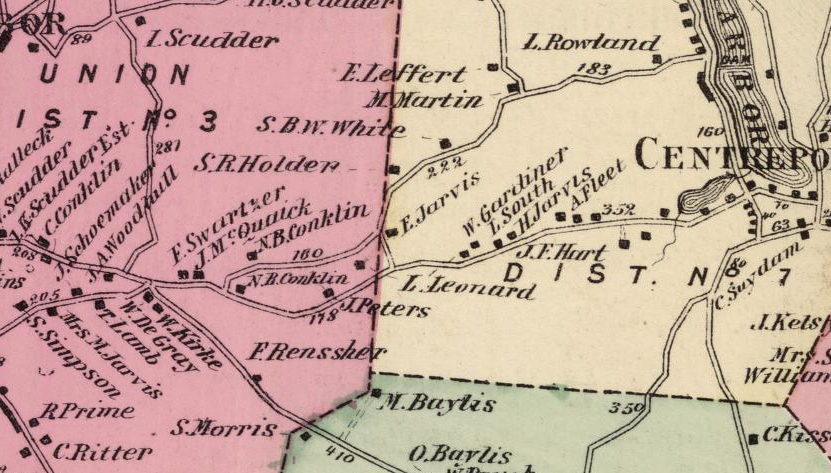
While the welfare state is considered a modern development, caring for the less fortunate among us is not a new concern.  And while today it is considered a federal and state responsibility, until the last quarter of the nineteenth century it was a local concern.  In Huntington, the first record of aid to the poor is dated 1729.  The Town continued to care for the poor until 1872, when the responsibility was passed onto the County.

Caring for the less fortunate is an ancient practice.  Ancient Babylonian, Greek, and Roman societies imposed a duty to provide for the poor.  The Bible also imposes such an obligation.  The Old Testament speaks of the duty to aid the sick, the old, the handicapped and the poor.  The injunction is repeated in the gospel of Matthew:  “whatever you did for one of these least brothers of mine, you did for me.”

In medieval England, the responsibility to provide for the poor fell to the church through its extensive system of monasteries.  But with the abolishment of monasteries under Henry VIII, the obligation fell to secular authorities at first supported by voluntary contributions and then after 1572 by a compulsory assessment (i.e. taxes).  Further amendments led to the enactment of the Elizabethan Poor Law of 1601, which was based on the principle of local relief supported by local taxes.  Under the direction of a town’s Overseers of the Poor, the unemployable were given direct aid, the young were given apprenticeships and the able bodied were given work relief.

This system was brought to the New World by the English settlers.  The obligation to provide for the poor led to restrictions as to who could settle in a town lest they become indigent and in need of relief.  In thirteenth century London, “No ‘stranger’ was allowed to spend more than one day and a night in a citizen’s house, and no one might be harboured within a ward ‘unless he be of good repute.’”[1]  Four centuries later the selectmen of Boston “prohibited citizens from entertaining strangers for more than two weeks without first securing official permission; if the visitors seemed likely to stay longer and become a public burden, such permission was denied.”[2]  Likewise, in 1662, the townsmen of Huntington ordered that no resident of Huntington shall sell or rent his house or lands to anyone who has not been approved by a committee appointed for the purpose of approving such transactions.  Failure to secure such approval would incur a fine of £10—a substantial sum to be sure.[3]

Due to its small population and approval of new inhabitants, Huntington probably did not have to worry about poor relief in its first three quarters of a century.  In 1729, the Town paid Eliphalet Hill £8 for “keeping Sarah Scudder the Last Year.”  This charge accounted for 80% of the Town’s expenses for that year.[4]  Over the next 23 years, others received support from the Town, but the need must have been limited because the Town did not formally appoint Overseers of the Poor until 1752.  For ten years, the Town’s Board of Trustees acted as Overseers of the Poor.  Beginning in 1763, a separate group was appointed.

The early records of the Overseers include payments to local doctors for tending to the poor and bonds posted by individuals to guarantee payment for the support of children born out of wedlock.  In many of these cases, the bonds are posted by the reputed father to secure payment for the education and upbringing of the child.  For example, in 1776, Nathaniel Youdal and Philip Youdal (presumably Nathaniel’s father) posted a bond in the amount of £200 to guarantee that the male child of Mary Jarvis, a single woman, would not become the responsibility of the Town. Nathaniel Youdal was reputed to be the father.  In many other cases, the bond was posted by the father of the newborn’s mother.  For example in another case from 1776, Hezekiah Smith posted a bond to guarantee the support of the child of Susanah Smith, his daughter.  The baby’s father was William Buchanan of Smithtown, which placed him beyond the jurisdiction of Huntington’s Overseers.

The main duty of the Overseers was to provide for the care of the poor.  This was done in a variety of ways.  Children could be placed in an apprenticeship.  Such was the case for five-year-old Samuel Hand in 1777.  He was bound to Sarah Bunce for a period of eleven years.  Young Samuel was obligated to faithfully, honestly, and obediently serve “as a good and faith[ful] apprentice ought to do.”  For her part Sarah Bunce was to provide sufficient meat, drink, apparel, washing, and lodging.

Older poor residents, such as widows, the disabled and the mentally ill, were placed with local families who would be paid by the Overseers to provide “them meat, drink, washing, lodging, mending & nursing Suitable and find all their Clothing that is necessary for one year from the date, and return them as well clothed as they took them.”  In these cases, care of the indigent was “auctioned off” to the lowest bidder.   Prices varied from person to person.  Without knowing the particulars of each person’s situation, it is impossible to determine why.  In 1806, John Conkling was paid $51 to take in Ruth Lewis.  Silas Plat was paid almost twice as much ($95) to take in Mary Williams and her daughter.  Meanwhile, Micah Bedell was paid the same amount ($95) to take in Henry Chadeayn.  Timothy Bennett received $19 for taking care of Elizabeth Price, who is identified as a child.  Other similar amounts must also be for children.  From this small sample, we can deduce that it was less expensive to feed, clothe and house children than women, who in turn were less expensive to take care of than men.

At the Town’s annual meeting on April 3, 1821, it was resolved that “the Poor of Sd   Town be put out in bulk and that one person be hired to keep them all together provided the Trustees of Sd    Town approve of the price asked and if not for them to be put out in the Usual manner.”  It appears that this new arrangement was not carried out in 1821 or in the subsequent two years.  In 1824, the Trustees were given authority “to dispose of the Poor of the Town in the most comfortable and economical manner.”  Likewise the Overseers records for that year refer to the possibility of providing a central house for the care of the poor.  Eventually, the Overseers and Trustees decided to buy a farm on the west side of the Green for use as a poor house.  Rather then being sent to various private homes throughout the town, the poor would be sent to this farm.  Within the poor house, the races were segregated.  According to the records, several people refused to go to the poor house.  The Trustees in 1825 ordered that all paupers were to be provided for at the poor house.  “Those who refuse to conform are to have no assistance except extraordinary cases at the discretion of the Overseers of the poor.”  That year nearly two dozen residents lived at the poor house.

In this respect, Huntington would be in the vanguard.  Throughout the state, resentment over the system of providing outdoor relief, that is, outside of a poor house, was growing.  Many felt that the poor were not thankful enough for the relief they received, and that aid destroyed the incentive to work.  In 1823, the New York State legislature commissioned Secretary of State J.V.N. Yates to conduct a study of poor relief throughout the state.  Yates sent questionnaires to Overseers of the Poor and presented his findings in February 1824.  He found that the auction system through which the poor were farmed out to private homes was inefficient; and that the poor were often treated cruelly.  “Moreover, the education and the morals of children were almost wholly neglected.”  Children “grow up in filth, idleness, and disease, becoming early candidates for the prison or the grave.”  Moreover, “the able bodied poor were rarely employed; home relief encouraged idleness, and ‘vice, dissipation, disease and crime’ resulted.”[5]  [According to the Yates Report, Huntington had 51 paupers in 1823 (22 males, 29 females), ten of whom were children and the Town spent $1,316.12 to support them.  “The paupers are placed in various families by contracts for the year, until the ensuing town meeting.”  There is no reference to Huntington experiencing the deplorable condition cited elsewhere in the report.]

Yates recommended that the poor be cared for in an institutional setting, which it was felt would be more efficient.  The legislature enacted the County Poorhouse Act, which directed each county to purchase land “and thereon build and erect, for the accommodation, employment and use of the said county, one or more suitable buildings, to be denominated the poor house of the county.”  Suffolk County did not purchase land for a poor house until 1870, however, so the relief continued to be given at the town level.

By mid-century, Huntington’s Town expenses totaled $3,000, of which about $2,100 went to care of the poor.  The number of poor helped by the Town averaged about 15.   Dissatisfaction with the expense of the program and the perceived mismanagement of the poor house led to a meeting at the hotel of Ezra Smith in Long Swamp to discuss the matter. Despite the stormy weather, the meeting was well attended.  Some argued that the poor house should be done away with.  Others argued that better care of the poor was possible with a woman in charge of the poor house—a woman could also be paid less than a man.   A committee was appointed to confer with the Overseers of the Poor to present a solution.  Three weeks later the committee presented its report recommending that those who could be placed with relatives at less cost than keeping them at the poor house should be so accommodated.  However, some of the poor had no relatives in town; others were inflicted by disease that would render such placement impossible.  The committee suggested that a suitable manager be found who could work the farm for the support of the poor and that the residents (inmates as they were then called) should assist with the farm work when able.  The Overseers were to make weekly inspections of the farm to ensure its efficient operation.

The next month, the Overseers engaged Nathan Wiggins to manage the farm and poor house.  He was provided with equipment to work the farm, the produce of which was used to support his family as well as the residents of the poor house.  Wiggins was also entitled to sell pine wood from the farm.  In addition, he was paid 98¢ per week.

The poor house approach was continued for many years thereafter.  However, in 1868, the farm on the Green was exchanged for the 70-acre Elias Smith place in Long Swamp.  The move was welcomed because it was felt that having the poor house in the middle of the village was a nuisance.  “A congregation of men and women so near the main road sunning themselves on pleasant days, and using all sorts of profane and obscene language, is not very pleasant for passers by, or those that reside in the vicinity.”  It should be remembered that some residents of the poor house were there due to mental illness.  The new location had the added advantage of being over two miles from town, which would dissuade ”the inebriates” from “the habit of having their bottle filled.”[6]

The new poor house was also used as a venue for Town meetings.  But it didn’t last long.  In 1871, a County poor house was established in Yaphank.  By May of that year, there was talk of selling the poor house.  On December 5, 1871,  at a Special Town Meeting, it was resolved to remove the poor to the County alms house and sell the Town House, as it was known. The Overseers of the Poor them met at the Town House to make arrangements for the relocation of the residents to Yaphank.  A fire was lit in an unfrequented room.  Due to a defect in the chimney, the fire escaped the chimney and spread to the attic.  The building was a complete loss.  “The inmates of the house were immediately carried to the Railroad station and sent to the County House the same afternoon.”  (The Long-Islander, December 15, 1871).

The poor house or alms house remained the means of providing relief in New York State until 1929 when the Public Welfare Law was enacted


[1] London, The Biography, by Peter Ackroyd (London: Vintage Books, 2001), page 61

[2] From Poor Law to Welfare State, A History of Social Welfare in America, Sixth Edition, by Walter I. Trattner (New York:  The Free Press, 1999), page 19

[3] Huntington Town Records, Volume I, page 40-41

[4] Records of the Overseers of the Poor Addendum 1729-1843 (Town of Huntington 1992), page 1

[5] Trattner, page 58.  Thanks to David Weinstein for locating an online copy of the Yates Report.

[6] The Long-Islander, April 3, 1868

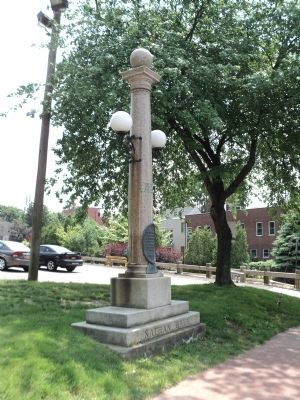
When Frederick MacMonnies 13′ tall statue of Nathan Hale was dedicated in New York’s City Hall Park in 1893, it was suggested that a suitable memorial should also be placed on the shores of Huntington Bay where Nathan Hale began and perhaps ended his spying mission in September 1776.  A committee of local citizens was formed.  Originally, the committee planned to place a granite boulder from Connecticut, Hale’s home state, on the shore of Huntington Bay.  It was thought that a bronze statue on Main Street in Huntington village would also be appropriate. [Huntington does have a copy of the New York City statue–but much smaller.  It is in safekeeping in the Town Clerk’s archives.]

Nathan Hale 1

The 1894 Memorial on Main Street

As it turns out, the Main Street memorial—a marble shaft, rather than a statue—was ready first.  The shaft was erected in front of the library, which at that time was located in the Soldiers & Sailors Memorial Building, and was dedicated on July 4, 1894.  The committee did not realize its goal of placing a Connecticut boulder on the shores of Huntington Bay.  But the same year the Main Street memorial was dedicated, George Taylor, the president of a prominent Manhattan dry goods store, purchased a large tract of land in Huntington Bay.  Taylor soon became enthralled with the Nathan Hale story—no doubt because he now owned the land where Hale landed.  Taylor named his estate “Hale-Site,” a name that was soon applied to the entire section on the east side of Huntington Harbor.  Taylor, at his own expense, also completed the second part of the memorial committee’s plan.  He arranged for local contractor Oscar “Dynamite” Kissam to move a large boulder from near Taylor’s house to the beach.  Perhaps unwittingly realizing the committee’s original intent, the boulder did, in fact, come from Connecticut, courtesy of the last glacier.  Taylor also had three bronze plaques affixed to the boulder, telling Hale’s story.

For three quarters of a century the boulder stood on the beach at the end of Vineyard Road, where, unfortunately, it was subject to the effects of erosion and vandalism.  Ownership remained in the Taylor family.  At one point Taylor’s grandson, Balmor Taylor, removed the bronze plaques for safekeeping.  As early as 1962, he also explored transferring ownership to the Town of Huntington.  It appeared that an agreement had been reached and in 1974, town workers removed the 45-ton boulder from the beach and transported it to a new home at the intersection of New York Avenue and Mill Dam Road.  Mr. Taylor, however, did not think he and the Town had reached an agreement.  Over the next two years, differences were resolved and an agreement was reached.  The boulder was rededicated at its new location on September 19, 1976, two hundred years after Hale’s mission.

Nathan Hale Rock

The Nathan Hale Rock before its latest move

But that was not the last stop for Huntington peripatetic monument.  As part of the current road improvement project along New York Avenue, the New York Department of Transportation constructed a roundabout at the intersection where the boulder stood.  The rock would be in one of the travel lanes around the new traffic circle.  So last September (2012), the monument was moved once again.  This time the move was only about 50 feet to the southwest corner of the intersection.  When the roadwork is done, the area around the rock will be landscaped.

The Town of Huntington continues to celebrate its most famous visitor.  Just be careful when you read an earlier description that says the rock marks the spot where Nathan Hale landed.  He did not land at Mill Dam Road.

 The Town of Huntington recently acquired twelve acres of open space in Greenlawn.  While valued as a natural habitat, the property also has a long history dating back to the early eighteenth century when it was owned by Charles Saxton, who sold a portion of his land to Jeremiah Smith in or about 1719.  An easement to allow Saxton access to Smith’s property to clear a drainage ditch refers to the earlier land transfer.[i]

But the property is known for its connection to the Brush family.  Thomas Brush was a farmer in West Neck who, in addition to his farm at West Neck, owned land in Old Fields (now Greenlawn).  When he died in 1862, he bequeathed to his son Samuel the large farm in Old Fields “where he now resides.”[ii] The 1858 atlas lists “S. Brush” in that location.  Samuel’s brother James owned the farm to the east across Old Field Road.

Samuel Brush was born in 1807 in Huntington.  He married Elizabeth Sammis in 1835.  Two years later, he acquired six acres from Moses Rogers on the west side of the road leading from “Centre port to the Old Fields” bounded on the east and south by the road, on the west by land owned by someone whose name is illegible and on the north by land of Henry Lewis.[iii]  Six years later he acquired from William Smith 20 acres of partly enclosed arable land and partly timber land near Centerport bordered on the south and west by an old road, on the north by the timber land of Henry Lewis and on the east partly by other land Brush already owned and partly by the highway leading from Centerport to Old Fields.[iv]  From the descriptions given in the deeds, these two tracts would appear to include at least part of the current 12-acre subject property.

Brush

The Brush Homestead

An inspection of the original part of the house indicated a construction date in the 1830s, which is consistent with the date of Brush’s marriage and his acquisition of the property described above.

Samuel’s son Samuel Brush, Jr., who was born in 1845, and his wife Anna lived with him on the farm when he was widower (his wife died in 1864).[v]  Father and son were both farmers.[vi]  Samuel Brush Jr. inherited the farm when his father died in 1881.

In 1905, Samuel Brush, Jr. sold the 116-acre farm to Frederick A. Phelps of Brooklyn.[vii]  Phelps was a land speculator who acquired hundreds of acres of land in the Centerport-Greenlawn area as an agent for Dean Alvord, the developer of Prospect Park South in Brooklyn and Belle Terre in Port Jefferson.  Locally, he subdivided land overlooking Northport Harbor, known as Cedarcroft.  Part of that subdivision became the Grace Estate, and a part of that property including a log cabin, is now Town of Huntington parkland.

Phelps did not intend to live in the house and his acquisition of the property saw its transformation from a working farm to a wealthy gentlemen’s farm, where horses, sheep and show dogs would be raised.  Two years after he acquired the property, Phelps sold it to Harrison Gilmore of Utica.  Gilmore was a successful coal dealer in western New York[viii] and did not intend to live in the house year round—it would be a summer retreat.  Gilmore hired William A. Davis to work as foreman on the farm.[ix]  In 1912, Gilmore sold 12½ acres at the southern end of the farm to Claire A. Knapp of Bellport;[x] and the northern parcel of about 80 acres to Francis C. Hicks of Philadelphia.[xi]

Claire Knapp, who was only 23 years old at the time, was from an old Fairfield, Connecticut family.  Her grandfather made a fortune in the printing business in Brooklyn and was one of the founders of the Metropolitan Life Insurance Company.  Her father Joseph Palmer Knapp followed his father in the printing business, merging the family company with others to form American Lithograph Company, later known as ALCO.  Joseph P. Knapp also acquired and started several newspapers and magazines, including Everyweek magazine and Collier’s Weekly.

According to one account, Joseph P. Knapp purchased the Greenlawn property for his ex-wife, who divorced him in 1903, and his two children; and spent $75,000 fixing it up. [xii]  The work included adding a large wing to the west side of the old Brush farmhouse.  An article in December 30, 1914 editions of The American Architect shows the historic house with the new west wing forming an L shaped house.  The new wing contained a spacious living room and dining room on the first floor and a large master bedroom on the second floor.  The original deed was to Claire Knapp; but within a year, she transferred the property to her father.

Knapp1914

The Brush Homestead with West Wing added by Joseph Knapp

Miss Knapp, operating under the name Clairedale Farm, raised show dogs—and cats.[xiii] She apparently moved the operation to Mastic in 1916, where she later eloped with her chauffer (but that’s another story).   The same year, Joseph Knapp leased the farm to Baron de Stackelberg of Russia for the summer.[xiv]  A year later, the Knapps sold the 12½-acre property to Annie Brinley, the widow of Captain Edward Brinley of Greenlawn subject to a $15,000 mortgage held by Joseph Knapp.[xv]  Edward Brinley, a member of the Annapolis class of 1880, had died just six months earlier.

The property then changed hands several times over the next thirty years.  Brinley sold the property to James G. Hall of Garden City in 1924.[xvi]   Just three years later Ida Bell Hall of Coronado, California (presumably the heir of James G. Hall) conveyed the land to Waldron and Rey Belknap of Manhattan.[xvii]  The Belknaps also acquired a 76½-acre parcel to the north reuniting the property to close to its original size.  Waldron Belknap was a vice president of the Bankers Trust Company.  As a young man, he had been a member of Manhattan’s Squadron A Cavalry unit, whose Brooklyn rival, Squadron C, had a summer farm in Huntington.  He re-enlisted in 1916, at the age of 43, to serve in World War I.

Knapp Barns

Stables, Water Tower and Kennel Building

In 1946, Rey Belknap, now residing at the St. Regis Hotel in Manhattan, sold the 12½-acre southern portion of the property to Henry Sanford of Smithtown Branch for $50,000.[xviii]  Two years later Henry Sanford conveyed the property to Anne N. Sanford.[xix]

Anne Sanford married Dr. Walter T. Carpenter and transferred ownership of the property to him in 1977.[xx] Dr. Carpenter was the first board-certified pediatrician in Suffolk County.  He was born in Brooklyn in 1911.  After graduating from Cornell Medical School, he volunteered as a ship’s surgeon during World War II and later joined the Office of Strategic Services.  After the war, he set up his pediatric practice in Greenlawn.  He enlarged the east wing to the house in the 1950s for his medical practice.

Dr. Carpenter died in October 2008.  His estate had the house and outbuildings demolished in 2010 in order to save the expense of insurance and taxes.


[i] Suffolk County Clerk’s Office Deed Liber X, page 85

[ii] The Descendants of Thomas and Richard Brush of Huntington, Long Island, compiled by Stuart C. Brush, Gateway Press, Inc., 1982, page 115

[iii] Suffolk County Clerk’s Office Deed Liber 28, page 121

[iv] Suffolk County Clerk’s Office Deed Liber 39, page 205

[v] Brush, page 244

[vi] Brush, pages 244 and 429

[vii] Suffolk County Clerk’s Office Deed Liber 567, page 314

[viii] History of Oneida County, New York
From 1700 to the present time
of some of its prominent men and pioneers.
By: Henry J. Cookinham
The S. J. Clarke Publishing Company
Chicago 1912

[ix] The Long-Islander, March 15, 1907, page 6

[x] Suffolk County Clerk’s Office Deed Liber 798, page 220

[xi] The Long-Islander, October 4, 1912, page 4

[xii] See http://www.spoonercentral.com/2011/Talk.html for an account of the Knapp family in Mastic.

[xiii] The Long-Islander, September 29, 1922

[xiv] New York Times, June 2, 1916

[xv] Suffolk County Clerk’s Office Deed Liber 959, page 353

[xvi] Suffolk County Clerk’s Office Deed Liber 1116, page 135

[xvii] Suffolk County Clerk’s Office Deed Liber 1270, page 149

[xviii] Suffolk County Clerk’s Office Deed Liber 523, page 68

[xix] Suffolk County Clerk’s Office Deed Liber 2835, page 106

[xx] Suffolk County Clerk’s Office Deed Liber 8261, page 123

Until it was developed in the 1920s, the area between Depot Road and Lenox Road from Ninth Street south to a point south of Vondran Street was home to a one-mile horse racing track featuring a 1500 seat grandstand, a club house, large barns and open fields.

Horses had been raced at this site since as early as the 1840s.  The Suffolk Racing or Driving Course was a half-mile track that reportedly was the scene of some the first races run by the legendary horse “Lady Suffolk.”  These early races featured trotters pulling a driver in a sulky.  The track sat on a 47-acre parcel and endured an uneven history with different owners and operators.  Races were held sporadically.  For example, in 1874, the summer meeting lasted just three days with only two or three races each day.  Nonetheless, the meet was popular enough to attract visitors from Brooklyn by way the Long Island Rail Road.

After the Civil War, concerns were raised about the future of the track.  In 1878, it was suggested that a fair be held at the course—so long as it didn’t detract from the county fair in Riverhead.  But it took another decade for the idea to be realized.  In 1886, Henry C. Brown, proprietor of the Long Island Brewery in Brooklyn and a recent resident of Northport (his home is now the Indian Hills County Club), organized the Huntington Live Stock Fair Association.  Despite the Association’s best efforts, the grounds were not ready for the hoped for opening in 1887.  The Association had purchased additional land around the track and had made extensive alterations to the grounds and the track itself.

The track and fair grounds were formally opened on the Fourth of July the following year.  The track was hard and pebbly; the grand stand was missing some final details and needed a coat of paint.  Nonetheless, attendance was excellent.  The wealthy summer residents of East Neck and from miles around came.  So did local farmers and their families dressed in their Sunday best.  Several races were run—but there was no betting.  Between heats, a brass band played.  Visitors enjoyed the scene from the wide balconies of the club house; and enjoyed meals in the lunch rooms.  The grounds were surrounded by open meadows and fields of grain with forests on the distant horizon.  It was a “picture so full of beauty and variety” that it “calms the mind when agitated by conflicting thoughts.”  Further improvements were made in time for the September races, erasing all memory of the “unsavory Mecca of the horsemen of olden times.”

Fair Grounds

By September–when the Association’s first annual fair was held—every pebble had been removed from the track, but racing was not part of the program.  The event featured livestock shows, displays of local produce and flowers, samples of bread, cakes, pies and jellies, as well as quilts and paintings.  Wagons and carriages, and farm equipment were displayed.  Visitors could ride the merry-go-round, have their photograph taken, or watch a baseball game between the Suffolks and the Norwalks.

It was a welcome diversion for a town that had experienced a terrible blizzard the previous March and a devastating fire that had destroyed the block of stores known as the Brush Block, a carriage factory, blacksmith shop and the Central Presbyterian Church just a week before the fair opened.  But the first day of the fair also featured rain, which turned out to be an omen of things to come.  In succeeding years, rain would be a constant problem for the fair’s organizers.   Even though the Long Island Rail Road ran extra trains to get visitors to the fair, which was only a few minutes walk from the train depot, rain kept them away.

By 1893, the Live Stock Association had defaulted on its debts.  A new company, known as the Long Island Fair Grounds Association, was formed to take over.  The group intended to resume the fairs, but it seems the only activity was horse racing.  In 1905, an effort was made to incorporate a new organization—The Huntington Fair and Exhibition Company—to purchase the property and resume the fairs.    The grounds were instead purchased by Singleton Van Schaick, son of one of the founders of the Huntington Live Stock Fair Association.  In 1921, the old fair grounds were purchased by Addison Sammis, who turned the land over to the Huntington Station developers, Koster & Cornehlsen, who subdivided the land into 20 foot wide lots and began building houses where the horses had once raced.

Perhaps the only tangible reminder of the old race track, other than horse shoes found buried in the area, are the cement pillars that flank the south entrance to East Park Drive.  According to neighborhood lore, the pillars were a part of the stable area and were where the jockeys dismounted from their horses.

Although the annual fairs did not last, they did give rise to a new name for the surrounding community—Fair Grounds.  But that too turned out to be a temporary appellation.  In 1911, the name was changed to Huntington Station.

Roads in Huntington today are mostly paved in asphalt.  There are a few concrete roads—especially in Northport—and maybe even a dirt road or two.  But a hundred years ago, Huntington’s Main Street was a wood road.

In 1911, the Town Board decided to pave Main Street with wood blocks.  At the time the road was basically a dirt road with a covering of Peekskill gravel.  It tended to get muddy in wet weather and dusty in dry weather.  For many years around the turn of the twentieth century, Samuel Shadbolt would ride up and down Main Street in a wagon equipped with a water tank in an effort to keep the dust down during the summer months.  In 1907, George Taylor circulated a petition asking that oil be used instead of water because it would last longer.  Those who favored water circulated their own petition.  They say oil and water don’t mix, but that didn’t keep several storeowners from signing both petitions.

The decision was made to use oil.  But oiling the dirt road was not good enough.  For one thing, it did nothing about the mud after a rainstorm.  For another thing, the advent of automobiles took their toll.  In 1907, The Long-Islander predicted that with the arrival of William K. Vanderbilt’s Long Island Motor Parkway, Huntington would became “an Arcadia for Autoists.”  One Sunday afternoon that summer, Mrs. Thomas Aitken counted 250 automobiles pass along Main Street in just three hours.

Four years after the oil was introduced to Huntington’s streets, the Town Board decided it was time for a more permanent solution.  This time salvation from mud and dust came in the form of wood

Image

blocks measuring 8” x 3” and 3” deep (the block pictured here measures 7¾” x 2¾’”and 2½“ deep).  The work began in September 1911.  The blocks were laid on a concrete foundation from New York Avenue to Green Street (the wood paving was extended to Prospect Street two years later).   Private companies wishing to lay water, electric, telephone, or gas lines were warned to do their work before the wood blocks were laid because they would not be allowed to dig up the blocks once they had been installed.

There was some discussion as to the effect the new surface would have on the annual bobsled races down Cold Spring Hill into the village.  Would sleds go faster and further; or slower and less far?  The blocks also inspired a weekly newspaper column, “Along the Wood Blocks.”  The column was inaugurated soon after the blocks were laid and ran for five years.  The witty observations exposing the foibles, idiosyncrasies, and charm of the local population and extolling the beauty of their town were signed, appropriately enough, with the name  “Creosote.”  The writer was, in fact, Harry R. Fleet, a Huntingtonian who had enjoyed a long career in newspapers.

The wood blocks lasted until 1927.  Despite the warning to the utility companies, over the course of a decade and a half, so many holes were dug into the blocks—and improperly filled—that it was almost impossible to keep the street in decent shape.  Out with the wood blocks, in with concrete.

Blocks were salvaged by local residents.  Some were burned to heat houses.  The one pictured here—along with a few thousand others—was used to pave the new cow barn at the Park Avenue Dairy.

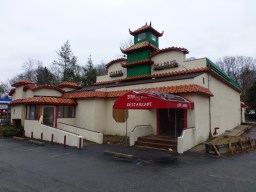
The sign in the window says:  “Closed for Renovations.”  The work will be more extensive than originally planned—the former Sun Ming restaurant building is slated to be demolished.

Image

As an example of Roadside Architecture, the building has served as a landmark along Jericho Turnpike, but it did not achieve enough significance to arise to the level of a “ historic landmark.”  Nonetheless, like any building that’s been around for over 80 years, it does have a history.

In 1923, Pat and Lena Maggi, a young couple from Brooklyn, moved to West Hills and opened a restaurant on Jericho Turnpike called Ye Old Homestead Chop House.  The exact location of Ye Old Homestead, which appears to have been in a converted house, has not been determined.  A 1924 newspaper article in the “Plainview” column refers to it as being “on the Jericho Turnpike near Huntington.”  So it may have been in Nassau County.

After seven and a half years, the Maggis built a new restaurant at the corner of Jericho Turnpike and Round Swamp Road.  The Chateau Maggi featured American and Italian food and promised “A real, bang-up good time.”  Maggi sold the restaurant in 1940.

By 1947, it was known as Pavillon Henri IV and featured a live orchestra.  A year later the owner and the orchestra were the same, but there was a new chef and a new name:  The Patio.  It can be assumed from the name Cliff Fearn originally gave to his version of the restaurant that he served French cuisine.  While the quality of the food is unknown to us, perhaps the bigger attraction was Mr. Fearn’s novel idea of a “television theatre.”  Mr. Fearn claimed to have the world’s largest television screen—eight feet by ten feet.   Weekly bulletins were mailed to patrons to advise them of the nightly schedule.  For example, in July of 1948, the schedule included the Democratic Convention on Thursday night, the CBS feature film on Friday, the Brooklyn handicap on Saturday, “Author Meets the Critics” on Sunday, baseball on Monday, the Texaco Start Theatre on Tuesday,  and the Kraft Television theatre on Wednesday.

196_001

Apparently the novelty of the world’s largest television and the French cuisine were not popular enough to sustain The Patio.  Within just a few years, new ownership invited Huntingtonians to “Dine delightfully in a beautiful Spanish Inn;”  a Spanish inn that served southern fried chicken, sirloin steaks and sugar cured ham steaks.  The new incarnation was known as Raay-Nor’s Inn, the north shore companion to Baldwin’s Raay-Nor’s Cabin, which opened in 1946.  In Baldwin the country cuisine was matched by the building’s log cabin architecture, which was similar to Link’s Log Cabin in Centerport.

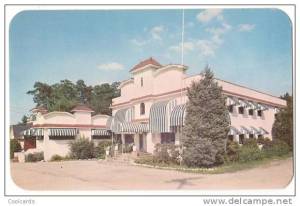
Soon the rotation of international cuisine turned to the east.  In February 1955, Peter Chinn, who served as a Marine Intelligence Officer in World War II, added pagoda details to the French chateau cum Spanish inn and converted the menu to Chinese fare.   Chinn had come to the United States with his family in 1930 as a teenager.   During the war he was stationed in China and remained there until the Communists gained control of the country in 1948.   Each of the two dozen employees of King Wah Restaurant had an ownership stake in the venture.

In 1966, the restaurant changed hands, but the menu remained Chinese.   The new owner Albert Chin renamed the place Sun Ming.  This last incarnation would prove to be the most long-lived—over 40 years—but it too closed a few years ago.  And soon Pat Maggi’s building like each of its incarnations will just be a memory.

The building at the southwest corner of Main Street and New York Avenue in Huntington village has an unusual shape.  It’s as if someone chopped off the western third of the building.  And, in fact, that is what happened.

The first building at that location was erected by Stephen C. Rogers in 1860.[1] Rogers and David C. Brush had opened the Suffolk Hotel just to the west of the corner lot in 1840.[2]  In the summer of 1860, Rogers built what was initially called a “Village Hall.”  It was not built for governmental purposes, rather as a venue for lectures, concerts and meetings.  It was estimated that the 27’ x 56’ building would seat 600 persons, which seems an overly optimistic number.[3]  In September 1860, the new hall opened with an address by the Reverend Hiram Crozier on the science of music, which was appropriate because the new venue was known as Euterpean Hall, named for the Greek muse of music.  The address, of course, was followed by a concert.[4]

Euterpean Hall was used not only for concerts, but also for lectures, religious services and town meetings.  Both the Central Presbyterian Church and the Methodist Church used the hall for religious services when their church buildings were being constructed.  The Hall was used as a drill room when men were training to defend the village from a supposed Draft Riot at the West Neck brickyards (see The Irish in Huntington, posted on this site on March 17, 2012).

Town meetings and annual elections were also held here.  In the nineteenth century, town matters were decided by the citizens of the town in an annual meeting held in April.  The Hall was not big enough to accommodate all the town’s residents, so the Town Supervisor would announce the propositions to the crowd from the rear staircase.   Matters were decided by voice vote unless there was some doubt on which position received the loudest response; in which case a show of hands was requested.  Residents, who came to the village for the annual meeting, took advantage of the large crowds to do some business.  They would swap horses and cows and conduct many lines of business.  The trading wasn’t limited to livestock; votes were openly bought as well. The bars did a good business that day and impromptu horse races were held on Main Street. [5]

The ground floor of the building housed the grocery business of Stephen Morris and the feed store of Russell Hurd.  The grocery business was later assumed by Sammis & Baylis and the feed store became the meat market of Burling & Higbie.[6]   Rogers retired from the hotel business in May 1864, but continued to own the land until 1875 when he sold it to Samuel Hubbs.[7]

The 1899 Building

The 1899 Building

In 1899, the executors of Hubbs’ estate sold the property, which included the Euterpean Hall building, to Edward Carll, the son of Northport’s famous shipbuilder Jesse Carll.  At the time of the sale, it was announced that the Euterpean Hall building would be taken down and replaced with a wider two-story building that would cover the alley between Euterpean Hall and the hotel and contain three stores.[8]  Within just a couple of weeks, the two businesses in the Euterpean Hall building were relocated to a new building on New York Avenue and the old building was torn down.[9]  A month later the new building was completed and Sammis & Baylis as well as Burling & Higbie moved back to Main Street.  The second floor was used as sleeping accommodations for the Suffolk Hotel.[10]  After the hotel was torn down in 1927, the second floor rooms were converted to office use.

Edward Carll died in 1913 and left the Main Street property in trust for his family.[11]  The heirs sold the property in 1921.[12] The following year, the portion of the building containing corner grocery business of Sammis & Baylis and the middle store occupied by the Barr & Willis jewelry store was purchased by Henry M. Woessner.[13]  Woessner and his brother-in-law John F. Semon owned a pharmacy on Main Street opposite the Bank of Huntington.[14]  Woessner made several improvements to the store including installing large show windows and a soda fountain.[15]  The new store opened on July 29, 1923.  Within two years, Woessner had transferred the pharmacy business to Harris A. Tomashoff.[16]

In the westernmost storefront,  David W. Trainer conducted his stationery and newspaper business.  In 1928, the drug store was re-divided and the middle storefront was used for a shoe store.[17]

The Building Today

The Building Today

In 1934, just as the drugstore (now the Max Rosen Pharmacy) and the shoe store were about to be taken over by Walgreen’s, fire swept through the building.  Believed to have started from an oil burner in the drugstore, the early Saturday morning fire gutted the stores and second floor offices.  Above the drugstore and shoe store were two dental offices.  Above Trainer’s stationery store was the law office of Theron Sammis.  Although it was one building, there were two owners.  The two storefronts to the east were owned by H.T. and S.E. Corporation (H.T. was Harris Tomashoff and S.E. was Sol Elkins).  The western most storefront and office above was owned by Trainer.  It was thought the entire building would have to be razed.[18]

Tomashoff and Elkins decided to restore their portion of the building.  Trainer decided to start over again with a new brick building.[19]  The result is Huntington’s lopsided building.


[1] A later account (The Long-Islander, March 25, 1899) indicates that Rogers raised the second floor of an existing building.  Contemporaneous accounts confirming this assertion have not been located.

[2] The Long-Islander, August 3, 1860

[3] The Long-Islander, July 27, 1860

[4] The Long-Islander, September 28, 1860.  It should be noted that there had previously been a Euterpian Hall in Huntington. In 1852, the Odd Fellows Hall was re-dedicated as Euterpean Hall (The Long-Islander, November 12, 1852).  The location of this hall has not been determined yet.  Euterpean Hall later relocated to a third building at the northeast corner of Main and Wall Streets.

[5] The Long-Islander, March 25, 1899, March 20, 1925, and April 1, 1927

[6] The Long-Islander, March 25, 1899.

[7] The Long-Islander, September 11, 1885

[8] The Long-Islander, March 25, 1899

[9] The Long-Islander, April 8, 1899

[10] The Long-Islander, May 6, 1899

[11] The Long-Islander, September 5, 1913

[12] The Long-Islander, November 4, 1921

[13] The Long-Islander, December 15, 1922

[14] The Long-Islander, October 29, 1942.  Semon later entered the real estate business and built Columbia Hall on New York Avenue in Huntington Station, the first three story office and business building in that section of town.

[15] The Long-Islander, April 6, 1923

[16] The Long-Islander, March 20, 1925

[17] The Long-Islander, September 21, 1928

[18] The Long-Islander, March 30, 1934

[19] The Long-Islander, April 20, 1934.

147 Woodbury RoadOn Woodbury Road, about a half mile south of Main Street, Huntington sits a brick commercial building in the middle of a residential neighborhood. For decades, half of the first floor has been home to a delicatessen, while the other half has been dedicated to personal grooming businesses—previously a beauty parlor, currently a nail salon. The upper level has seen a variety of businesses. How did this commercial building end up in a residential neighborhood?
Ben Tasman, one of the first glaziers in the Town of Huntington, acquired the almost half acre property in 1928. By the following year, he apparently started to construct a building on the site—a notice in The Long-Islander that year advises that Tasman had topsoil available for removal from a site across the street from the Woodbury Avenue School.  The building is built into the side of a hill across from the site of the old schoolhouse.  This early construction date explains why a commercial building sits in an area zoned residential—Huntington didn’t enact a zoning ordinance until 1934. However, it seems the building was not finished before the onset of the Great Depression.
The not-yet-completed building drew the attention of one of Huntington’s wealthy summer residents.  In 1935, during the depths of the Great Depression, Marshall Field, whose estate on Lloyd Neck is now Caumsett State Historic Park, wanted to help alleviate unemployment in town and show that a small town like Huntington could support manufacturing enterprises. He established the United States Leather Goods Company, Inc. with John Clark, the superintendent of Caumsett, as the company’s president. The manufacture of leather luggage was chosen because it was a labor-intensive business and would not compete with any existing businesses in Huntington. The company expected to employ 50 or 60 hands initially. The company leased Tasman’s building and would begin operations “as soon as it is completed.” Perhaps Tasman started construction in 1929 and stopped with the onset of the Depression, but was able to complete the building with the promise of a new tenant.
The company manufactured high-grade luggage for department stores across the country and was soon known as Suffolk Leather Goods Company and later as Suffolk Craftsman, Inc. Field hired Samuel Balterman, who was later described as “one of the best leather manufacturing men of the East,” to serve as general manager of the venture. Six years later, Balterman purchased the company from its organizers. Despite the earlier predictions of increased employment, by 1941 the company had only 20 employees.
The building was almost entirely destroyed by fire in December 1950 with damage estimated at $40,000 to $60,000. It took firefighters five and a half hours to extinguish the blaze, which they attacked from all sides as well as from an aerial ladder truck. All that was left were the four walls and the roof. Mr. Tasman said he would rebuild. But the fire appears to have been the end of the leather goods factory. At the time of the fire, the building was also home to a printing concern known as Pheasant Press, and was used for storage by the owner of Peggy’s Outlet store on Elm Street in Huntington village.
Three years after that devastating fire, M&D Coat Company moved into the building because there had been a fire at its previous location on Railroad Avenue in Huntington Station. M&D made coats on the premises and sold at factory prices, or as they advertised in 1958 “A little out of the way; less to pay.”
According to Building Department records, in 1958, the roof on the building was re-shingled, the rotted cornices replaced and the building was painted. Around the same time, a deli was opened on the north side of the first floor; while the south side was home to a hairdresser.
The executors of Tasman’s estate sold the property in 1984 to Henry Birli, Paul Birli and Michael Macchiarella, who sold appliances from the second floor of the building under the name Three D T.V. & Appliance Co., Inc. The current owner acquired the property in 2000 and the upper floor is now the production studio of a shop that sells monogrammed gifts.

Early in the last century there were two businesses on Wall Street operated by Huntingtonians named Thomas Gorman.  One was born in 1884; the other was born in 1887.  At one time they each conducted business from the store directly behind the First National Bank building, which was at the northeast corner of Wall and Main Streets.  Each man’s paternal grandfather was named Daniel Gorman.  One was a tinsmith; the other sold fish.

Thomas Henry Gorman, the tinsmith, was the son of William and Anna Mullen.  His father had been in the fruit and vegetable business.  He had four sons and three daughters.  His son Thomas found employment in William H. Stoyle’s tinsmith store on Main Street.  In 1918, after 20 years with Stoyle, Thomas started his own business at 6 Wall Street (an addition to the back of the First National Bank building).  His business eventually occupied the upper two floors of the building comprising nearly 2000 square feet in addition to the 13’ x 18’ storefront.  Ten years later, the business grew to such an extent that Thomas needed a bigger building.  He purchased land across the street at 13 Wall Street and built a brick structure.  The new facility was considered the largest sheet metal works east of New York City.

In addition to repairing and cleaning stoves, ranges and heaters, Thomas installed metal work, such as gutters, tin ceilings and ventilating ducts at construction projects throughout the Island.  Local projects included Huntington High School, the Lowndes Avenue School, Central High School and the Hotel Huntington.  Thomas’ two brothers, Walter and Joseph, joined him and  in 1929 incorporated as Thomas H. Gorman Brothers, Inc.

In 1935, the business moved to Thomas’ home at 102 Woodbury Road, where he died in 1959.

The other Thomas Gorman was the son of Peter J. Gorman.  During the 1890s, Peter worked at the Cold Spring Harbor Fish hatchery.  In 1899, he purchased the saloon of James Garity on Wall Street.  James Garity’s wife was the sister of Peter Gorman’s wife.  The 1900 census identifies Peter as a saloon keeper.  In 1910, he was listed as working at a saw mill—in 1915 there was a notice that he had retired as an engineer at the Brookside Mill, which was a steam mill on the west side of New York Avenue, north of Main Street.  In 1920, Peter’s occupation was given as day labor; and in 1930 as a fish market dealer.  His sons, Daniel and Thomas meanwhile were identified as masons and later as plasterers. (In the 1915 New York State census, Daniel was identified as a trolley car conductor).

But in 1919, Thomas and Daniel Gorman purchased the Wall Street Fish Market.  A photograph of Gorman’s Lobster Grill shows an address of 6 & 8 Wall Street, meaning that the fish store was in the same building as the tinsmith shop.   It should be noted that the picture probably dates to after 1934 because italso advertised that there was “Beer on Draught.”  The 1922 Sanborn insurance map shows three stores in that location:  closest to Main Street is “Fish,” next is “Rest’rt,” and the northernmost store is “tin shop.”

Thomas F. Gorman of the fish market was a World War I veteran.  He, his brother, two sisters, his brother’s daughter and his mother lived in the brick house at the top of Carver Street.  Thomas continued to live there until the late 1960s when he moved to Walnut Creek, California, where his niece lived.  Thomas died in 1970.

The First National Bank building, which included the fish market and tin shop was torn down in the early 1950s.

Because their paternal grandfathers had the same name and they operated their businesses in the same building, it may be thought that the two Thoamses were related.  Perhaps their fathers—Peter and William—were brothers, making the two Thomases first cousins.  But the 1870 census, when William was 13 years old, does not list Peter, who was 5 years old that year.  Moreover, Peter’s mother’s name was Ellen; William’s mother’s name was Ann.   It seems just a coincidence that Thomas H. Gorman and Thomas F. Gorman shared a name, a grandfather’s name, and a business address.